This e-book was created by the pupils from Poland, Greece, Croatia and Slovenia participating in the the Erasmus + program "Through artistic abilities to developed basic skills" during the 2nd reading night event which took place the 25th of April, 2018.


Deadalus and Icarus
Deadalus was a famous architect I Athens at ancient times. He used to be so good at his work that only Talos could compete with him. Talos was Deadalus nephew . Little by little , Talos became better and better in comparison to his uncle. Deadalus became really jealous. They went together to the Acropolis and Daedalus threw him down. The supreme court decide to exile him about this criminal action. Deadalus went to Crete. There he presented himself in front of Minoa, the King of Crete. King Minoa let him stay in the palace and after a while he got married to Naucrate and they gave birth to a baby boy , Icarus.
One day, Daedalus heard that his wife had died and so he took on raising their son, Icarus. One day Daedalus and Icarus visited Minoa and asked for permission to return to Athens. Minoa got really angry but he didn’t want Daedalus to leave and so he prisoned them in the Labyrinth, a maze that was really hard to find a way to escape. But Deadalus was creative and made gigantic wings while being in the maze from feathers of birds and wax.
Father and son could now fly to Athens. Icarus, however, being enthusiastic and too young, got excited by the thrill of flying and carried away by the amazing feeling of freedom and started flying high to salute the sun, diving low to the sea, and then up high again.
Icarus didn’t listen to his father’s advice and flew next to the sun, his wings melted. Icarus fell into the sea and drowned. The Icarian Sea, where he fell, was named after him and there is also a nearby small island called Icaria. Then Daedalus went to Sicilia. He stayed there for a while and afterwards he left for Athens.
In order for the wind to blow, we need to make an offering to Goddess Diana.
Sacrifice of Ifigenia in Avlida
In ancient times, the greks wanted to sail towards Troy. Agamenmon was the leader. They wanted to take back Beautiful Hellen that Paris had eloped. But the wind was not good enough to sail and so the Greeks decided to get advice by Diviner Kalhas. He told them that the reason for the bad wind was Goddess Diana , the goddess of Hunting , who was mad with the Greeks as Agamemnon had killed her sacred Deer. The only way for the boats to sil was to sacrifice Agamemnon’s daughter Ifigenia.
Agamenon lied to his wife, saying that Ifigenia would get married to the famous king Achileles , so that he could persuade his wife to bring Ifigenia with her . And so it happened. Agamemnon announced the bad news in front of Ifigenia, who , then , on her own , decided to be sacrificed since it was the Goddess’s will. Her mother’s curses were heard everywhere.


Suddenly, at the exact moment Kalhas raises his sword, Goddess Diana went down and grabbed Ifigenia and put a deer in her place.
Goddess Diana took Ifigenia with her.
At the port of Avlida, there was an upheaval, and strong winds broke out. Finally, it was the right moment for the big expedition to Troy to begin.
The trojan horse
After Achilles’s death, the Achaeans could not believe that they would capture Troj. Then , Odysseus thought that Troj would not fall out of weapons but out of cunningness. So he advised the Achaeans to build a huge, wooden horse that would be empty from the inside calling it the Trojan Horse.
When they constructed it, they wrote on it:
“A present from the Achaeans to Athena”
and then got inside. The men, who didn’t get in,
went to Tenedos, a small nearby island.
The next morning, Trojan people couldn’t believe their eyes as the Achaeans had gone and had left a big, wooden horse behind. When they came out of the city walls, they read the note, but Kassandra and Laokoontas kept telling that they should be afraid of the Achaeans even if bringing presents.
Nonetheless, the Trojan people took the wooden horse in the center of the city and in the evening, they celebrated their “victory”. At night and as the Trojans were all asleep, the Achaeans gout out of the Trojan horse and opened the gates for their fellow Achaeans to enter and destroy Troj. The next morning, the Achaeans unloaded the loots and left for their home country.















The legend of the Croatian coat of arms
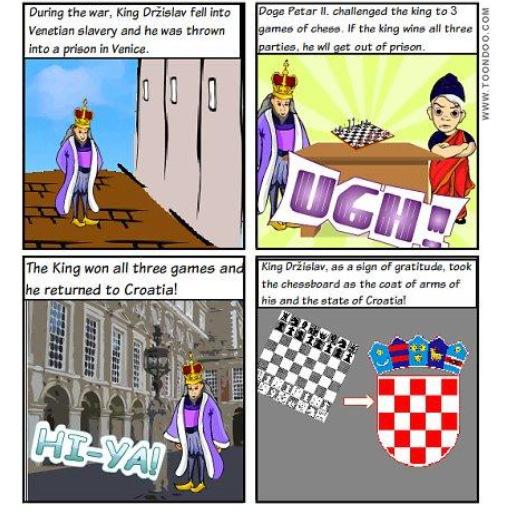

The legend of the Croatian coat of arms
According to the legend king Držislav fought numerous battles with the Venetians who wanted to conquer Croatian coast of the Adriatic sea. In one battle he was captured and thrown into prison in Venice.

The Venetian dodge Petar II Orseolo heard that king Držislav was good at playing chess.
Therefore he gave him the following challenge: If he managed to win tree games of chess in a row, he would be set free and he would be able to return to his country.

King Držisav accepted the challenge and won all three games of chess. The dodge kept his word , so the king returned to his country.
In gratitude and as rememberance of the event, the Croatian king choose the chess board for his own coat of arms as well as for the Croatian state.

The legend of the picok the rooster
This legend was created during the Turkish siege of Đurđevac in 1552. The Turks wanted to force people to surrender, hoping that they would soon lack food.

The defenders fought bravely, but after some time, there was indeed no food left, only one rooster. The inhabitants decided to put it into cannon and shoot him towards the Turks.

They managed to fool the Turks, as they believed that there was so much food left in the city and therefore they ended the siege.
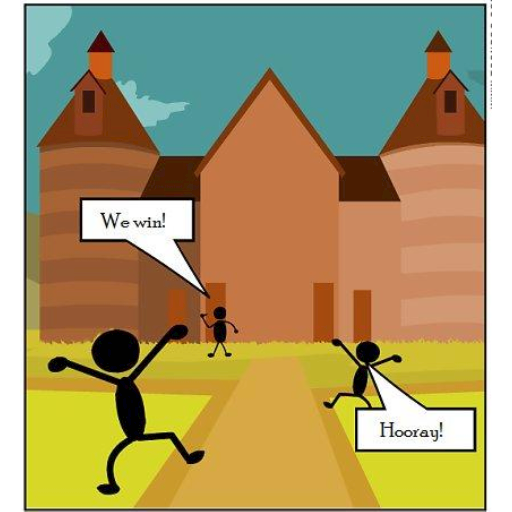
So did the inhabitants of Đurđevac got their nickname and are called "picoki".
This legend talks about a good king Zvonimir who helped the poor and punished the evil. During his reign the whole country was prosperous. The king was aksed by The Pope and the Byzantine emperor to summon an army for a Crusade. He read this plea to the Croatian knights and barons who he gathered on a field near Knin. He asked them to join their Christian brothers. But the Croats started yelling at him. They didn` t want to leave their homes and families. They took up arms and attacked him by slashing his body. The king, lying in his own blood cursed the Croatian people never to have a king of their own blood again. And indeed, for many centuries to come the Croats didn’t have their own country but were under rule of other people.
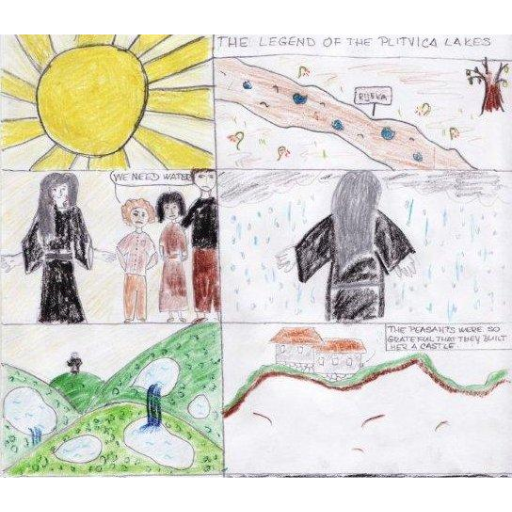
The black queen legend of The Plitvice Lakes
As the legend has it, there was a terrible draught in the area of today`s national park. People, animals and plants were longing for some water. Even the Black river was dry. The people prayed persistently for rain. One day the Black queen from the mountain Velebit came to help them. She heard their prayers, took mercy and gave them rain. It rained so heavily that 13 lakes were made. The first lake was named Prošćansko after the people who prayed for water (prayer-=prošnja).
The peasants were so grateful that they built her a castle at the top of the hill as a sign of their gratitude. The queen was happy because of the new lakes and she watched over them. But after some time she went back to her fairy castle. The castle they made for her began to look neglected, so they went to search for her to see if she was alive. All of the sudden there was a strong wind and it started raining heavily.
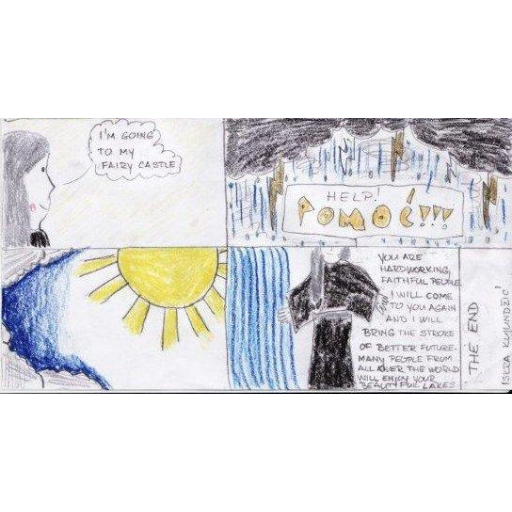
It seemed to the peasants as if it was the doomsday and they cried for her help again. The storm stopped instantly, and the Black queen appeared at the top of Galovica waterfall. She told them: You are hardworking, faithful people, loyal to the king and the country, obedient and persistent. But for a long time you will be protecting the Christianity spilling blood for your ruler, faith and fatherland. But I will come to you again and I will bring the stroke of better future. Many people from all over the world will come and enjoy your beautiful lakes.
The legend of Ruzica city
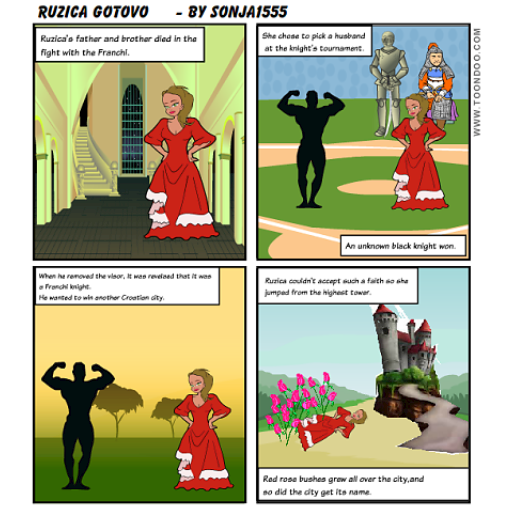
The legend says, there was a beautiful and noble duchess called Ruzica (Rose). Her father and brother were killed fighting Franks. Upon hearing the bad news, old duchess was heartbroken and Ružica was left to rule the city only by herself. She decided to choose her future husband and defender of her people by arranging a tournament. He who wins the tournament will be her husband. All of the knights were defeated by a black knight. When he took of visor it turned out he was a Frankish knight, who wanted to win another Croatian city through marriage. Ruzica couldn´t accept such destiny and she jumped off the highest city tower. Soon there were red rose bushes in the whole area, red as the colour of her blood. Finally, the fortress was named after her and is still called Ruzica city.
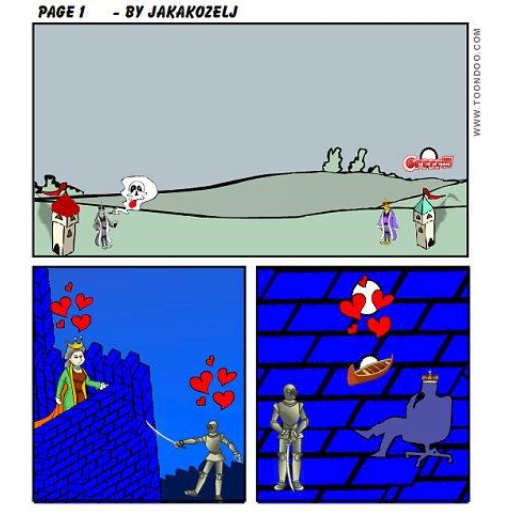
Forbidden love: The legend of Lake Cerknica
A long time ago, two castles – Stegberch and Karlovec – stood not far from the town of Cerknica. The two noble families who inhabited the castles held each other in contempt.
One day, the story goes, the unthinkable happened: a son from the Stegberch clan fell in love with a daughter from the Karlovac family. Their feuding fathers wouldn’t even consider a marriage, but the two lovers were persistent, so the head of the Karlovec family came up with plan: The couple could marry, but only when the valley was flooded and when the young nobleman could visit his bride-to-be on a boat.

The young man knew that the task was impossible, but one day, he met a mysterious man from the underworld. The man told him to dam several local streams using branches and nets. In desperation, the young man followed the advice – and created a brand-new lake.
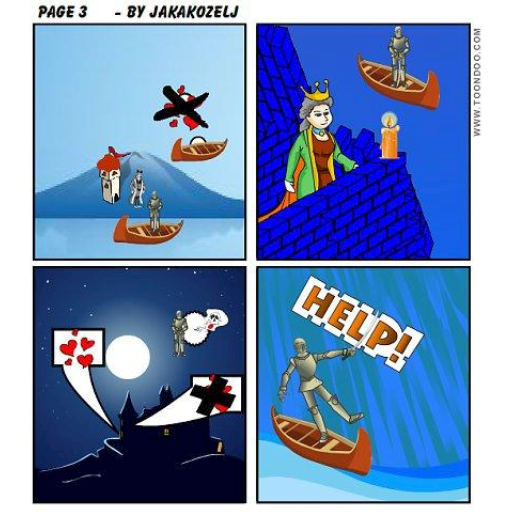
But the fathers broke their promise and refused to allow the marriage. The lovers didn’t give up, however, and they continued to meet secretly at night. The young nobleman would row his boat to his sweetheart’s castle guided only by the castle’s flickering light. One night, a rival suitor, who had learned of the visits, moved the light. The noble became disoriented and was swallowed up by a vortex in the lake. Realizing that her lover was lost, the young noblewoman took her own life.
Argonauts in Vrhnika
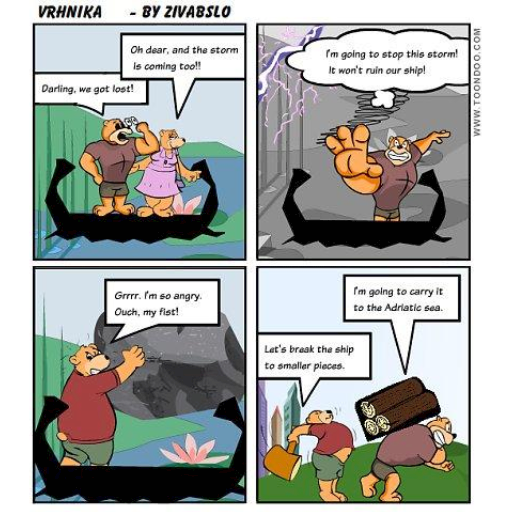
According to Greek mythology, the ancient Greek hero Jason assembled a group of champions to aid him in his quest to find the Golden Fleece. On their ship called Argo, the Argonauts sailed to many countries and finally reached Colchis on the Black Sea. King Aeëtes tried to stop Jason from taking the fleece, but his daughter Medea fell in love with Jason. She helped him with a magic potion, which put the dragon that guarded the fleece to sleep. With the Golden Fleece stolen, the Argonauts and Medea left Colchis and sailed for home.
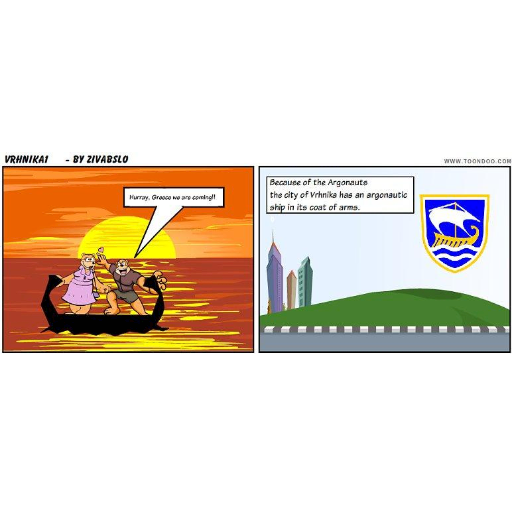
They sailed across the Black Sea to the Danube, then up the Sava River and finally up the Ljubljanica to Močilnik Springs. Jason was furious as they couldn’t go any further and he hit the rock with his fist. You can still see the imprint today in the rocks called the Devil’s Cliffs (‘Hudičeve skale') by local people. The Argonauts disassembled their ship and carried it on their shoulders to the Adriatic Sea.
As a memorial to these Ancient Greeks and their journey, Vrhnika’s emblem is an image of the ship Argo, and locals and visitors from other places remember them every year during the festival Argonaut days.
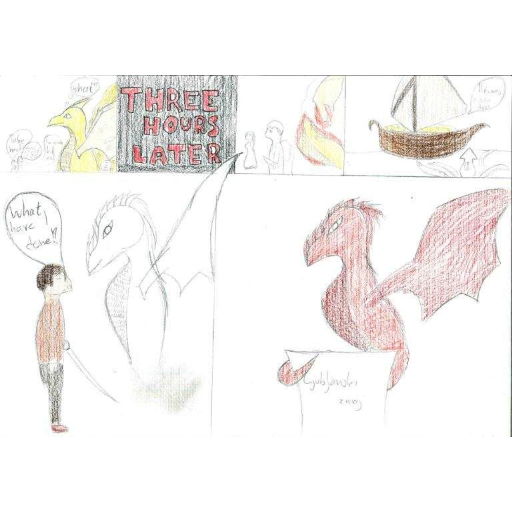
The Ljubljana dragon
Once upon a time, a Greek hero Jason set sail with his heroic friends on a ship called Argo across the Black Sea. He wanted so steal the Golden Fleece, which was guarded by a dragon. Jason wouldn’t have survived the battle, if he hadn’t fallen in love with the king’s daughter Medea. With her magic power he defeated the dragon and got to the Golden Fleece. Jason and Medea ran away on the ship Argo, but the king was that angry that he sent his own ships after them. Argo accidentally lost its way in the mouth of the river Ljubljanica and their journey ended. Argonauts found a place where they built a settlement. They named it Emona. They disassembled their ship and carried it on their shoulders to the Adriatic coast. One day, Jason found the dragon in Emona. He fought with it and beat it. Today a dragon adorns the City of Ljubljana’s coat of arms, as well as the famous Dragon Bridge.
- < BEGINNING
- END >
-
LIKE
-
COMMENT