

On 21 August 1835, The New York Sun published a series of articles about the discovery of life on the moon. These were falsely attributed to a well known astronomer of the time named Sir John Herschel.


Crina Popa
In June 1897, reports out of New York were that Mark Twain was ‘dying in poverty in London’. That this was fake news was confirmed by Mark Twain himself.

Irmak ŞOYAL
In 1916, Amerıcan womens started a massive boycott due to the price increase of eggs.
In order to prevent this boycott "the price of egg was reduced" news was published in the news.

But actually the price hadn't changed.So all the news turned out to be fake news.
DESPITE all these boycotts egg prices have increased steadily.
Nihan DEMIR


EGG PRICE BOYCOTTS



THE KING'S HEALTH İS FAILING
Büşra Nur MİRİK


WAR OF THE WORLDS
On Sunday, 30 October 1938, the Columbia Broadcasting network aired an adaptation of the 1898 novel War of the Worlds by HG Wells. During the broadcast, the first two thirds of the story were aired over the radio as a series of breaking news alert.
Osman Melih Kocaoğlu
On 10 August 1919 the Washington Herald ran the headline: ‘Planets Moving Into Huge Danger Zone; Earth Will Stagger From Mighty Shock’. In four months, warned Albert F. Porta, an Italian-born academic, seven planets would assemble on one side of the sun. Their collective electromagnetic pull, combined with the counterpull of Uranus, would induce a massive sunspot on 17 December, a ‘gigantic explosion of flaming gases, leaping hundreds of thousands of miles out into space’. This would trigger the ‘greatest weather cataclysm’ in human history. For at least four days, he predicted, ‘there will be hurricanes, lightning, colossal rains ... gigantic lava eruptions, [and] great earthquakes, to say nothing of floods and fearful cold’.
The Centers for Disease Control and Prevention has provided health and safety guidelines for pandemics and according to social media users, it's now offering advice on how to survive a zombie apocalypse.
A viral March 4 Instagram post by the page UberFacts correlates the CDC's zombie guidance to Nostradamus' purported prediction of a zombie apocalypse taking place in 2021.
"Back in the 16th century, French astrologer Nostradamus predicted that there would be a zombie apocalypse in 2021," reads a screenshot of a tweet from UberFacts. "The CDC is giving advice on how to prepare, just in case."
Accompanying the tweet is an image of zombies walking in a forest and the caption of the post links to a "Zombie Preparedness" page on the CDC's site. The post has over 73,000 likes. USA TODAY reached out to the page for comment.
In 2014, BuzzFeed News reported that a survey of the UberFacts Twitter account found numerous examples of "facts" that were false.
Fact check: No evidence to support online claims impeachment cost $33 million
The claim that Nostradamus predicted a zombie apocalypse would take place originates from a post on the site YearlyHoroscope.org. The site lists a number of purported "Nostradamus 2021 predictions" such as bitcoin, solar storms and a comet hitting Earth.
The article claims that Nostradamus, also known as Michel de Nostradame, predicted a Russian scientist would create a biological weapon and produce a virus that would turn humans into zombies, according to one of his prophecies from a book discovered at the National Library in Rome "which is believed to belong to him."
The purported quote reads, "Few young people: half-dead to give a start. Dead through spite, he will cause the others to shine, And in an exalted place some great evils to occur: Sad concepts will come to harm each one, Temporal dignified, the Mass to succeed. Fathers and mothers dead of infinite sorrows, Women in mourning, the pestilent she-monster: The Great One to be no more, all the world to end.”
While some believe the passage is evidence of a zombie apocalypse prediction because of words such as "half-dead" and "great evils" there is no evidence that he was referring to zombies.
Several historians and scholars also note that Nostradamus' predictions are often vague, leaving a lot of room for different interpretations.
His "popularity seems to be due in part to the fact that the vagueness of his writings and their lack of specific dates make it easy to selectively quote them after any major dramatic events and retrospectively claim them as true," History.com reported.
Some scholars believe Nostradamus's was not writing to be a prophet, but rather, writing to comment on events and people of his time, according to History.com
The claim that Nostradamus predicted the coronavirus pandemic has been previously debunked by Reuters. A YouTube user also falsely claimed that Nostradamus predicted a 9.8 earthquake would hit California on May 28, 2015.
Fact check: Claim about FBI official who said bureau recovered no guns at Capitol riot is missing context
While it's true that the CDC's website has a "Zombie Preparedness" page, the tips serve as a practical guide for real emergency situations such as hurricanes, earthquakes or floods, USA TODAY reported.
"As it turns out what first began as a tongue-in-cheek campaign to engage new audiences with preparedness messages has proven to be a very effective platform," the CDC's site reads. "We continue to reach and engage a wide variety of audiences on all hazards preparedness via 'zombie preparedness.'"
A "Zombie Preparedness" blog post, which has been on the CDC's site since May 2011, says "you may laugh now, but when it happens you’ll be happy you read this" and that you may learn about how to prepare for a real emergency.
If zombies were to start roaming the streets, the CDC would conduct an investigation and provide assistance to states until it could determine how to treat and stop the outbreak, the site says.
Tips on the page include gathering supplies such as a gallon of water per day, food, medications, tools, sanitation and hygiene, a first aid kit and important documents, among other supplies.
The CDC also recommends coming up with an emergency plan by identifying emergencies that are possible in the area. Aside from a zombie apocalypse, this could include other natural disasters.
Fact check: California's COVID-19 vaccine plan doesn't give priority to homeless people, prisoners
The claim that Nostradamus predicted a zombie apocalypse in 2021 and the CDC is giving advice on how to prepare for it is rated MISSING CONTEXT, because without additional information it could be misleading. The CDC does offer zombie apocalypse preparedness tips on its site, however, those tips were created so that people can learn about real emergency preparedness in an engaging way. Further, there is no evidence that Nostradamus predicted a zombie apocalypse. Historians and scholars note that his passages are often vague and open to interpretation.
You deserve the truth. You have every right to be insulted when you read fake news. You are smart enough to make up your own mind. Find the real facts, look at the real facts, and don't allow your self to be treated like an idiot.
Fake news destroys your credibility. If your arguments are built on bad information, it will be much more difficult for people to believe you in the future.
Fake news can hurt you, and a lot of other people. Purveyors of fake and misleading medical advice like Mercola.com and NaturalNews.com help perpetuate myths like HIV and AIDS aren't related, or that vaccines cause autism. These sites are heavily visited and their lies are dangerous.
Did your mother call you to tell you that liberals hate science? Did your Facebook feed pop up with an article on a new pesticide that's going to kill us all? Did one of your friends breathlessly tell you that President Trump was going to pardon mass shooter Dylann Roof? You might have heard any or all of these stories, but there's one thread connecting all of them: they're not true.
"Let's take a moment to define 'fake news,' since the term is so widely misused these days (deliberately or otherwise). We're not talking about news from professional media outlets with facts or a message that tells people something they don't want to hear, therefore they lob the term 'fake news' to give them a reason to ignore it. Actual fake news is false or misleading information written to resemble a valid news article to fool unwitting readers." -- Jennifer Oouellette, Ars Technica, Jan. 10, 2019
“Fake news” is not news you disagree with. The ability to tell accurate news from fake news is an important skill that you'll use your entire life. This guide will give you valuable insight in telling fact from fiction online, plus a chance to exercise your newfound skills. Remember to always read beyond the headline. What’s the whole story?
View Fake News and Cyber Propaganda: The Use and Abuse of Social Media
When the term “fake news” comes up, people usually think of social media posts with rather fantastic, implausible stories. While posts shared on social media is its most visible aspect, there is so much more to fake news than exaggerated article titles on social media feeds.
Fake News and Cyber Propaganda
Fake news may seem new, but the platform used is the only new thing about it. Propaganda has been around for centuries, and the internet is only the latest means of communication to be abused to spread lies and misinformation.
The fire triangle represents the three elements a fire needs to burn: oxygen, heat, and a fuel. Similarly, fake news requires three different items to succeed. These collectively represent the Fake News Triangle: without any one of these factors, it is unable to spread and reach its target audience.
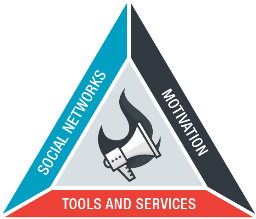
The first requirement: tools and services for manipulating and spreading the message across relevant social media networks, many of which are sold in various online communities from across the globe. A wide variety of tools and services are available; some are relatively simple (paid likes/followers, etc.), while some are more unusual—some services promise to stuff online polls, while some force site owners to take down stories. In any case, the tools and services for social media promotion are readily available, both inside and outside the underground scene.
Of course, for these tools to be of any use, social networks have to exist as a platform for spreading propaganda. With people spending more time on these sites as a way to get the latest news and information, their importance in spreading fake news cannot be underestimated. However, there’s a difference between simply posting propaganda and actually turning it into something that the target audience consumes. We show what kinds of techniques are used by spammers in order to lure users into viewing their stories.
Studying social media also gives us a view of the relationships between bots and the recipients of social media promotion on Twitter. This gives us an idea of the scope and organization of the campaigns that attempt to manipulate public opinion.
Finally, propaganda campaign always comes with the question: why. We discuss the motivations behind fake news: sometimes it’s simply a desire for monetary gain via advertising. In other cases, the goals can vary from the criminal to the political. Regardless of the motive, the success of any propaganda campaign will ultimately be based on how much it affects the real world.
Case Studies
To show the effectivity of these campaigns, our paper includes various case studies that show how various actors would use tools for spreading fake news for their own ends. Our case studies include:
The specific tools for each campaign are not particularly different—bought followers/fans, likes, reposts, comments, videos. Some campaigns may find it worthwhile to buy “high quality” versions of these products, which are theoretically harder to detect by the social media networks.
Countermeasures
Governments, companies, and users are all waking up to how serious public opinion manipulation—as manifested in “fake news”—can be.
Governments are starting to recognize that fake news is something that must be actively fought. Various government agencies are now setting up services to debunk stories that they consider to be false. They are also considering imposing regulations and punishing sites that do publish misinformation.
The targets of these new regulations would include social networking services. This would make fake news very bad for business indeed, and so they’re taking steps to fight it. The steps being taken include the suspension of bot/suspicious accounts, adding features to allow users to report fake news, and hiring more personnel to help deal with these reports.
In the end, however, it comes down to educated users. Our paper discusses some of the signs of fake news, in the hope that readers will be able to determine for themselves how to spot fake news. Our paper also discusses the psychology of fake news—what makes these campaigns work and how they’re able to convince people—in the hope that awareness of these techniques will empower readers to resist them.
For more details on the aspects of fake news and cyber-propaganda, read the research paper: The Fake News Machine: How Propagandists Abuse the Internet and Manipulate the Public.

- < BEGINNING
- END >
-
LIKE
-
COMMENT