This book is collaboration of the eTwinning Project ''Mınd Master Children'' .
All members of the project introduced planets in Solar System and modelled planets with several activity .
Enjoyable Reading...

PARTNERS OF PROJECT
1-Agnieszka Ciunel-POLAND 9-Mahmut ÖncelTURKEY 2-Ana Sousa-PORTUGAL 10-Mehmet Çetin-TURKEY
3-Ayça Satan Çubuk-TURKEY 11-Paola Meggetto-ITALY
4-Dilek Gündoğan-TURKEY 12-Rukiye Arslan-TURKEY 5-Esra Çakır-TURKEY 13-Toygar Yokuş-TURKEY
6-Greta Sangalli-ITALY 14-Yasemin Yalçınkaya-TURKEY
7-Gülsüm Balcı-TURKEY 15-Zühre Bayrak-TURKEY
8-Iwona Gawryluk-POLAND
Hello everybody from the Solar System.
I'm an astronot, my name is MMC. I work for Mind Master Children.
Our aim is to protect The World. We think that firstly we must know our planet and other planets so that we can do this.
Let's go....
MERCURY
Toygar YOKUŞ
Mustafa DÖRTÇELİK PRİMARY SCHOOL-BURSA/TURKEY

VENUS
Agnieszka Ciunel and Iwona Gawryluk- POLAND


EARTH
Azory


MARS
My 4th stop is Mars called the ''Red Planet''. It is also one of the planets that can be seen most easily with the naked eye from Earth.
Mars isone step ahead, especially with its earth-like structure.Red Planet with a thin atmosphere; it shos a great similarity with the poles, deserts and valleys.At the same time, the period of rotation together is also similar to the earth.It is the most important planet where the posibility of life is high, especially with the presence of liquid water in the Solar System, expect Earth.
Maybe a few years later, we can travel to the Mars and we can live there.Why not?
Ayça SATAN ÇUBUK -(AYDIN /Bozdoğan Center Primary School) TURKEY
JUPITER
Jupiter is the largest planet in the Solar System. It is more than 300 times more massive than Earth and is more than two times asmassive than all the other planets combined. Jupiter is called a gas giant planet. This is because its surface is made up of a thick layer of hydrogen gas. One year on Jupiter is the same as 11.8 Earth years. Jupiter's atmosphere is special because it is the Solar System's largest planetary atmosphere. It is made up of hydrogen and helium, in roughly the same proportions as are found in the Sun.
Gülsüm BALCI
Vali Saim Çotur Primary School ANTALYA


SATURN
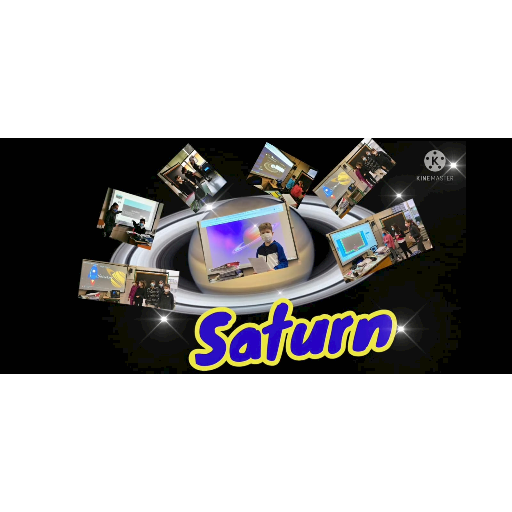
It orbits around the Sun in 29,5 years: each seasons lasts 7 earth years.
The day on Saturn is very short instead: it only lasts 10 hours and 39 minutes.
Greta Sangalli, Marianna Vitiello and Paola Meggetto/ITALY
URANUS
Hi MMC I'm Uranus spinning like a rolling ball.
MMC: - I'm so cold.
Uranus: My surface is covered with ice. You can ski on my surface.
MMC : Your brightest ring, Epsilon, looks beautiful. I feel too cold. I have to go back to my ship and stop by the planet Neptune. Goodbye Uranus, see you again
Mahmut ÖNCEL/TURKEY
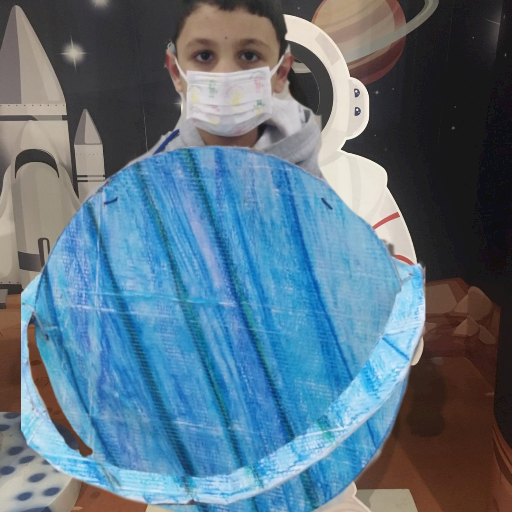
URANUS: It is the 7th planet of the solar system. It is 14 times larger than the Earth. It is the coldest planet. It rotates in reverse. It has 27 moons. It completes its orbit around the Sun in 85 years. There is no earth on which you can walk.
Yasemin Yalçınkaya Profilo Primary School Şanlıurfa
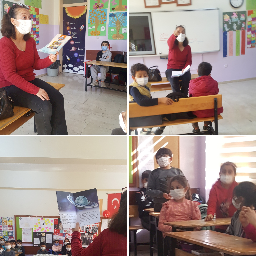
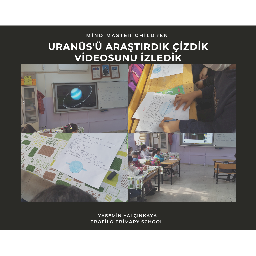
Reading the tale of Uranus
NEPTUN
Neptune is the eighth and last planet from the Sun in the Solar System. It is an ice giant. It is the fourth largest planet and third heaviest. Neptune has five rings which are hard to see from the Earth.
Neptune is seventeen times heavier than Earth and is a little bit more massive than Uranus. Neptune is denser and physically smaller than Uranus: its greater mass causes more gravitational compression of its atmosphere.
It was named after the Roman God of the Sea. Neptune's astronomical symbol is ♆, the trident of the god Neptune.
Neptune's atmosphere is mostly made up of hydrogen and helium. It also contains small amounts of methane which makes the planet appear blue.
- < BEGINNING
- END >
-
LIKE
-
COMMENT