Fourth grade: Maria, Manos, George, Gohn, Gohn, Artemis, Emma, Artemis, Gohn, Irini, Evelin, Irini, Michael, Aspasia, Manousos, Alexander, Anna-maria
Fifth grade: Nikos, Konstantinos, Margarita, Fay, Vasilis, Lefteris, Marinela, Ariola, Mary, Zoi, Dimitris, Valantis, Angelina, Efi, Kallia
Sixth grade: Antonis, Kosmas, Alexander, Helen, Anastasia, Evangelia, Dimitris, Vasilis, Christofer, Costis, Andreas, Panagiotis, Irini, Ioanna, Pelli, Andria, Labrini
Teachers: Maria Panagiotaki, Maria Garagkouni, Irini Peraki, Chara Anathreptaki, Ada Zabetaki, Desislava Topalova

Hello dear friends!
We are students of fourth, fifth and sixth grade of 47th Primary School of Heraklion.
We live in Crete the biggest island of Greece, in the Mediteranean sea. Heraklion Town is actually the largest town in Crete and serves as the main transportation hub for the island,


with a busy port and an international airport.
Here we speak Greek which is a very difficult language. We have a lot of traditional foods like 'gyros', 'mousakas' and 'gemista'.
The weather is hot and sunny, so we can enjoy the beautiful beaches of our island.

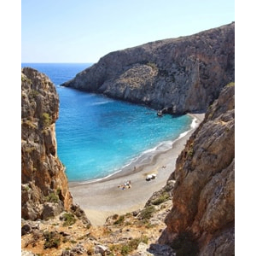
In and near our city there are a lot of attractions and archaelogical
sites like the Minoan Palace of Knosos,
Koules Fortress,


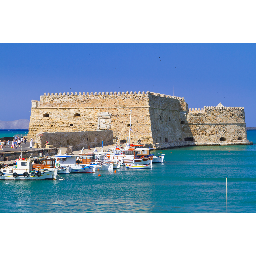
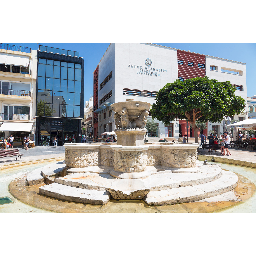
Morosini Lions Fountain, the venetian Loggia (our town hall),
the archaelogical Museum, caves and various monasteries. "Cretaquarium" is also a very interesting place, especially for children.


The Christmas boat decoration
The boat was decorated during Christmas in houses and squares, but later it was replaced by the Christmas tree. It is a tradition of an older era of Greece since our country has historically been a land of sailors. Several decades ago, from almost every house, one or two men of the house (father or son) worked on the ships, to support their family.
The boat symbolizes man's new voyage in life.It is a tradition of the old times of the country and a kind of honor and welcome to sailors, who were returning from their voyages. In recent years, many municipalities have brought back the custom, decorating the squares with ships instead of fir trees.

Breaking a pomegranate on New Year's as a sign of good footwork, is an ancient custom that originates from the Peloponnese but is now found all over Greece. On the first day of the year, families go to church to hear the Divine Service. Returning to their house, they all enter except the host. He knocks on the door to be opened for him because it is a pain to open with his key. He enters the house with his right foot and breaks the pomegranate behind him, saying the following words-wish: "with health, happiness and joy in the new year, and as many seeds as the pomegranate has, so many pounds in our pocket throughout the year".
In this way, people believe that they will have a favorable year for their house with lots of joy and money.
The Christmas festive table
The most festive table of the year is the Christmas table. It is the day when the whole family gathers to celebrate the birth of Christ. It is the time when everyone is happy and exchange gifts and wishes!
The Christmas table is special because there are a lot and various foods on it, such as pork in the wood oven,
fried
liver , sausages etc. Of course Christmas sweets are very important on the Christmas table. My favourites: melomakarona, kourabiedes and diples!
Cretan Christmas Sweets
At Christmas, housewives are used to making various Christmas recipes. Every year during these festive days the house is filled with the smells of our traditional local sweets: melomakarona and kourabiedes.
Recipe for Kourabiedes
Ingredients: 500g butter, 220g powdered sugar, 1 vanilla, 1 Mr. c. rose water, 30g bitter almond liqueur, 90g flour, 1 pinch of salt
Implementation: Preheat the oven to 1800 C. Put the butter and powdered sugar in the mixer and beat them for 10 minutes. Add the vanilla, flower water, liqueur and continue beating. Break the almond and put it in a bowl. Add the flour and salt. Mix with a spoon. Shape into 30g balls. Press lightly in the center and bake for 20 minutes. Remove and let cool.

The Christmas tree is undoubtedly one of the most beautiful Christmas customs. Each house has its own set of decorations. Its symbolisms are many. In Greece, the custom of the Christmas tree came from the Bavarians! 1834 was the first time it was decorated in our country, in the palaces of King Otto in Nafplion! However, the Christmas tree began to be established in all Greek homes from 1950 onwards.
Its symbolism. The fir tree we decorate is green and "alive" even in the winter, so its choice is not accidental as it symbolizes the eternal life of Christ.

The lamps symbolize that Christ is the Light of life. The star at the top of the tree symbolizes the bright rising star that led the three wizards to the manger. The red balls symbolize the Savior's sacrifice for the salvation of us all. The garlands symbolize something happy, namely the birth of Christ. The manger placed at the base of the tree represents the birth of Christ.The triangular shape of the Christmas tree symbolizes the Holy Trinity. The ornaments we put on the Christmas tree also symbolize the birth of Christ.

Carols
Singing the carols is a tradition in Greece still preserved to this day. Children of all ages go around the neighbourhood in groups of two or more singing the carols often accompanied by a musical instrument such as the metal triangle, guitars, the accordion, the lyre or the harmonica.
‘Carols’ mainly start with a greeting following the announcement of the great, Christian celebration about to begin ending up to warm wishes.
The children knock on the door asking ‘Shall we sing the Carols?’ and as soon as they receive a positive answer they start singing. When they finish, they wish ‘Merry Christmas’ or ‘Happy New Year’ and the owners of the house treat them with sweets or, the recent years, with some money. In the past, the main treat was traditional sweets called ‘kourabiedes’ and ‘melomakarona’.
Carols are sung on Christmas’ Eve, on New Year’s Eve and on Theophany’s Eve (a holiday in Greece celebrated on January 6, traditionally known as Phota (‘Lights’).


Singing the carols is said to have been a tradition since ancient times. In ancient Greece, the children would go around singing while carrying an olive branch or a laurel branch, decorated with seeds and white cotton (‘The Iresioni’).
Later, the tradition was also adopted by the Romans. During the Byzantine time the carols singers would carry steaks, lanterns, an effigy of a ship or a building accompanied with the metal triangle or the drum (as it appears in the famous painting by Nikiforos Lytras, ‘The Little Drummer 1832-1927’).
Merry Christmas dear friends!!!!!!
- < BEGINNING
- END >
-
LIKE
-
COMMENT