
Ana Maria Teixeira; AECV/JIA de Lagoas; Vizela-Portugal
Fotos of the
experiment
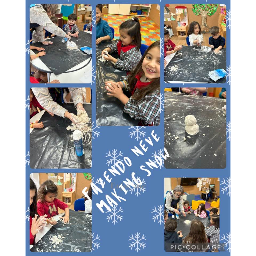

Veneta Kehayova, ДГ “Снежанка” Рудозем
“Snezhanka” kindergarten, Rudozem, Bulgaria
Fotos of the experiment
Description of the experiment:
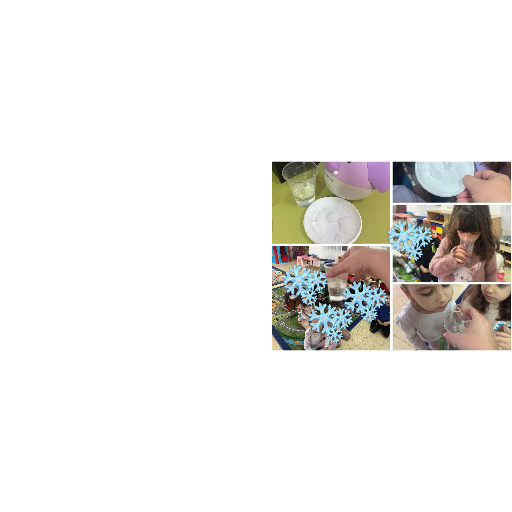
The children and I decided to use the purest water for our essential oil diffuser-vaporizer.
We decided that it would be best to use the water that we collect from the gutters when it rains.
However, looking outside, we saw that our water was frozen.
We thought and decided that we would melt a piece of ice by warming it with our hands and leaving it warm in our room.
After a while, we saw that the ice had turned into water.
We poured the water into our diffuser, added eucalyptus oil, and refreshed and disinfected the air in our room.
I explained to the children that the diffuser also turns water into steam by heating it.
Tzolali Vasiliki, 6th Kindergarten of
Kastoria, 1st class /Greece
Photos of the experiment
Description of the experiment
Ricky, the little ant, visited our kindergarten and asked for our help!
One day, when he had left his little house, he forgot the door open…
Unfortunately, that day it rained heavily, and water entered Ricky’s house, specifically into his food storage room. It was freezing cold, and everything froze solid…
Now, all the seeds and nuts he had gathered throughout the summer are trapped in the ice…
He came to us for help… We had to find a solution!
The children eagerly agreed to help Ricky thaw his food and came up with various ideas!
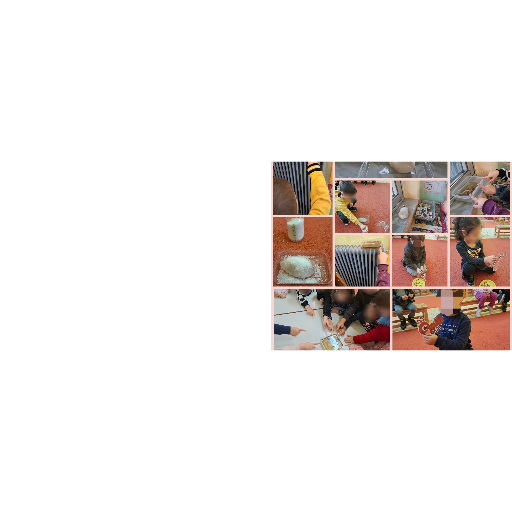
They placed one piece of ice on the radiator, inside a bowl.
They sprinkled salt on a second piece of ice.
They decided to place the third piece of ice next to the window so it could be exposed to the light.
We made predictions! Which piece of ice would melt the fastest?
By general consensus, the children believed that the piece of ice placed on the radiator would melt first!
We observed the melting of the ice at regular intervals…
Indeed, our predictions came true!
First, the piece of ice on the radiator melted, then the one with the salt, and finally, the one by the window (note: there was no sunlight that day).
Now it was time to feed Ricky, who had been waiting eagerly all this time!
Tzolali Vasiliki, 6th Kindergarten of Kastoria/Greece
Rohrmann Simona, BRANDUSA Kindergarten, Bucharest, Romania
Description of the experiment
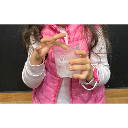
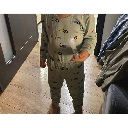
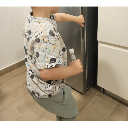
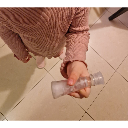
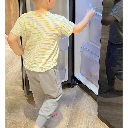
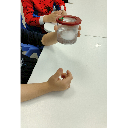
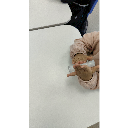
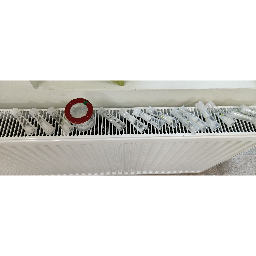
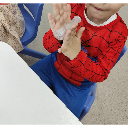
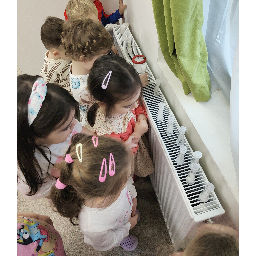
LIQUID STATE OF WATER (MELTING): The children heated with their hands, or put the frozen container on a warm radiator or held it above or next to a small flame and thus obtained water from the ice.
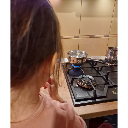
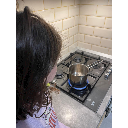
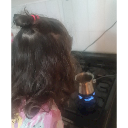
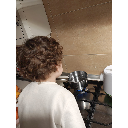
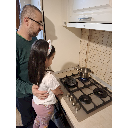
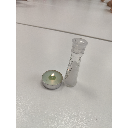
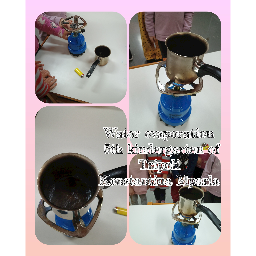
GASEOUS STATE OF WATER (EVAPORIZATION): The children put the heated water in a vessel and noticed that the fire helped to boil the water thus turning it into steam.
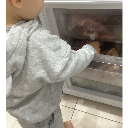
FREEZING
EVAPORIZATION
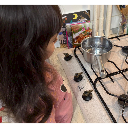
MELTING
Konstantina Mparla
5th kindergarten of Tripoli Greece
Περιγραφή του πειράματος:
Υλικά:
Διαδικασία :


Konstantina Mparla
5th kindergarten of Tripoli Greece
Photos of the experiment

Eleutheria Papaioannou
3rd Kindegarten of Aisonia- Sesklo Greece
Solid state
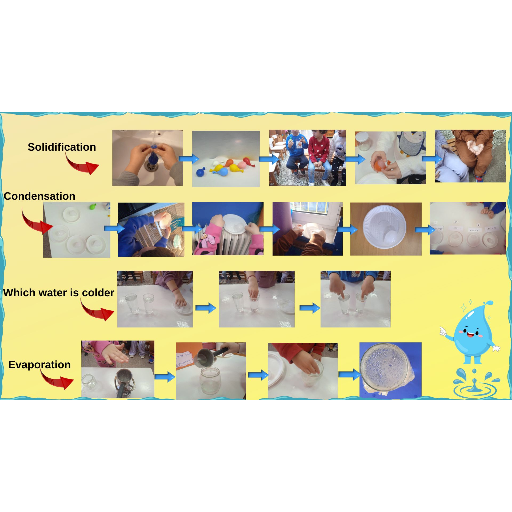
We filled balloons with water and placed them in the freezer. The next day, we saw that the water had turned into ice. We held a frozen balloon in one hand and a balloon with water in the other and discussed their differences. The frozen balloon was cold and hard, while the other one was soft.
liquid state
We removed the ice from the balloons and divided it into four plates. We placed one in the fridge, another on the radiator, a third on the windowsill (it was a sunny day), and the last one in a random spot in the classroom. After about half an hour, we observed that the ice on the radiator had completely melted, the ice on the windowsill had melted less, the ice in the classroom even less, and the ice in the fridge almost not at all.
Gaseous state
While we were waiting, we poured water into two glasses. In one of them, we added ice cubes. We stirred it and observed that the ice cubes melted in the water. The children dipped their fingers into the glasses and noticed that the water with the ice cubes had become very cold.
Next, we boiled water in a small pot. We observed that as the water heated up, steam began to rise. It evaporated. Then, we poured the water into a jar and covered it with transparent plastic wrap. As the steam rose and touched the plastic wrap, it turned into water droplets.
Description of the experiment
3ο Νηπιαγωγείο Αισωνίας- Σέσκλο Ελλάδα
Filiadou Konstantina, 1st Kindergarten of Argos Orestiko /Greece
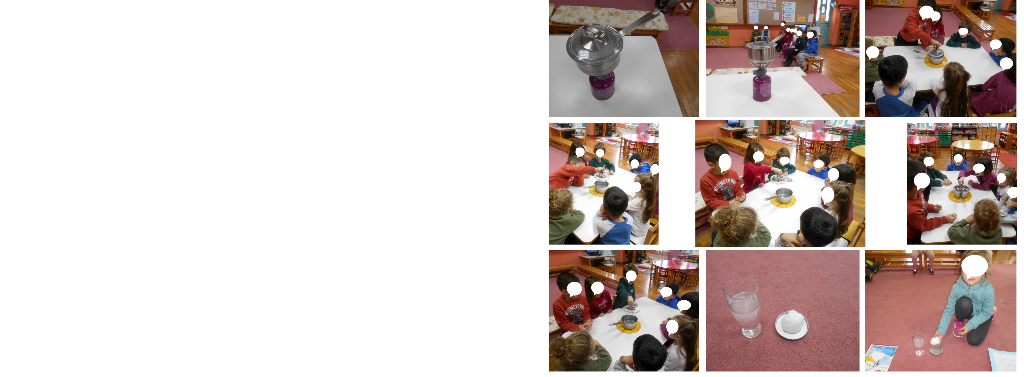
How rain is formed: evaporation of water, concentration and liquefaction.
Filiadou Konstantina, 1st Kindergarten of Argos Orestiko /Greece
Photos of the experiment
I.C. "L. SCIASCIA" -MISTERBIANCO - ITALY
Scuola dell'Infanzia sez. N and Q
Stefania Angela Di Guardo
HOW IS RAIN FORMED?
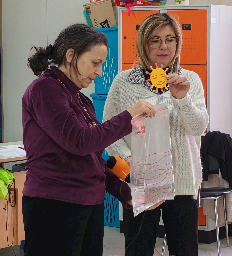
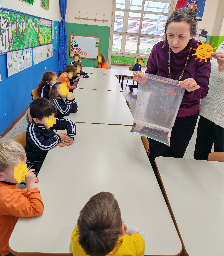
1 - We put water in a transparent bag, imagining it was the sea.
2 - Then we heated the water with a hair dryer, imagining the latter was the sun.
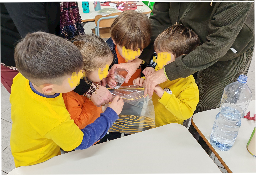
3 - We observed that, after a short time, steam and water droplets formed on the walls of the transparent bag.
4 - We have learned that water- when heated - evaporates and rises to the sky. Then it falls back on the earth in the form of rain.
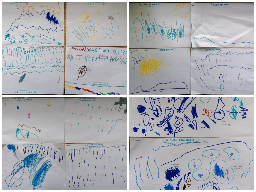
5 - Children produced a drawing on the subject.
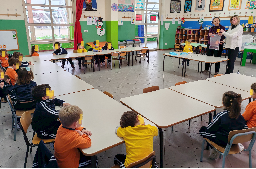
6 - We asked the children to conduct a similar experiment at home, with their parents, by boiling a pot of water. Water represents the sea, the lid of the pot the sky, and the stove the sun
7 - The next day, at school, children reported the experiment's results with photos.
Helen Karadimou
10th Kindergarten of Nea Ionia,Volos, Greece
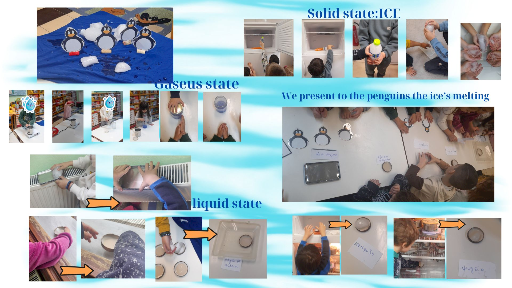

With our beloved penguins, we learn about the three states of water
How is ice formed? Why does ice melt? When does ice melt faster? What happens, when the ice melt?
(solid state )
We place a bottle of water in the freezer. Next day, the water has turned into ice.
(liquid state )
We hold the ice,it melts and our hands get covered in droplets because of their heat !!!
Then we break the ice into pieces and place one piece back in the freezer, one in the fridge, one on the warm radiator and one outside the window. Since it is winter and cold, we believe the ice outside the window won’t melt. We sprinkle a little salt on one piece of ice. We are curious but decide to try it too.
Half an hour later, we observe that the ice on the radiator melted the fastest, ,followed by the ice outside the window, even though it was cold. Next, the ice with salt melted, and the last to melt was the one in the fridge. Meanwhile, the ice in the freezer did not melt at all.
(Gaseous state)
We put water on an electrical heat surface .As the water heats up ,we put a metal lid and notice that evaporates , turns into fog and then water vapours .To understand it better ,weput the hot water colored in a jar and close the lid .After a while we opened the lid and saw the steam coming out
Agni Simota
6th Kindergarten of Kastoria/Grecce, 2nd class
Description of the experiment:
The students, divided into groups, put water and color in a plastic cup. They mix and mark the height of the water with a marker. They put the glasses in the freezer. They make predictions about what will happen and record them. The next day, we take the glasses out of the freezer and observe what happened. Were our predictions right?
Agni Simota
6th Kindergarten of Kastoria/Grecce, 2nd class
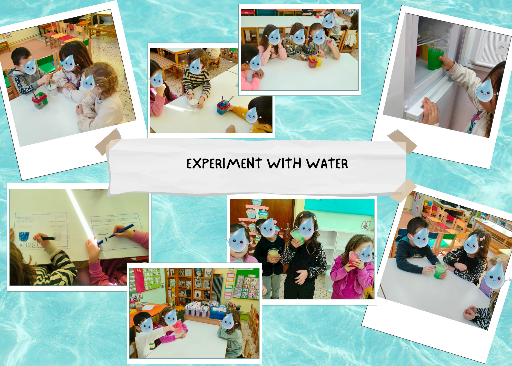
Solid-Liquid
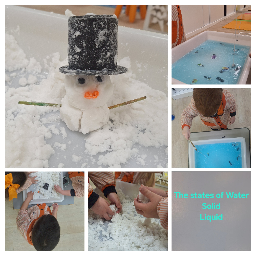
Los niños de 4 años procedieron a realizar juegos en los que pudieron experimentar con los distintos estados del agua.Creando un muñeco de nieve (estado sólido) y pescando peces en un lago (estado líquido).
Marta Guerra. Colegio Mariano. Spain
- < BEGINNING
- END >
-
LIKE
-
COMMENT