Made by students of 3rd ESO
Abdelillah Afkir-Ismail Azzoum-Laila Azzouzi-Chaimaa Bouzikou-Núria Clavera-Mohamed elKasmi-Mariona Fabré-Younes Latrach-Fikri Machar-Eva Macià-Carla Ramos-Joaquim Tomé-Aaron Torres-
Èlia Vilà-Aida Vilaregut-Dounia Amahou-Biel Codina-Júlia Costa-Hamza el baari-Salwa El Modneb-Laura Estragués-Noa Hernández-Zakaria Karrouch-Marwane Laanaria-Laia Macià-Gal·la Masoliver-Hicham Mnwar-Aissa Ouadi-Arnau Piquer-Mireia Porta-Gemma Pujol-Ali Al Habdal-laui-Ayoube AlMard-Sílvia Ballesteros-Joel Carrasco-Roger Cuscó-
Iman El Ouariachi-Dounia Lakdimi-Núria Mitjavila-Anna Montilla-Arnau Sánchez-N´úria Serra-
Gerard Tió-Gerard Vilà-

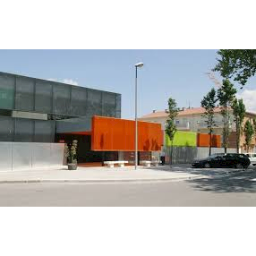
Our center is public, of Compulsory Secondary Education, Baccalaureate and Formative Cycles Medium Degree of Social Healthcare, Higher Degree in Early Childhood Education and Social Integration.
In our center, girls and boys are mixed, so that it becomes responsible and respectful citizens, with the others and with all its surroundings that allow them to be part of the society and the world of work, the center is non-confessional respectful of all beliefs. His educational task is also to achieve the involvement of families in the educational process of their children.

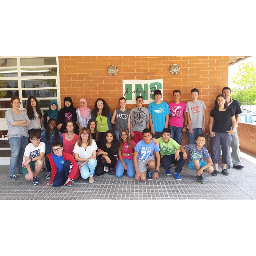
- The Catalan language is the main language of teaching and learning. Appreciate the use of new technologies, and innovation in the technological and scientific field.
- The way we treat teachers is very informal. We treat the teachers of "you", and they also treat us of “you”.
Our teachers are of different age.
We have teachers of more than 50 years old and under 30 years of age.
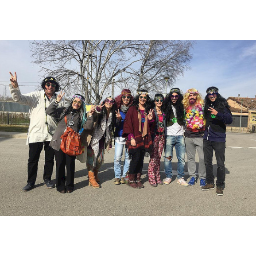
*This photo is from
when we celebrated
the carnival party.

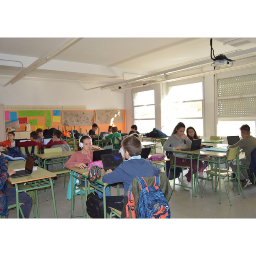
- The average of students for
class is about 20. But we
make groups for subjects like
Catalan, Spanish and Maths,
and the number of students
is reduced to an average of 15.
In 3rd course, there are 3 classes which average of students is about 20, and one classe which average of students is about 10.
But for example in 1st course the average of students is also 20 but there are 4 classes.
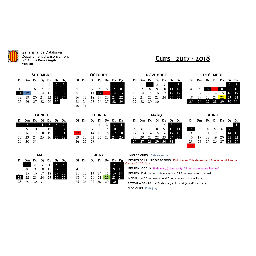
CALENDAR
On September 12th, 2017, compulsory secondary education classes began.
The first term ended on December 5th
December 11th began the second term
On December 23th, Christmas holidays began
The Christmas holidays ended on January 7th
The second term ended on March 9
March 12th began the third term
On March 24th, Easter holidays began
Easter holidays end on April 2th
June 22th, 2018: classes end in all centers.
TIMETABLES
To begin we must make it clear that we do not share the same schedule among third-year students, there are certain subjects that we do separately as Spanish, Catalan and mathematics that we do in different groups, the groups are separated by colors, the color yellow, the color green , the color blue and the color black, increases the difficulty of the subjects respectively.
The timetable begins at eight in the morning, the doors of the institute open and give way to a great wave of students.
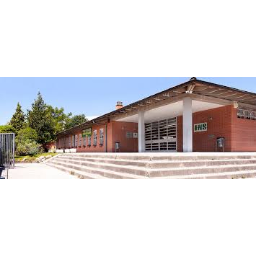
All students enter and everyone goes to their class, we begin to do 30 minutes of reading, all the students of the institute are required to read in the morning, they naturally choose their book according to their tastes.
We officially start the schedule at 8:30, then we do 55 minutes of class, we change the classes at 9:25, we make other 55 minutes of class and we go out to the playground at 10:20.
We do 20 minutes of recess and, we return to classes at 10:40, we do two classes of 55 minutes each and we go to the second recess at 12:30 and we go back to do two last classes of 55 minutes each class.
Finally we finish our schedule at 2:40, we go to our house, and so on five days a week.

HOLIDAYS
Christmas (nadal): from December 23rd, 2017 to January 7th, 2018, both included
Easter (setmana santa or Pascua): from March 24th to April 2nd, 2018, both included.
Those are determined by the corresponding provision of the Education Department and the two local holidays.


We don’t celebrate the Halloween. We celebrate La Castanyada. La Castanyada is a popular festival in Catalonia we toast and eat a lot of chestnuts. The day before we don’t go to the school. It’s the All Saints day.
Three days of free disposal that each center establishes.
We have three month of vacation in summer from the 22th of June to the 12th


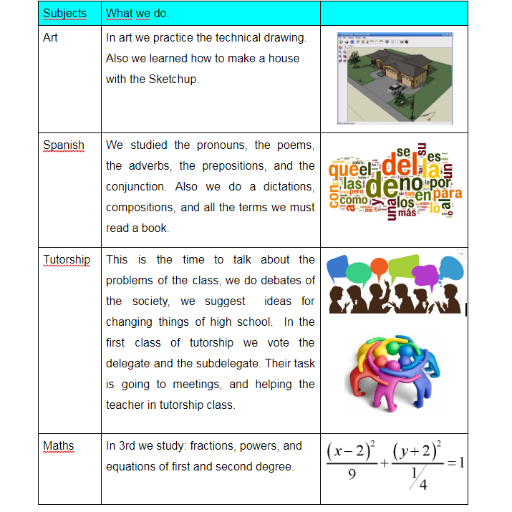
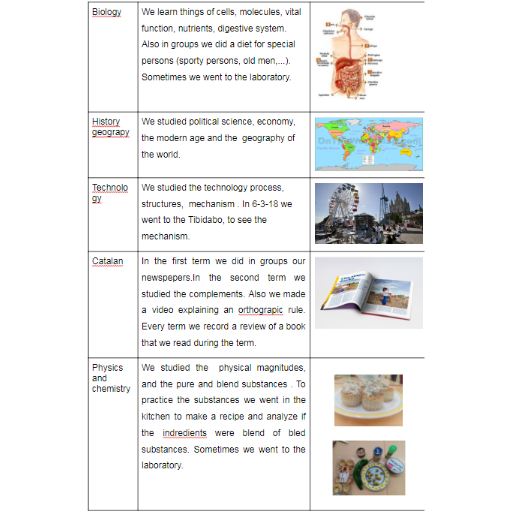
SUBJECTS OF 3RD ESO IN HIGH SCHOOL ANTONI POUS AND ARGILA
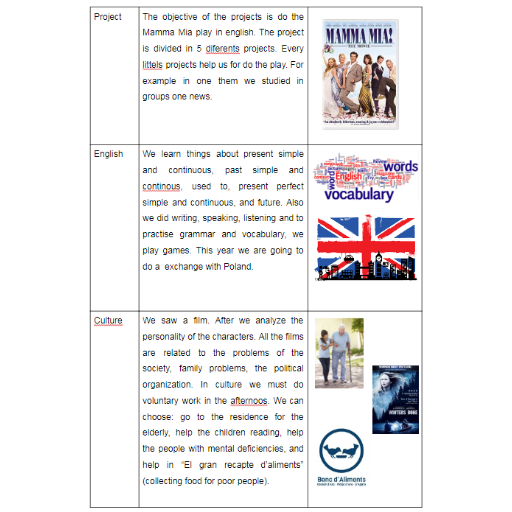
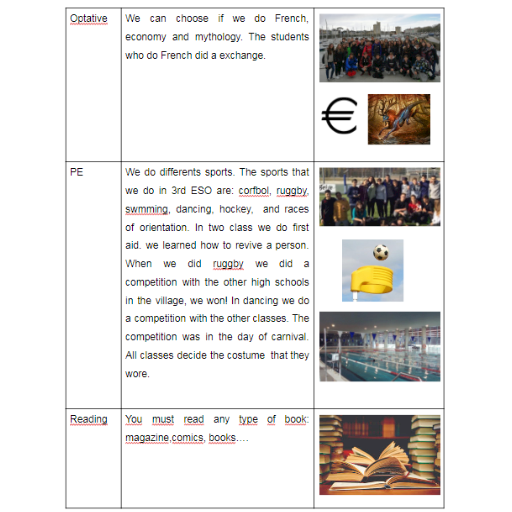
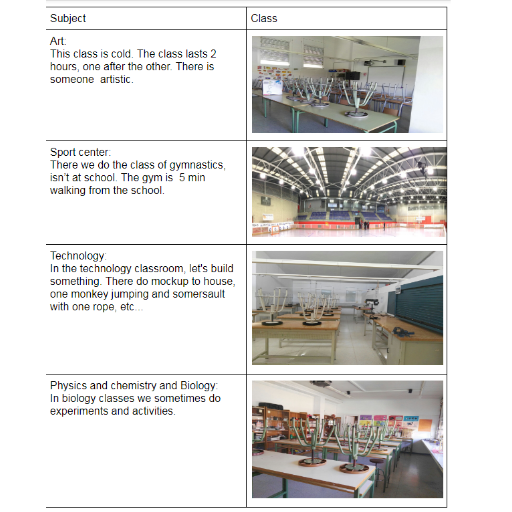
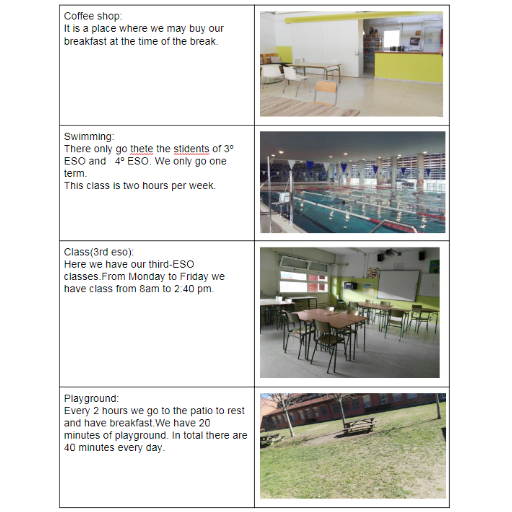
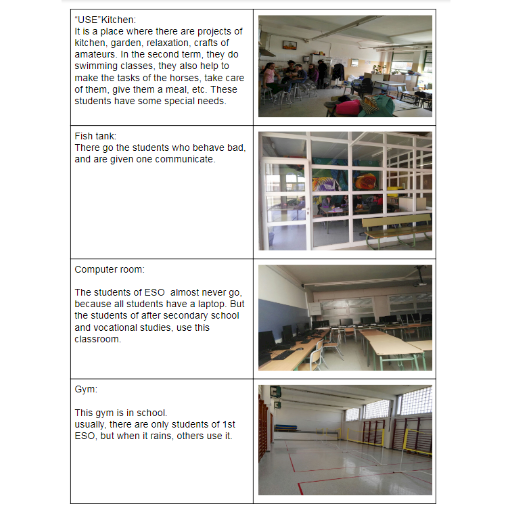
Classrooms
hOMeWORK
Homework is a normal thing at school, but I will explain to you how we do it at our school.
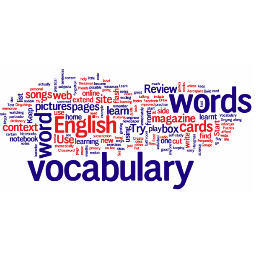
In the Ins Antoni Pous, the homework and specifically in English class, we work in class and not to forget about what we have done, she gives us a few pages of homework, a maximum of 4 or 3 exercises.
For my opinion there is not much homework and if you do them and be able to pass with other things you do that are not tested.

TESTS
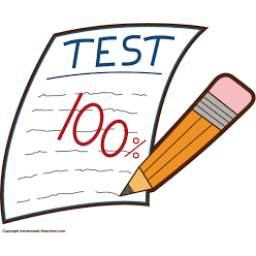
This year, the exams do not count much for the subject.
The teacher gives a more simple exam to those of yellow group or those who have difficulty with English (very good treatment) and the mark counts on:
Insufficient: 0-4
Sufficient: 5
Good: 6
Notable- 7-8
Excellent- 9-10
The truth is that if You know how to organize the subject you can pass because there is no difficulty.
delays and COMMUNICATES
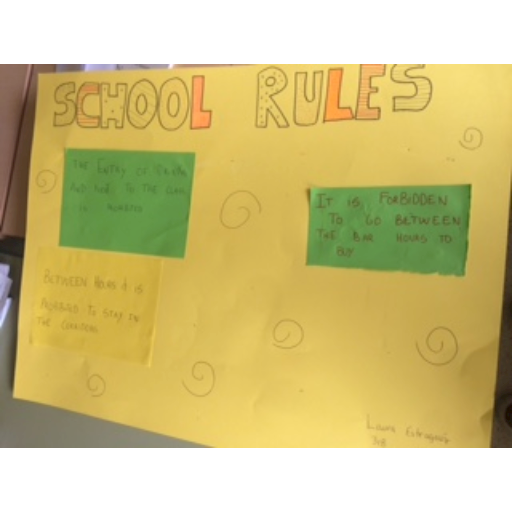
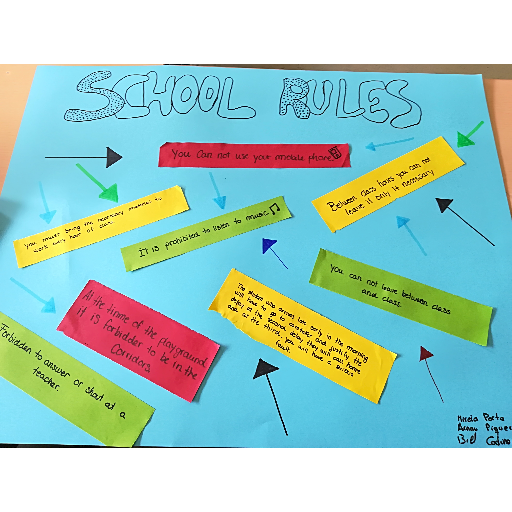
Our institute is clear on this topic.
We have basic rules that are the following:
If you arrive 5 minutes late, nothing happens, you enter the class without any problem.
And if you arrive between 10 minutes or more you have a delay but you go to the fish tank not to disturb the class.
Marks
We have the marks we have as another center .
You have to do everything to pass, the activities, and exams, but sometimes there are no exams.
PROJECTS
At our school, we work on different projects.
In these projects we work with competencies, that is to say:
-We intend to work on a specific topic.
-We always work in groups or in pairs.
-We accept the project with a presentation.
SKETCHUP:
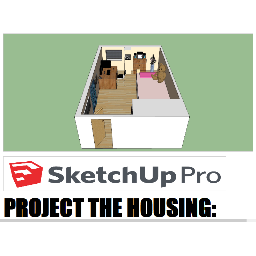
The first project we did was creating your own room and the one you want to have in a program called Sketchup.
The program allows drawing with a straight line. It also allows you to insert triangles, blocks, etc. To see 3D, there is a button that you have to click on. You must click on the figure and load it to the top. There was also the option to paint the figure: wood color, yellow iron, ... The choice that many people chose was to download landscapes, houses, tables
PROJECT THE HOUSE.
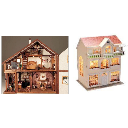
One of the projects that we liked most was to build a house with wood, with objects, etc.
-The first thing we need to do is making the wooden base.
-The second thing that we needed were objects such as: wood, cyclic
-The third we had to cut the wood, each wooden piece was a size.
-Then we had to paint the piece of wood, then we had to place them at the base. Then we had to start to build the house with wood.
After building the house, we had to make an electric circuit at home.Next, we had to make figures with wood,
or if you have Lego, you can also make a figure, etc.
Finally, this was the result.
SUGAR PROJECT.
Last year we made a project about sugar, we did a lot of activities to work and learn. We did the work in groups of 4. In this project we learned that sugar can not always be good, sugar can affect health in some way, causing some illness, such as diabetes. We also learned that some drinks, such as Coca-Cola, contain a large amount of sugar.

NUTRITIONAL PROJECT
In the subject of Biology, we worked on a project called food project, and we had to make it look as if we were nutritionists. The case was that there was a man who was 67 years old and that he was fat, and our Work was doing a healthy one-week recipe for his health and what kind of physical exercise he could do. And all the information we found was written in a Powerpoint. Among the concepts of work, we also had to make an energy table, we had to choose a dish and say how many kcal, vitamins, proteins, fats, carbohydrates had that dish.

THE CAR
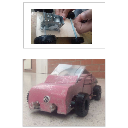
The students of the 2nd ESO of our institute have done a project to build a car with wood and an engine, 4 wheels and had to do it as a contest of cars that run more. They had to make the car with little weigh, because if it weighs, it does not run so much and the cars that win pass the technology subject; if you get more than a of 5, you have a breakfast at the bar of the institute. You could do all kinds of cars such as car rally auto caravan..
TRIPS
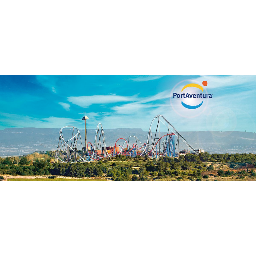
In our secondary school it is normal to do one or two trips every term. Usually are near Manlleu, our village, but we also make trips outside Osona, in Ripoll or Barcelona for example. Now we are going to explain some examples of trips we usually did every school year. The secondary years, we go in an Aquatic Park or in Port Aventura in one of the last days of the school year. And the students that read four books selected by the Government they go in a trip into Barcelona library. Here are the most importants trips that we usually did every year in our school.
1st: Boys and girls from 12 and 13 years old:
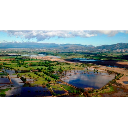
- Aiguamolls de l’Empordà: We go there to watch the nature, the different types of birds... for the biology subject.
- Manlleu porta cua: We go in the streets center and in there we can play the piano. Also the music teacher explains us different things about the piano like the number of keys, the piano tipes
- Aula de percusió: We go there with other schools to learn how to do different rythms with music.
- Maths Competition: We do a competitions with a lot of schools in Catalonia and if your grup you do it so well you go one day with the best students in every school to do a Maths Gymkhana.
- Serpent de llibres: We go to the library and in there they explain and recommend us some interesting books for our age.
2nd: Boys and girls from 13 to 14 years old:
- Control of air pollution:
- The students of 1st bat teach the students the pollution that is in the air, through activities.
- Besalú:
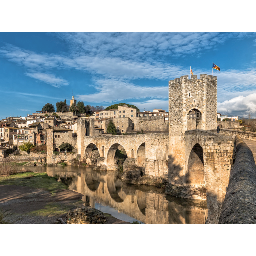
- The students go to Besalú to see different buildings of the medieval age. We do that to learn more things of the History subject.
- Serpents de llibres: They explain us a lot of books that they recommend for our age.
- Caminada Creu de Gurb: We go to walk in the mountain Creu de Gurb, and it's a physical education activity.
- Mercatec: They will look at an exhibition of technology, of projects from other schools.
3rd: Boys and girls from 14 to 15 years old
- Ripollès TV and Ripoll: We go there to see how television of Ripollès worked and we visit the streets and monuments of Ripoll.
- Picalletres: Is one TV program what promotes the catalan language and every year, three or six students of Institut Antoni Pous participate here. Is part of Catalan language.
- Tibidabo: For the subject of technology we go there to learn how the roller coasters work and do a dossier.
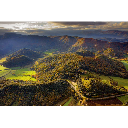
- Zona volcànica de la la Garrotxa: We went to see the volcanic rock and the volcano of Santa Margarita.
- Pasqual factory: It is a milk factory. We go there to see how the factory works and how to make milk.
4th: Boys and girls from 15 to 16 years old:
- Museu Dalí (Figueres): On 25th November of 2017 the students of 4th ESO went to Figueres to visit the Dalí art museum to learn more things of art. The trip was linked to the subject of projects.
- Cosmocaixa: On February 20, 2018 the students of 4th ESO went to the Cosmocaixa to do different activities related to sciences and the scientific field. The departure was free.
- End of course: This is done at the end of the course, and they usually go to another country because is the last year they study together.
- Episcopal museum: Is one excursion of subject of latin and is free.

SPECIAL EVENTS
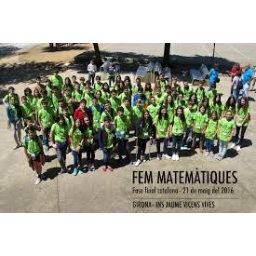
FEM MATES (Let’s do maths):
It is a competition that there is a previous phase before reaching the truth contest where all the students of all the participating schools have an opportunity to go to the competition. In the contest a series of mathematical problems arise and the one who is able to solve all is the winner.
RIPOLL ORENTATION DAY
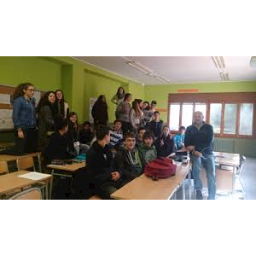
It is like an informative talk on the educational vocational studies that are here an outlet of higher education, there are different tables where different options are offered to study and where.
DAYS VIC CAPSULE
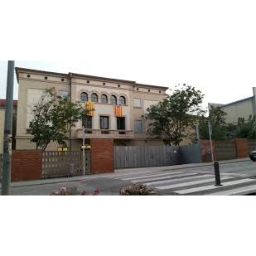
It would be the same as informative but more complex as it offers a lot more information related to the vocational studies and is very useful because not all cycles are done in the same schools.
SPORT PROJECT
The sports project consists of choosing different sports, such as football, handball, chess ... and a tournament is held for each sport that has been chosen previously. There are sports that can be individual or collective. In the chess mode and could also be played in pairs, the purpose was be to exercice.
Work with children and primary school students
Vocational studies’ students throughout the year must do compulsory hours with children and elementary students.
Learn about habits and how to treat children of different ages.
Go to the different schools and kindergartens of Manlleu.
Christmas
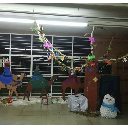
The last day of school, before to start the holidays, we celebrate the Christmas in INS Antoni Pous with different activities:
·Watch a movie . Hand crafts . Play boardgames
·Sing songs . Dance . Cooking
Then, with all the class, the students make the invisible friend: they give presents anonymously. This activity is organized by the students.
Also, at the school they sing Christmas songs. All courses sing a different song in front of all the school.
Carnival
In carnival the students of high school, a few weeks before prepare a dance and a theme to get dressed.
During the carnival week, every day, they bring a banner that the baccalaureate students tell them.
On Friday of carnival, at the last 2 hours each class represents their dance, and high school students become the jury. The classes that win receive a prize, which is 1 hour of playground.
The students of vocational studies during the carnival week must face the challenges that the king of carnival asks them and at carnival day they wear a disguise if they want. Also some teachers disguise themselves on some topic


VOCATIONAL STUDIES TRAVELS AND EXCHANGES
Vocational courses take part in a formative travels: some are very little travels, for example go to visit nursery schools of other towns, but others travels are go to, for example, Pais Basc.
The travel of Pais Basc will be at the beginning of April (returning from Setmana Santa).
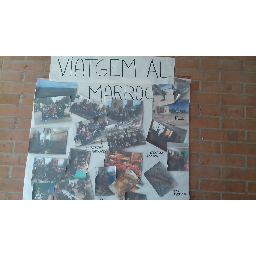
Travel to Morrocco
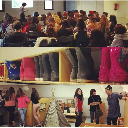
The students of vocational studies, every year, make a trip to Morocco to learn how a culture differs from ours.
On this trip, they discover the reality of centers of battered women and disabilities.
This trip is voluntary.
Exchanges
3rd eso = France and Poland
1st Batxillerat - Belgium
This year some students of 3rd have exchanged some students from France. ( Town: Niort). They went to Niort from March 1st until March 8th and they will come in April.
They have left by bus that is about 10 hours away. Once there, everyone will be with families and they will enjoy a fantastic week, doing activities and visiting places.
And, the first baccalaureate students have gone to Belgium.
PEOPLE TO PEOPLE
This summer, some students hosted children from the United States, you had them home for 4 days.
They had to make life with you, what you did, too, they should do, and that was also useful for learning English.
Where the extracurricular ones are made
93% do not take extracurricular activities at the institute
7% make extracurricular activities at the institute
Types of extracurricular activities
People who do extracurricular activities 70%
People who do not do extracurricular activities 30%
From 70% 30% sports 15% art 20% study support 5% others
EXTRACURRICULAR ACTIVITIES AT SCHOOL
Extracurricular institute
-Arab
- Assisted study
-Swimming
-Fotography
Extra-school outside the center
Sport Football Basketball Hockey Chess
Kick boxing Rugby Volleyball Karate
Taekwondo Ping pong Tennis Paddle
Surf Paddelsurf SkiJiu jitsu Gymanstics
Kunfu swimming Handball Street workout
others
- < BEGINNING
- END >
-
LIKE
-
COMMENT