We are collaborating on the Chemistry Everywhere project. Please complete each page by preparing 5 pages of school.

HAYRİYE AYDIN
KTSO ANOTOLIAN HIGH SCHOOL
Marie Curie
Who is Marie Curie, the first scientist to have two Nobel Prizes in history?
Marie Curie was born in Poland on November 7, 1867. In 1885 she began studying medicine at the Sorbonne in Bronze. She began her studies in November 1891 and received a physics diploma as the first of her class at the end of a year and a half. In 1894 he took his second degree in mathematics.
After receiving his teaching diploma in 1896, he began to work in detail in 1897 on the ray, which Henri Becquerel announced earlier, that the uranium salts had laid, which would later be called radioactivity.
In July of 1898, Curie announced that he had found a new radioactive element, a polonium from the radioactive decay of uranium.
Nevin GUVENDİK
GUMUSPALA VOCATİONAL AND TECHNICAL SECONDARY SCHOOL
Family
Both of Marie Curie’s parents were teachers, and she was the youngest of five children, following siblings Zosia, Józef, Bronya and Hela. As a child Curie took after her father, Wladyslaw, a math and physics instructor. She had a bright and curious mind and excelled at school. However, tragedy struck early: When she was only 10, Curie lost her mother, Bronislawa, to tuberculosis.
A top student in her secondary school, Curie could not attend the men's-only University of Warsaw. She instead continued her education in Warsaw's "floating university," a set of underground, informal classes held in secret. Both Curie and her sister Bronya dreamed of going abroad to earn an official degree, but they lacked the financial resources to pay for more schooling.
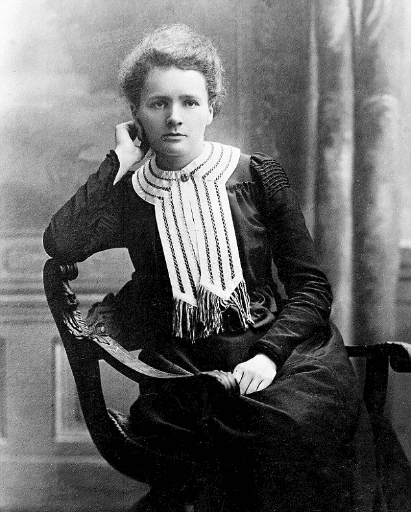
Undeterred, Curie worked out a deal with her sister. She would work to support Bronya while she was in school and Bronya would return the favor after she completed her studies. For roughly five years, Curie worked as a tutor and a governess. She used her spare time to study, reading about physics, chemistry and math.
The Curie's research was crucial in the development of x-rays in surgery. During World War One Curie helped to equip ambulances with x-ray equipment, which she herself drove to the front lines. The International Red Cross made her head of its radiological service and she held training courses for medical orderlies and doctors in the new techniques.
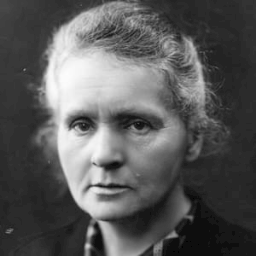
Marie Curie was the first woman to win a Nobel Prize, in Physics, and with her later win, in Chemistry, she became the first person to claim Nobel honors twice.
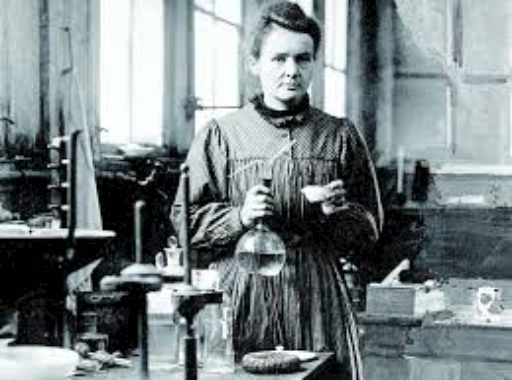
SNEZANA KALAMKOVIC
PRIMARY SCHOOL "PRVA VOJVODJANSKA BRIGADA"
NOVI SAD, SERBIA
Her husband Pierre Curie had developed a version of the electrometer, a sensitive device for measuring electric charge. Using her husband's electrometer, she discovered that uranium rays caused the air around a sample to conduct electricity. Using this technique, her first result was the finding that the activity of the uranium compounds depended only on the quantity of uranium present.
In 1897. Marie Curie gave birth to dauther Irene.
At that time, radiation damage was not taken into account.
A doctoral student of Curie, Marguerite Perey, became the first woman elected to membership in the Academy – over half a century later, in 1962. During the French Academy of Sciences elections, she was vilified by the right wing press who criticised her for being a foreigner and an atheist.
GEORGIA- IRINA SOSELIA
LEPL Zugdidi muncipality village Chkhoria public school
Marie Curie Quotes
,,I was taught that the way of progress was neither swift nor easy''
Marie Curie
,,Be less curious about people and more curious about ideas''
MARIE CURIE
Life is not easy for any of us. But what of that? We must have perseverance and above all confidence in ourselves. We must believe that we are gifted for something and that this thing must be attained.
Marie Curie
- < BEGINNING
- END >
-
LIKE
-
COMMENT