 This book is dedicated to my parents
This book was created and published on StoryJumper™
©2010 StoryJumper, Inc. All rights reserved.
Publish your own children's book:
www.storyjumper.com



 Contents
Benefits of Trees page # 5
Mahatma Gandhi page # 6
Mother Teresa page # 9
Florence Nightingale page # 13
Abraham Lincoln page # 16
Martin Luther King Jr. page # 19
Nelson Mandela page # 22
Trees of Humanity page # 27
Books Referred Page # 28

 Benefits of Trees
A tree is a wonderful creation in nature that symbolizes love and sacrifice.It
serves other creations by:
1. Renewing our air supply by providing oxygen and absorbing
carbon-dioxide.
2. Providing food and shelter for wildlife.
3. Combating the greenhouse effect (global warming).
4. Cleaning the air by absorbing odors and pollutant gases.
5. Conserving energy; when three trees are placed strategically around a house,it
cuts summer air conditioning needs up to 50 percent.
and even when it is cut down, its wood is used for fire, construction, paper etc.
Now let us see some trees of humanity.
 Mahatma Gandhi
Gandhi was an Indian leader. He fought for India’s independence against the
British. He used Non-Violence. Gandhi believed that Non-Violence was the mightiest
weapon on Earth. Gandhi was a very spiritual person. Gandhi fought against
injustice and racism for Indians in South Africa and in India. In South Africa he
fought for twenty years (1895 - 1915) and succeeded in his work. In 1915 he
returned to India and fought against the British for India’s Independence for thirty
years (1916 - 1947.) All this time he used Non-Violence. Mahatma Gandhi is India’s
“Father of the Nation”.
Sathyagraha
Sathyagraha was the non–cooperation movement that was founded and used
by Gandhi. Sathyagraha means firmness in fighting injustice by sincere and
truthful means. Policies adopted by Satyagrahis are “I shall stand firmly by truth,
Ahimsa (Non-Violence), Non-Stealing, Swadeshi (boycott of British products and
revival of domestic products) and fearlessness and stand against untouchability.”
South Africa
In the twenty-year period, Gandhi made 3 Sathyagraha strikes and
succeeded in his work.
India
In India, Gandhi improved village industry by improving village crafts work,
spinning and weaving of Khadi clothes.
The use of Khadi clothes and the boycott of British clothes were promoted among
Indians.
Sathyagrahis also promoted the abandoning of wine, liquor and untouchability.
Gandhi headed various events such as the Salt Satyagraha, Go Back Simon, Quit
India, etc.
Mahatma Gandhi was an embodiment of devotion and
non-violence.

Quotes
1."I do not claim I have committed any mistake, but this I claim, at
any given time, I did what I considered right at that time."
2."Non-Violence is the greatest force at the disposal of mankind. It is
mightier than the mightiest weapon of destruction devised by the
ingenuity of man."
3."When I despair, I remember that all through history, the way of
truth and love has always won. There have been many tyrants and
murderers and for a time they seem invincible but in the end, they
always fall, think of it, ALWAYS."
 Mother Teresa
Mother Teresa dedicated her life to love and serve the poor and sick.
Birth and Early Life
Mother Teresa was born in Skopje, Albania. When she was young, her name
was Agnes. Her full name then was Agnes Gonxha Bojaxhiu. She was born on
August 26, 1910. She was inspired by a quote of St. Therese. It was “Even the
smallest work is good as long as you do it with love”. Also every year the family
went on a trip to a shrine in Letnice, Montenearo. During one visit at the age of
12, Agnes thought “I want to become a missionary and help people, guide me
Mother; Let me do what is right.” Later she did become a missionary. She joined
the Loreto Sisters. She took up a new name, Sister Teresa, after St.Therese.
Life as a Missionary
Sister Teresa didn’t just work in the convent; during extra hours she
worked in a clinic for the poor. Then on September 10, 1946 she got a CALL
FROM GOD while traveling on a train, to leave the safety and comfort of the
convent and love and serve the poorest of the poor on the streets and in the
slums.
That day was an “Inspiration Day” in Mother Teresa’s life. Mother Teresa
requested the Pope. The Pope said he would think about it. Mother waited
patiently. Finally the Pope granted Mother Teresa permission to leave the convent
and serve the poorest of the poor by August, 1948.
Work for Poor and Sick
When she served the poor, help came from all four corners. Her students in
the convent, Subashini and Magdalena and other young people were inspired by
her work and became nuns to help her in serving the poor and sick. Many people
then started calling her “Mother” Teresa. Though Mother had very less money, her
faith in God brought help from Delhi to Chennai and outside India many other
countries helped, like the United States and Britain.
In 1950 the Pope named Mother Teresa’s order of nuns as the “Missionaries
of Charity”. The Missionaries of Charity did a lot of work in a lot of cities, states
and countries. Mother built a home for poor children. One was called “Shishu
Bhavan.” She also made a home for dying people. She called it “Nirmal Hriday”
(Place of the pure heart.) She also provided medication for lepers (people with a
disease called leprosy.) She taught
lepers farming, spinning and carpentry. She also helped the poor outside
India. In her lifetime, Mother Teresa started 610 missions in 123 countries. These
610 missions included hospices, orphanages, soup kitchens, schools and homes for
people with AIDS, leprosy and TB.

Mother Teresa was an embodiment of love and compassion
Awards
Mother Teresa was not just recognized in India, but in many other places in the
world.
For her work, she was awarded with
1. Padma Shri Award in 1962
2. Pandit Nehru Award in 1972
3. Nobel Peace Prize in 1979
…and many others.
Quotes
1. "If we have no peace, it is because we have forgotten that we belong to each
other."
2. "Love begins at home, and it is not how much we do, but how much love we
put in that action."
3. "Intense love does not measure, it just gives."
4. "Each one of them is God in disguise."
5. "We shall never know all the good that a simple smile can do."
6. "The biggest disease today is not leprosy or tuberculosis, but rather the feeling
of being unwanted."
 Florence Nightingale
Birth and Early Life
Florence Nightingale was born on May 12, 1820 in Florence, Italy. Her
parents were a young English couple. Her father was William Nightingale and her
mother was Fanny Nightingale.They were very wealthy. In those days, in wealthy
families,young woman were expected to get married and have children. They were
not encouraged to work outside home. Florence dared to be different.
Teen-age and Young Adult Life
On her seventeenth birthday Florence had a vision from God to serve the
society. When she had free time, Florence cared for her sick relatives, but her
family did not support her goal of being a nurse. When she told her family her
“wonderful” idea, Fanny got outraged. So in the night she studied about health
care and nursing secretly.
Work towards her Goal
In 1850 some family friends took Florence to the nursing training center in
Kaiserswerth, Germany. Later in 1851, she studied there and learned
basic nursing skills. In 1853, her wishes of becoming a nurse were starting to
come true. With the help of Sidney and Liz Herbert she became a superintendent
nurse in a hospital in London. She also trained other young women in nursing.
The students were called "Nightingale Nurses". Florence set many of the
standards of health, cleanliness and compassion that nursing still follows today.
Florence's Nursing Health Care Reforms
Florence was very strict about cleanliness and hygiene. She wanted beds,
sheets, clothes etc to be kept clean.
Service in Crimean War
Florence got the name "Lady with the Lamp" from her service in a war
called the Crimean war. The man who sent British soldiers to fight was Sidney
Herbert. He admired Florence's work for the sick and asked her to help. She got
the name "Lady with the Lamp" because each night she went from bed to bed
carrying a lamp to make sure each soldier was alright.
She lived to be 90 years old (1820-1910).
Florence was an embodiment of dedication and compassion.
Quotes
1. "I think one's feelings waste themselves in words; they ought all to be distilled
into actions which bring results."
2. "How very little can be done under the spirit of fear."
3. "The very first requirement in a hospital is that it should do the sick no harm."
 Abraham Lincoln
Abraham Lincoln was born on February 12, 1809. He was born in
Hodgenville, Kentucky. His father's name was Tom Lincoln and his mother's name
was Nancy Lincoln. He also had an elder sister called Sarah Lincoln. Abe and his
family were very poor. They almost had no money at all. As Abe grew older Abe
and Sarah grew happy in Kentucky but not Tom Lincoln. He always had a hard
time planting seeds. When Abe was 8 they moved to Indiana. In Indiana there
was a lot of work to do. First Abe helped Tom build the log cabin. Then Abe helped
with the planting.Then Abe would keep the wood in the fireplace. The girls helped
in washing, cooking, sowing, spinning, weaving and making soap. At age 9 Nancy
Lincoln died of milk sickness. Tom married to a wife named Sarah who had 3
children Sarah, Matilda and John. It was his mother Sarah that encouraged Abe to
read. Abe soon loved reading.
Young Adult Life
Abe was on a boat to New Orleans. He was delivering cargo. When he got to
New Orleans, he saw something... It was a slave market! He saw black people
being chained and sold like animals. Of course Abe had heard
of slavery, but he had never seen people being treated like animals.
Before Abe had went to New Orleans he worked in a store in New Salem.
Everyone could trust Abe. Once a lady came to buy cloth, but when she left Abe
found out she had paid six cents too much. That night Abe walked six miles to her
house to give back the money. Abe was known far and wide for his honesty. He
also worked as a postmaster in New Salem. After this he moved to Springville,
Illinois to be a lawyer at the age of 28. Abe was a good lawyer. He made fair
judgments. At age 33 he married Mary Todd. Abe was a lawyer for about 9 years.
Then he was elected as the U.S. president when he was 37 years old. As a
president he worked to end slavery.
The End of Slavery
A few years before tension over slavery had grown between the South and
the North. On April 12, 1861 Southern Troops attacked Fort Sumter, a federal fort
in South Carolina. Abe knew now that the North had to fight the South. Abe was
the commander in chief of the Union (North) army. In the third year of the war
Abe signed the Emancipation Proclamation. It freed over 30,000 black people and
called black men for the war. The South finally surrendered. Now somebody had
to heal the nation but Abe couldn't. A bullet ended his life.
Abe was a honest man who worked towards human rights so
everybody would be treated fairly.
Quotes
1. "I am not bound to win, but I am bound to be true. I am not bound to succeed,
but I am bound to live by the light that I have. I must stand with anybody that
stands right, and stand with him while he is right, and part with him when he
goes wrong."
2. "Nearly all men can stand adversity, but if you want to test a man's character,
give him power."
3. "Sir, my concern is not whether God is on our side; my greatest concern is to
be on God's side, for God is always right."
4. "Give me six hours to chop down a tree and I will spend the first four
sharpening the axe."
 Martin Luther King Jr.
Martin Luther King fought racism for African Americans in the United States.
Early Life
Martin Luther King Jr. was born on January 15, 1929. He was born as
Michael Luther King (which was his father's name also) and then they both
changed their name to "Martin" when the younger Martin was 4. Martin had an
older sister named Chris and a younger brother named Alfred. Due to Jim Crow
laws (which were the laws that supported the segregation of black and white
people) Martin did not know many white people. He only had one white friend, the
son of a nearby grocer but their friendship ended when he went to his friends
house to play. When he got there the grocer said "You may no longer play with
my son". Martin did not know that it was the color of his skin that affected his
friendship. Later that day his mother told him "You are as good as anyone else".
Then his mother told him about slavery and racism.
Education
Martin was a smart student. His mother taught him reading. Martin read so
well that his mother enrolled him in school a year early, but the school soon found
out that he was too young. Martin was so good that he was allowed to skip ninth
and twelfth grades. In 1944 when he was 15 years old he graduated from Booker
T Washington High School. Then four years later he graduated from the
Morehouse College and was ordained as a Baptist Minister. But instead of joining
his father at the Ebenezer Baptist Church immediately he joined the Crozer
Theological Seminary to pursue his religious studies. At the Seminary, Martin was
inspired by 2 men Mohandas Karamchand (Mahatma) Gandhi and Henry David
Thoreau. He graduated in 1951. In 1953 he got married to Coretta Scott King. A
year later they moved to Montgomery, Alabama.
The Work
In those days, many African Americans in Montgomery would use the bus to
get to work and come back again. Unfortunately, they were treated badly by white
bus drivers. They were to pay in the front and enter in the back. Some bus drivers
sometimes even sped off without waiting for the blacks who paid. In 1955
something happened. That day a woman named Rosa Parks boarded a bus. Then a
white man climbed aboard. The driver ordered Rosa to stand up. Rosa refused.
The driver called the police.
The police arrested Rosa. Martin decided that they would have a one day boycott
of the bus system. Amazingly it came into effect. A few years later he moved to
Atlanta, Georgia. Later he delivered his famous "I Have A Dream" speech on the
steps of the Lincoln Memorial on August 28, 1963. A year later he was awarded
with the Nobel Peace Prize.
Sadly on April 4,1968 he was assassinated.
Martin Luther King was an embodiment of non-violence
and peace.
Quotes
1. "Darkness cannot drive out darkness; only light can do that. Hate cannot
drive out hate; only love can do that."
2. "I have a dream that my four little children will one day live in a nation where
they will not be judged by the color of their skin, but by the content of their
character."
3. "I have decided to stick with love. Hate is too great a burden to bear."
 Nelson Mandela
Nelson Mandela was a South African Leader who fought for South Africa's
Independence.
Early Childhood
Nelson Mandela was born on July 18, 1918. His father, Henry Gadla
Mphakanyiswa was the chief of the Thembu. When Nelson was born his name was
Rolilahla which meant "troublemaker". At age 7 Rolilahla went to school and was
renamed Nelson by his teacher. At the age of 9 his father died and he went to live
with his father's friend Chief Jongintaba Dalindyebyo who had a son named
Justice who became his good friend.
Education
Nelson continued his schooling at Clarkesbury Boarding institute and did his
high schooling at Healdtown with Justice. At age 21 he was enrolled at the Fort
Hare University College where he studied law. There he met Oliver Tambo who
became his good friend.
The Struggle for Freedom
When Nelson and Justice got back, Uncle Jongi asked them to get married.
They were shocked. They refused and ran away to Johannesburg to live their life.
Justice returned to take Uncle Jongi's place after Uncle Jongi died. Nelson stayed
at Johannesburg.
Nelson later met Walter Sisulu and his old college friend Oliver Tambo. They
all joined the ANC (African National Congress) and formed the ANC Youth League.
The ANC peacefully protested by marching through streets demanding their
freedom. In 1948 the government passed a law called apartheid which meant
blacks and whites were separated. It wasn't just black people who were against
apartheid. Thousands of colored, Indian, and white South Africans were against it
too. Many joined the Congress Alliance. In 1955, the ANC and the Congress
Alliance drew up the Freedom Charter which was a promise to fight for the South
Africa's freedom and democracy. The government did not like the Freedom
Charter and arrested 156 Congress Members including Oliver,Walter and
Nelson.They were charged with planning to destroy the government.The trial
lasted 4 years but in the end they were not found guilty.
In 1960, in Sharpville 5,000 people marched to a police station to protest
against carrying passbooks (passbooks were books that had the persons name,
house address, occupation etc. Any black person found without one would be
arrested). They were not armed with weapons but the police shot guns at them.
69 people were killed and 400 people were injured. In 1962 Mandela was sent to
gather support from other countries sentenced for 5 years on his return to South
Africa. In 1964 Mandela and 7 other men including Walter Sisulu are found guilty
and are sentenced to life in prison at Robben Island. From 1980 to 1981 tons of
people signed the "Release Mandela" petition. In 1982 he was moved to the
Pollsmoor prison and in 1988 to the Victor Verster prison with a bedroom, a
kitchen, and a swimming pool. Finally Nelson Mandela was released after 27 years
in prison. In 1994 white and black people both come out of their houses to vote.
Mandela won the election and was the first black president of a democratic South
Africa.
Mandela was an embodiment of sacrifice (as he spent
nearly 30 years of his life in prison for his community)
and peace.
Quotes
1. "If you want to make peace with your enemy, you have to work with your
enemy. Then he becomes your partner."
2. "I learned that courage was not the absence of fear, but the triumph over it.
The brave man is not he who does not feel afraid, but he who conquers that
fear."
3. "It always seems impossible until its done."
4. "We must use time wisely and forever realize that the time is always ripe to do
right."
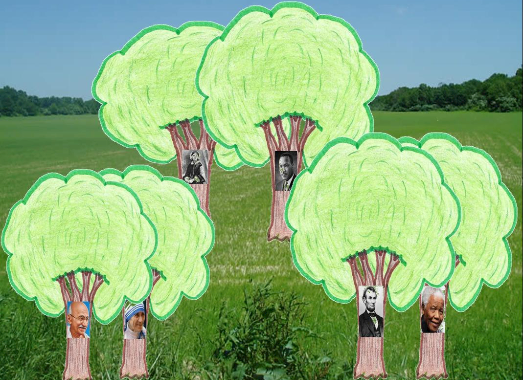
 Trees of Humanity
Just as trees serve other creatures by offering oxygen,wood,food etc, these
people served humanity to make our world a better place.Their messages
influenced the society.Their lives were role models.
The most important thing that we must learn from them is:
They did not worry about themselves and they contributed
and worked for the benefit of the society.
 Books Referred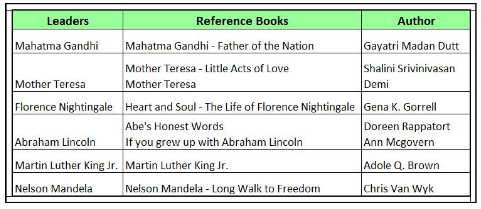

 About the Author
My name is Adithya Narayanan Selvakumar. I am called Adi by my
family and friends. I wrote this book at the age of 8. During my free time I
learnt about some of these great people and the rest I learnt about at
school. When I was in second grade I read a Hindu scripture called
"Bhagawat Gita". In this scripture along with several other concepts I learnt
the importance of the concept of sacrifice. As an example, it explained how
trees serve nature.
Based on this information, when I revisited the biographies of these
great people I had a better idea of how much they gave for the society
where they belonged.
That is why I wrote this book.


- < BEGINNING
- END >
-
DOWNLOAD
-
LIKE(1)
-
COMMENT()
-
SHARE
-
BUY THIS BOOK
(from $5.59+) -
BUY THIS BOOK
(from $5.59+) - DOWNLOAD
- LIKE (1)
- COMMENT ()
- SHARE
- Report
-
BUY
-
LIKE(1)
-
COMMENT()
-
SHARE
- Excessive Violence
- Harassment
- Offensive Pictures
- Spelling & Grammar Errors
- Unfinished
- Other Problem





COMMENTS
Click 'X' to report any negative comments. Thanks!