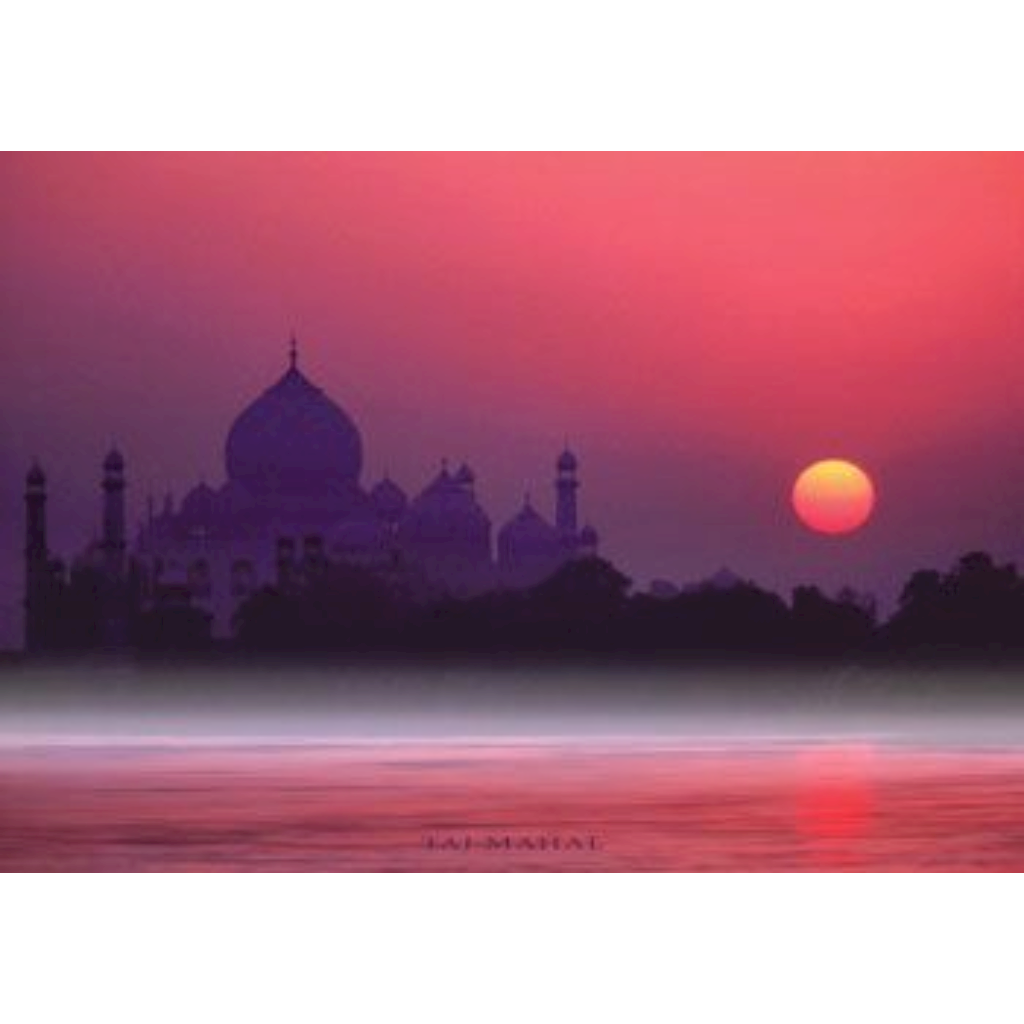
This book is dedicated to my Grandma, who inspires me to learn new things every day.

Table Of Contents
Setting Pages 4-5
Key Players Involved Pages 6-7
Cause of Conflict Pages 8-9
Conflict Pages 10-11
Resolutions Pages 12-13
summary/long term impact Pages 14
Works Cited Page 15-19
The Indian Independence Movement began in 1857 with the Sepoy Rebellion
It ended in 1947 when Lord Louis Mountbatten watched over the transfer of power and the split of the subcontinent.
Also named the "Father of the Nation", Mohandas Gandhi was a huge figure and leader in the Indian Independence movement. He was born in Porbandar, India, in 1869 and studied law in London. He lived in South Africa for 21 years where he campaigned for Indian rights. After India gained its independence in August 1947, Gandhi was assassinated by a Hindu extremist who hated Gandhi's tolerance to Muslims.
In his speech to Congress, Gandhi said, "Here is a mantra, a short one that I give to you. You may imprint it on your hearts and let every breath of yours give expression to it. The mantra is 'Do or Die.' We shall either free India or die in the attempt; we shall not live to see the perpetuation of our slavery."
Indian soldiers working for the British called Sepoys began to become wary and unhappy with the British East India Company. The sepoys heard that they would have to bite gun cartridges containing pig and cow lard, which went against their religion. They revolted in the Sepoy Mutiny of 1857 but were beaten by the British. This mutiny led Britain to take the company's assets and impose a direct rule over India called the British Raj.
Britain exploited India by only allowing native citizens to have the last level of civil service. Britain also turned rice farms into cotton farms to provide greater material for cotton mills in England. India had many food shortages because of this.
Gandhi rose as a new leader of the Indian Independence movement in the early 1920s.
Gandhi encouraged civil disobedience and created methods of action based off of courage, nonviolence, and truth. He called these methods Satyagraha.
He used Satyagraha in his march against the Salt Laws. These laws taxed the salt that Indians bought while also banning them from creating their own salt. On March 12, 1930, Gandhi and 79 of his Satyagaha Ashram went on march from Ahmadabad to Dandi. Along the 241 mile journey, Gandhi would give speeches and rally up more people to participate in the march. Once he got to Dandi, he made salt and was arrested. His actions inspired protests all throughout India.
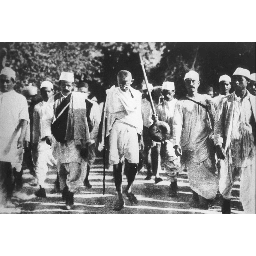
In 1942, Gandhi started the Quit India Movement in an attempt to end the British Raj.
The British ordered support from India for World War II but they resisted and ordered the British to leave in August 1942. Due to their resistance, Gandhi and many other nationalists were arrested. During his time in prison, Gandhi went on numerous hunger strikes and he was eventually released by 1944.
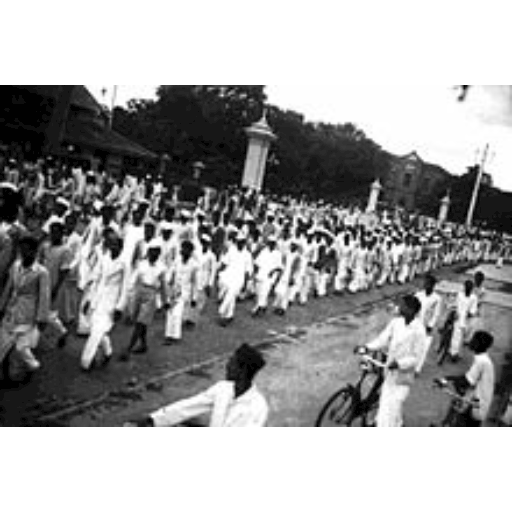
After Gandhi's Quit India Movement, the Indian National Congress passed the Quit India Resolution. This put a provisional government in place and stated that India will become an ally of the United Nations. This was only a temporary fix though.
A permanent resolution occurred when Clement Attlee, the Labour Party leader, supported India's independence movement and promised to transfer power when it was safe.
Although Gandhi wanted to see Muslims and Hindus live together peacefully, the division and creation of Muslim Pakistan was authorized in the Indian Independence Act of 1947. Lord Louis Mountbatten, the last British colonial ruler, overlooked the power transfer and division of the Indian subcontinent.
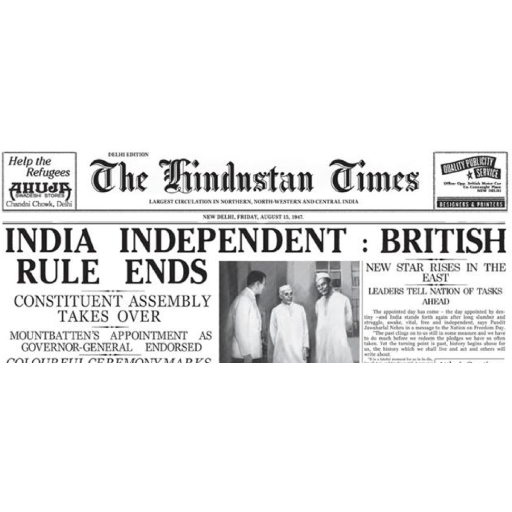
After many years of oppression by the British Raj, India finally protested for their independence. A big part of the movement was led by Mohandas Gandhi, whose methods of peaceful protest won their independence without bloodshed. He became extremely well known for his nonviolent but effective protests. In 1947, India gained its independence.
Bartholomew, John George. Map "Prevailing Religions of the British Indian Empire, 1909." WikipediA, Wikimedia Commons, 2007, en.wikipedia.org/wiki/File:Brit_IndianEmpireReligions3.jpg. Accessed 26 Mar. 2021.
The front page of the Hindustan Times announces Indian independence from the British Empire (1947). Image from the Hindustan Times. National History Center, nationalhistorycenter.org/decolonization-resource-collection-asia/.
Gandhi Arrested: Do or Die-Quit India Movement. Different Truths,
www.differenttruths.com/governance/politics/gandhi-arrested-do-or-die-quit-india-movement-i/.
Gandhi during the Salt March, March 1930. 1 Mar. 1930. WikipediA, en.wikipedia.org/wiki/Salt_March.
"Indian Independence." Gale Encyclopedia of U.S. History: War, Gale, 2009. Gale In Context: High School, link.gale.com/apps/doc/EJ3048500206/SUIC?u=vbcps&sid=SUIC&xid=97ad42e6. Accessed 23 Mar. 2021.
Indian Mutiny. Skagit Valley College E Learning, Skagit Valley College, 2017, skagit.instructure.com/courses/5362/pages/indian-mutiny-or-sepoy-rebellion?module_item_id=227231. Accessed 25 Mar. 2021.
"Mohandas Gandhi Leads the Salt March: March 12–April 5, 1930." Global Events: Milestone Events Throughout History, edited by Jennifer Stock, vol. 2: Asia and Oceania, Gale, 2014. Gale In Context: High School, link.gale.com/apps/doc/PFWWET666650812/SUIC?u=vbcps&sid=SUIC&xid=97aa65ab. Accessed 23 Mar. 2021.
"Mohandas K. Gandhi and Jawaharlal Nehru." World Book Advanced, World Book, 2021. Online image,www.worldbookonline.com/advanced/media?id=pc326438. Accessed 30 Mar. 2021.
"Mohandas Karamchand Gandhi." World Book Advanced, World Book, 2021. Online media,www.worldbookonline.com/advanced/media?id=lr001080. Accessed 30 Mar. 2021.
Monumento a Mohandas K. Gandhi. Wikipedia, 10 Dec. 2016, en.wikipedia.org/wiki/File:Madrid_-
_Plaza_Joan_Mir%C3%B3,_Monumento_a_Mohandas_K._Gandhi_2.jpg.
Procession in Bangalore during the Quit India Movement. Wikipedia, en.wikipedia.org/wiki/Quit_India_Movement.
Wolpert, Stanley A.. "British raj." Encyclopedia Britannica, 8 Sep. 2020, https://www.britannica.com/event/British-raj. Accessed 19 March 2021.
"The Partition of India, August 15, 1947." Historic World Events, Gale, 2020. Gale In Context: World History, link.gale.com/apps/doc/FNWIOE662788601/WHIC?u=vbcps&sid=WHIC&xid=15a728de. Accessed 19 Mar. 2021.
Studio Photograph of Mohandas K. Gandhi, London, 1931. 1 Jan. 1931. WikipediA, Wikipedia, en.wikipedia.org/wiki/Mahatma_Gandhi.
Two Sepoy Officers; A Private Sepoy, 1820s. WikipediA, Mar. 2006,
en.wikipedia.org/wiki/Indian_Rebellion_of_1857. Accessed 26 march 2021.
- < BEGINNING
- END >
-
DOWNLOAD
-
LIKE
-
COMMENT()
-
SHARE
-
BUY THIS BOOK
(from $3.59+) -
BUY THIS BOOK
(from $3.59+) - DOWNLOAD
- LIKE
- COMMENT ()
- SHARE
- Report
-
BUY
-
LIKE
-
COMMENT()
-
SHARE
- Excessive Violence
- Harassment
- Offensive Pictures
- Spelling & Grammar Errors
- Unfinished
- Other Problem






COMMENTS
Click 'X' to report any negative comments. Thanks!