This digital book is part of an eTwinning project entitled EUROPE IS THE WAY and it was produced by the following schools:
IIS Fermi - Nervi - Cassandro. Barletta. ITALY
Lycée François Truffaut. Beauvais. FRANCE
CPI Domingo Fontán. Portas. SPAIN

INDEX




Presentation ............................................... 4
The Codex .................................................... 8
Parts............................................................ 18
Medieval Workshop.................................. 20
Glossary ..................................................... 30
Bibliography ............................................. 32
Making of .................................................. 34

In the 12th century, the scriptorium of the cathedral of Santiago (Spain), promoted the creation of a codex that reflected the impulse of the pilgrimage to the tomb of the Apostle.
Writers and artisans from various countries participated in this manuscript, many French (or with French influence), and to illuminate it they used the Italian technique of tempera.
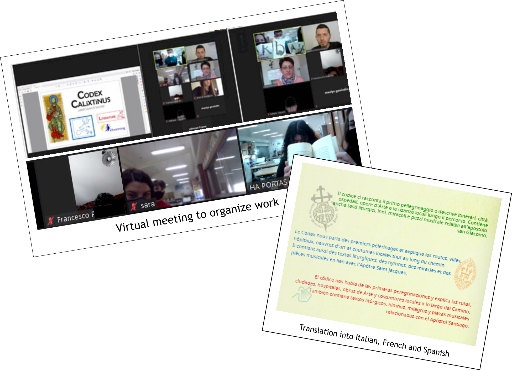
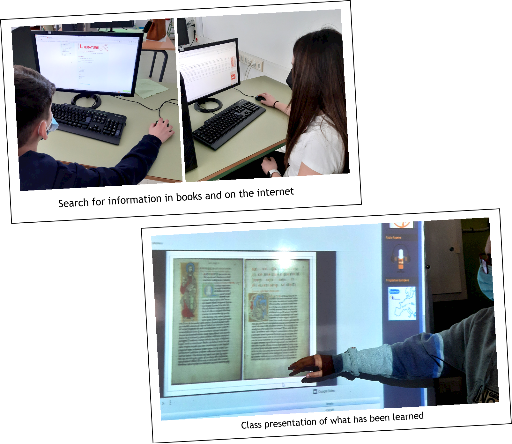
In the 21st century, a team of brave students from these three countries, with the same cosmopolitan spirit and desire for European integration, They have teamed up to investigate the codex and try to get into the shoes of medieval copyists.
His work is collected in this book... We hope you enjoy it!!!
In this e-book we talk about the Codex Calixtinus, a medieval manuscript preserved in the Cathedral of Santiago and which constitutes a guide for pilgrims.
Thanks to our research we also learned how scrolls were illuminated and we built a glossary with the most relevant terms.
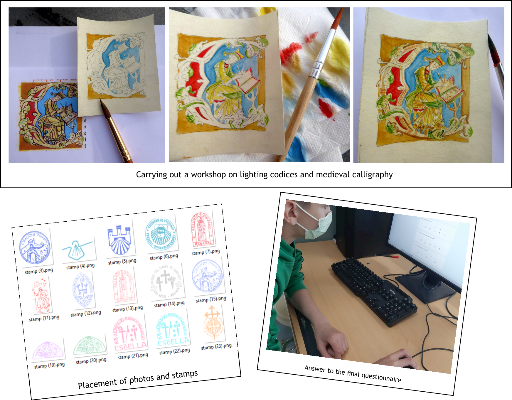
We put some stamps to decorate the book...
These stamps (of the places through which the pilgrim passes), are stamped on the Pilgrim's Credential. They certify that we have traveled the minimum required in any of the Jacobean Routes: 100km on foot or 200km by bike.
The "Compostela" is the final document that certifies that the Way has been completed and that it is collected at the goal.




El Códice Calixtino es un manuscrito iluminado escrito en el s.XII y contiene la más antigua versión del Liber Sancti Iacobi.
Su libro V ("Guía del Peregrino") se considera la primera guía de viajes de Europa.
Le Codex Calixtinus est un manuscrit illustré écrit au 12e siècle qui contient la plus ancienne version du Liber Sancti Jacobi (Le Livre de Saint Jacques)
Son Livre V ("Le Guide du Pèlerin") est considéré comme le premier guide de voyage d'Europe
Il libro di san Giacomo è un manoscritto elaborato nel dodicesimo
secolo e contiene la versione più vecchia del libro di san Giacomo.
Il suo quinto libro (la guida dei pellegrini) è considerato la prima guida di viaggi in Europa.


The Codex Calixtinus is an illuminated manuscript written in the 12th century and It contains the oldest version of the Liber Sancti Iacobi.
His fifth book ("Pilgrim's Guide") is considered the first travel guide in Europe.
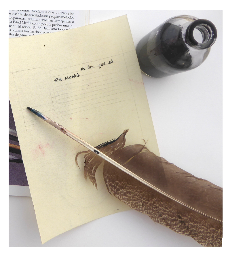
Este libro se guarda en la Catedral de Santiago de Compostela (Galicia/España).
Hay otras versiones en Italia, Inglaterra y Portugal.
Ce livre est gardé dans la Cathédrale de Saint Jacques de Compostelle (Galice/Espagne).
Il y a d'autres versions en Italie, en Angleterre et au Portugal
Questo libro è conservato nella Cattedrale di Santiago di Compostela (in Spagna, Galizia).
Ci sono altre versioni in Italia, Inghilterra e Portogallo

This book is kept in the Cathedral of Santiago de Compostela (Galicia/Spain).
There are other versions in Italy, England and Portugal.
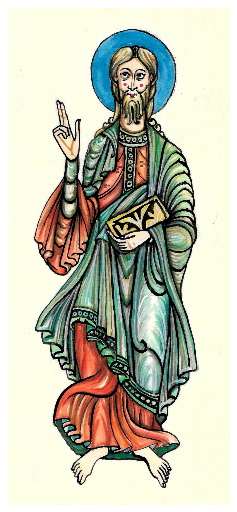
Se cree que fue escrito por un monje francés, Aymeric Picaud, aunque lo más probable es que fuera escrito por varias manos.
On croit qu'il fut écrit par un moine français, Aymeric Picaud, bien qu'il ait probablement
été écrit par plusieurs mains.
Si credeva che fosse stato scritto da un monaco francese, Aymeric Picaud, anche se molto probabilmente è stato scritto
da più mani.

It is believed to have been written by a french monk, Aymeric Picaud, although most likely it was written by several hands.
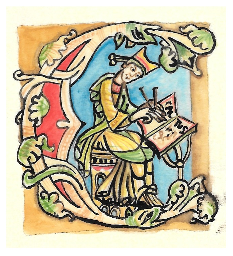
El códice nos habla de las primeras peregrinaciones y explica las rutas, ciudades, hospitales, obras de Arte y costumbres locales a lo largo del Camino.
También contiene textos litúrgicos, himnos, milagros y piezas musicales relacionadas con el Apóstol Santiago.
Le Codex nous parle des premiers pélerinages et explique les routes, villes, hôpitaux, oeuvres d'art et coutumes locales tout au long du chemin.
Il contient aussi des textes liturgiques, des hymnes, des miracles et des pièces musicales en lien avec l'Apôtre Saint Jacques.
Il codice ci racconta il primo pellegrinaggio e descrive itinerari, città, ospedali, opere d’Arte e le usanze locali lungo il percorso. Contiene anche testi liturgici, inni, miracoli e pezzi musicale relativi all’apostolo san Giacomo.


The codex tells us about the first pilgrimages and it explains routes, towns, hospitals, works of Art and the local customs along the Way.
It also contains liturgical texts, hymns, miracles and musical pieces related to the Apostle St. James.
Finalmente, cuando el peregrino alcanza la meta final,
el libro describe la ciudad de Santiago
y su catedral con increíble detalle.
Finalement, quand le pèlerin atteint son but final, le livre décrit la ville de Saint Jacques de Compostelle et sa cathédrale
avec un détail incroyable.
Finalmente, una volta che i pellegrini hanno raggiunto la meta finale, il libro descrive la città di Santiago e la sua cattedrale con dettagli incredibili.

Finally, once the pilgrim has reached the final goal, the book describes the city of Santiago and its cathedral in incredible detail.



PARTS:
Book I compiles the liturgical texts in honor of the Apostle.
Book II collects the most famous miracles of Saint James the Great.
Book III is dedicated to the transfer of the body of Santiago by boat from Jerusalem to Galicia.
Book IV is dedicated to Charlemagne's adventures in Spain and his discovery of the Apostle's tomb.
Book V is the best known and describes the roads to Santiago in France and Spain.
It also has a Musical Appendix, with the first examples of European polyphony. Its authors would be French musicians who worked in the cathedral scriptorium of Santiago.


Scriptorium médiéval :
Les pages du Codex sont en parchemin, c'est à dire, en cuir d'animal hautement poli.
L'écriture se faisait avec une plume et de l'encre, sur des lignes tracées avec une barre de plomb.
Scriptorium medieval:
Las páginas del Códice son de pergamino, es decir, piel de animal altamente pulida.
La escritura se hacía con pluma y tinta, sobre renglones marcados con barras de plomo.
Scrittorio medievale:
Le pagine del Codice sono pergamene, cioè pelle animale altamente levigata. La scrittura è stata fatta con la penna d’oca e inchiostro su linee segnate da barre di piombo.
Medieval Scriptorium:
The pages of the Codex are parchment, that is, highly polished animal skin.
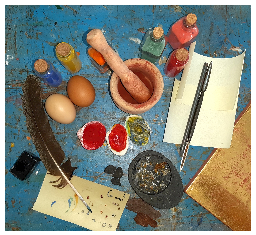
Las ilustraciones se pintaban con temple (una mezcla de pigmento y huevo). También se usaban finas láminas de oro, por lo que a esta parte del trabajo se le llama "iluminar".
Los italianos, creadores de la técnica, prefieren llamarle "miniare", que proviene de minio, un pigmento rojizo muy utilizado en los códices.
Les illustrations se peignaient à la détrempe (un mélange de pigments et d'oeufs). On utilisaient aussi de fines feuilles d'or, c'est pourquoi on appelait cette partie du travail "illuminer".
Les italiens, créateurs de la technique, préfèrent l'appeler "miniare", ce qui provient de minium, un pigment rougeâtre très utilisé dans les codex.
Le illustrazioni sono state dipinte con la tempera (un miscuglio di pigmenti e uova). Sono anche utilizzati sottili fogli d’oro, quindi questa parte dell’opera è chiamata “illuminata”.
Gli italiani, creatori della tecnica, preferiscono chiamarla “miniare”, che deriva da “minium”, un pigmento rossastro ampiamente utilizzato nei codici.

Illustrations were painted with tempera (a mixture of pigment and egg). Thin sheets of gold were also used, hence this part of the work is called "illuminate".
The Italians, creators of the technique, prefer to call it "miniare", which comes from minium, a reddish pigment widely used in codices.
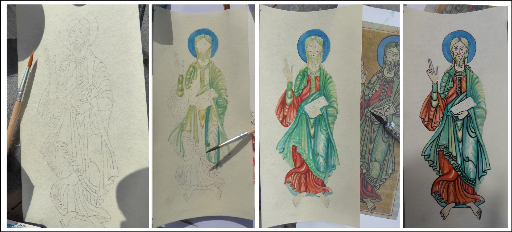
We did our own version of
painted capital letters and
illustrations with tempera...

GLOSSARY
binder - aglutinante - liant - portatore
calligraphers - calígrafos - calligraphe - calligrafi
capital letter - letra capital - lettre capitale - lettera maiuscola
codex/codices - códice/s - codex - codici velina
dyes - tintes - colorants - coloranti
illuminated - iluminado - illuminé - illuminato
ink - tinta - teinte - inchiostro
pigment - pigmento - pigments - colore
quill - pluma - plume - piuma
manuscript - manuscrito - manuscrit - manoscritto
monk - monje - moine - monaco
minium - minio - minium - minio
tempera - temple - détrempe - tempera
vellum/parchment - vitela/pergamino - vélin/parchemin - velina/pergamena

BIBLIOGRAPHY
ANTÚ, Q. All about Calligraphy. Ed. Parramón
A.A.V.V. Santiago's way: an illustrated journey. Ed. Planeta
CENNINI,C. Book of Art. Ed. Argos
DE HAMEL, C. Medieval craftsmen: copyists and illuminators . Ed. Akal
GONZÁLEZ, J. Illustrated guide to the Santiago's Way. Ed. El Patito
MORALEJO, A. Codex Calixtinus. Book V. Ed. Alvarellos
NÚÑEZ, T. The French Way. Ed.Fervenza
VALIÑA, E. Pilgrim's guide to compostela. Ed. Galaxia
WHITSON, A. A Celtic Alphabet. From the Book of Kells and other sources. Appletree Press
WOLF, N. Romanesque Art. Ed. Taschen
www.nationalgeographic.com/expeditions/destinations/europe/land
/spain-walking-el-camino/
www.wikipedia.org



MAKING OF


- < BEGINNING
- END >
-
DOWNLOAD
-
LIKE(1)
-
COMMENT()
-
SHARE
-
BUY THIS BOOK
(from $6.99+) -
BUY THIS BOOK
(from $6.99+) - DOWNLOAD
- LIKE (1)
- COMMENT ()
- SHARE
- Report
-
BUY
-
LIKE(1)
-
COMMENT()
-
SHARE
- Excessive Violence
- Harassment
- Offensive Pictures
- Spelling & Grammar Errors
- Unfinished
- Other Problem





COMMENTS
Click 'X' to report any negative comments. Thanks!