Thanks for the support of my dear family and especially to teacher Dhurata Pashaj, who taught me many new things in this difficult year.

Titan is the largest moon of Saturn and the second-largest natural satellite in the Solar System. It is the only moon known to have a dense atmosphere, and the only known body in space, other than Earth, where clear evidence of stable bodies of surface liquid has been found. Titan is one of seven gravitationally rounded moons in orbit around Saturn, and the second most distant from Saturn of those seven.
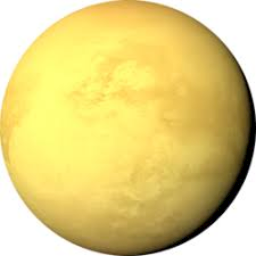
Mars
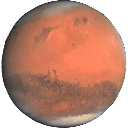
Mars is the fourth planet from the Sun and the second-smallest planet in the Solar System, being larger than only Mercury. In English, Mars carries the name of the Roman god of war and is often referred to as the "Red Planet". The latter refers to the effect of the iron oxide prevalent on Mars's surface, which gives it a reddish appearance distinctive among the astronomical bodies visible to the naked eye.
Jupiter is the fifth planet from the Sun and the largest in the Solar System. It is a gas giant with a mass (more than) two and a half times that of all the other planets in the Solar System combined, but (a little) less than one-thousandth the mass of the Sun. Jupiter is the third-brightest natural object in the Earth's night sky after the Moon and Venus.
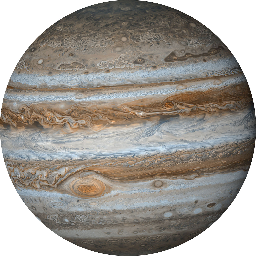
Mercury
Mercury is the smallest planet in the Solar System and the closest to the Sun. Its orbit around the Sun takes 87.97 Earth days, the shortest of all the Sun's planets. Like Venus, Mercury orbits the Sun within Earth's orbit as an inferior planet, and its apparent distance from the Sun as viewed from Earth never exceeds 28°.
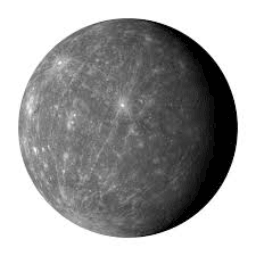
Venus
Venus is the second planet from the Sun. It is named after the Roman goddess of love and beauty. As the brightest natural object in Earth's night sky after the Moon, Venus can cast shadows and can be, on rare occasions, visible to the naked eye in broad daylight. Venus lies within Earth's orbit, and so never appears to venture far from the Sun, either setting in the west just after dusk or rising in the east a little while before dawn.
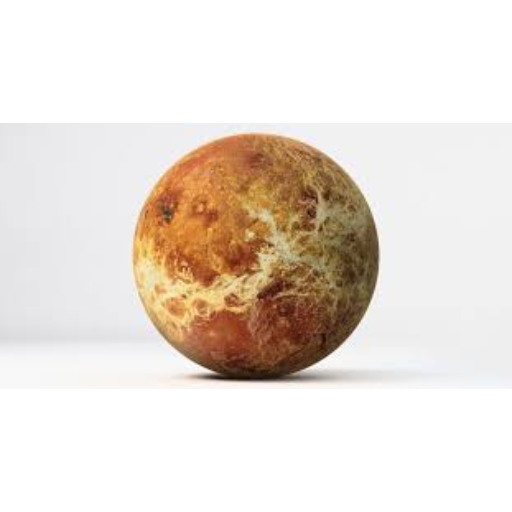
Saturn
Saturn is the sixth planet from the Sun and the second-largest in the Solar System, after Jupiter. It is a gas giant with an average radius of about nine and a half times that of Earth. It only has one-eighth the average density of Earth; however, with its larger volume, Saturn is over 95 times more massive.
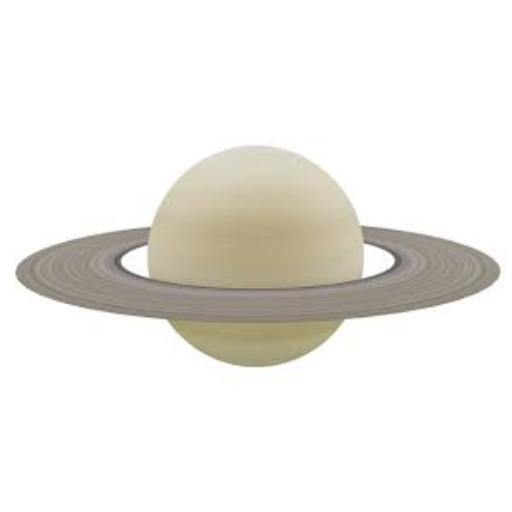
Pluto
Pluto (minor planet designation: 134340 Pluto) is a dwarf planet in the Kuiper belt, a ring of bodies beyond the orbit of Neptune. It was the first and the largest Kuiper belt object to be discovered. Beginning in the 1990s, its status as a planet was questioned following the discovery of several objects of similar size in the Kuiper belt, including the dwarf planet Eris.
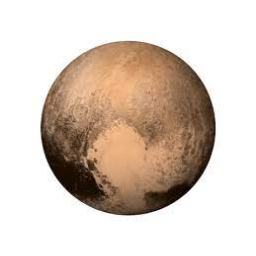
Neptune
Neptune is the eighth and farthest-known Solar planet from the Sun. In the Solar System, it is the fourth-largest planet by diameter, the third-most-massive planet, and the densest giant planet. It is 17 times the mass of Earth, slightly more massive than its near-twin Uranus. Neptune is denser and physically smaller than Uranus because its greater mass causes more gravitational compression of its atmosphere.
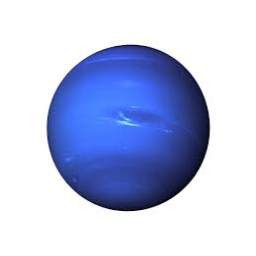
Uranus
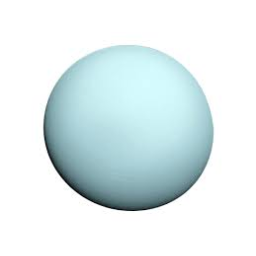
Uranus is the seventh planet from the Sun. Its name is a reference to the Greek god of the sky, Uranus, who, according to Greek mythology, was the great-grandfather of Ares (Mars), grandfather of Zeus (Jupiter) and father of Cronus (Saturn). It has the third-largest planetary radius and fourth-largest planetary mass in the Solar System.
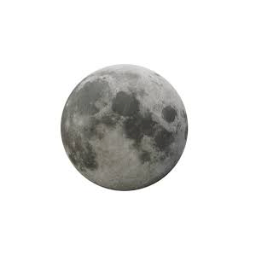
Moon
The Moon is Earth's only natural satellite. At about one-quarter the diameter of Earth (comparable to the width of Australia), it is the largest natural satellite in the Solar System relative to the size of its planet, the fifth largest satellite in the Solar System overall, and is larger than any dwarf planet. Orbiting Earth at an average distance of 384,400 km (238,900 mi), or about 30 times Earth's diameter, its gravitational influence slightly lengthens Earth's day and is the main driver of Earth's tides.
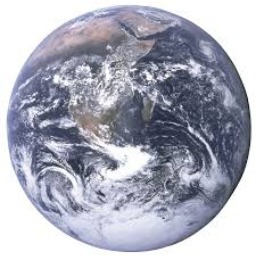
Earth
Earth is the third planet from the Sun and the only astronomical object known to harbor life. About 29.2% of Earth's surface is land consisting of continents and islands. The remaining 70.8% is covered with water, mostly by oceans, seas, gulfs, and other salt-water bodies, but also by lakes, rivers, and other freshwater, which together constitute the hydrosphere.
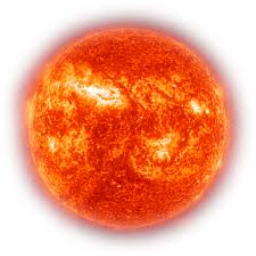
Sun
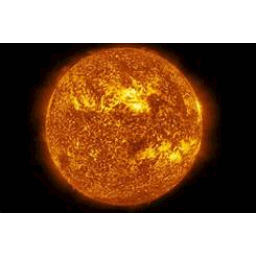
The Sun is the star at the center of the Solar System. It is a nearly perfect sphere of hot plasma, heated to incandescence by nuclear fusion reactions in its core, radiating the energy mainly as visible light and infrared radiation. It is by far the most important source of energy for life on Earth.
Milky Way
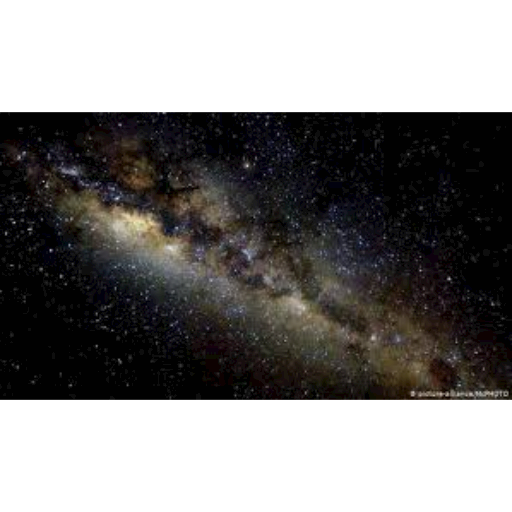
The Milky Way is the galaxy that contains our Solar System, with the name describing the galaxy's appearance from Earth: a hazy band of light seen in the night sky formed from stars that cannot be individually distinguished by the naked eye.
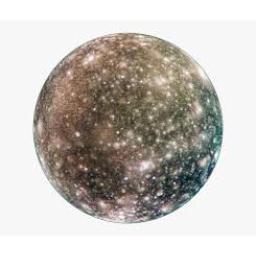
Io or Jupiter is the innermost and third-largest of the four Galilean moons of the planet Jupiter. Slightly larger than the Moon, Io is the fourth-largest moon in the Solar System, has the highest density of all of them, and has the lowest amount of water (by atomic ratio) of any known astronomical object in the Solar System. It was discovered in 1610 by Galileo Galilei and was named after the mythological character Io, a priestess of Hera who became one of Zeus's lovers.
Phobos
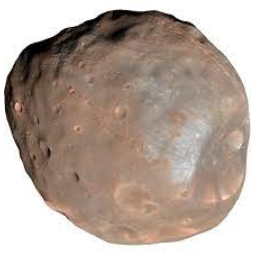
Phobos is the innermost and larger of the two natural satellites of Mars, the other being Deimos. Both moons were discovered in 1877 by American astronomer Asaph Hall. Phobos is named after the Greek god Phobos, a son of Ares (Mars) and Aphrodite (Venus) and twin brother of Deimos.
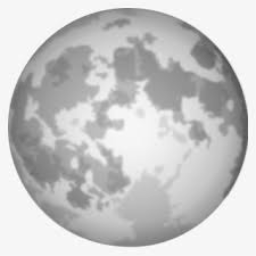
Triton is the largest natural satellite of the planet Neptune, and the first Neptunian moon to be discovered. The discovery was made on October 10, 1846, by English astronomer William Lassell. It is the only large moon in the Solar System with a retrograde orbit, an orbit in the direction opposite to its planet's rotation. At 2,710 kilometres (1,680 mi) in diameter, it is the seventh-largest moon in the Solar System.
Triton
Asteroid
An asteroid is a minor planet of the inner Solar System. Historically, these terms have been applied to any astronomical object orbiting the Sun that did not resolve into a disc in a telescope and was not observed to have characteristics of an active comet such as a tail.
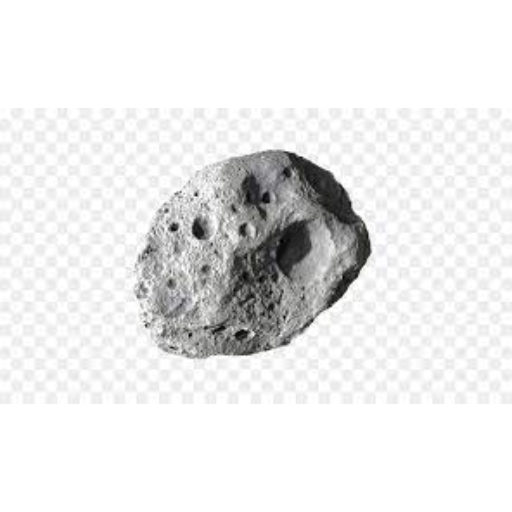
Ganymede is the largest and most massive of the Solar System's moons. The ninth-largest object in the Solar System, it is the largest without a substantial atmosphere. It has a diameter of 5,268 km (3,273 mi), making it 26% larger than the planet Mercury by volume, although it is only 45% as massive. Possessing a metallic core, it has the lowest moment of inertia factor of any solid body in the Solar System and is the only moon known to have a magnetic field.
Tethyns
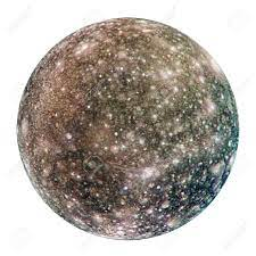
Tethyns or Saturn III, is a mid-sized moon of Saturn about 1,060 km (660 mi) across. It was discovered by G. D. Cassini in 1684 and is named after the titan Tethys of Greek mythology.Tethys has a low density of 0.98 g/cm, the lowest of all the major moons in the Solar System, indicating that it is made of water ice with just a small fraction of rock.
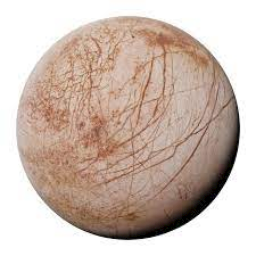
Europa
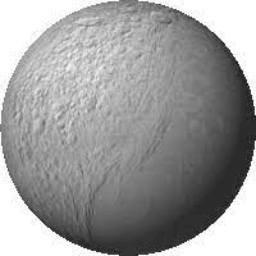
Europa or Jupiter II, is the smallest of the four Galilean moons orbiting Jupiter, and the sixth-closest to the planet of all the 79 known moons of Jupiter. It is also the sixth-largest moon in the Solar System. Europa was discovered in 1610 by Galileo Galilei and was named after Europa, the Phoenician mother of King Minos of Crete and lover of Zeus (the Greek equivalent of the Roman god Jupiter).
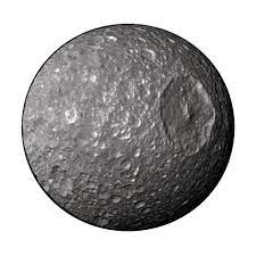
Mimas
Mimas also designated Saturn I, is a moon of Saturn which was discovered in 1789 by William Herschel. It is named after Mimas, a son of Gaia in Greek mythology.
With a diameter of 396 kilometres (246 mi), it is the smallest astronomical body that is known to still be rounded in shape because of self-gravitation. However, Mimas is not actually in hydrostatic equilibrium for its current rotation.
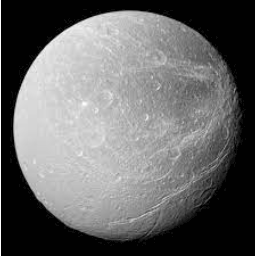
Dione is a moon of Saturn. It was discovered by Italian astronomer Giovanni Domenico Cassini in 1684. It is named after the Titaness Dione of Greek mythology. It is also designated Saturn IV.
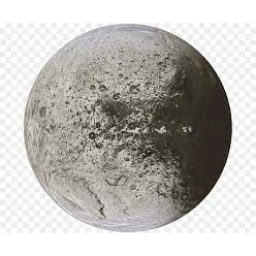
Iapetus
Iapetus is the third-largest natural satellite of Saturn, eleventh-largest in the Solar System, and the largest body in the Solar System known not to be in hydrostatic equilibrium. Discoveries by the Cassini mission in 2007 revealed several unusual features, such as a massive equatorial ridge running three-quarters of the way around the moon.
Vesta
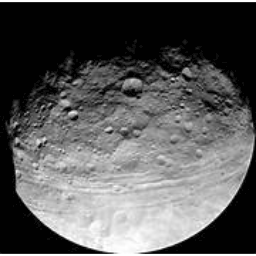
Vesta is thought to be the second-largest asteroid, both by mass and by volume, after the dwarf planet Ceres, though in volume it overlaps with the uncertainty in the measurements of 2 Pallas. Measurements give it a nominal volume only slightly larger than that of Pallas (about 5% greater, which is the magnitude of the uncertainties in measurement), but it is 25% to 30% more massive. It constitutes an estimated 9% of the mass of the asteroid belt.
Arcturus
Arcturus, designation is the brightest star in the constellation of Boötes, the fourth-brightest in the night sky, and the brightest in the northern celestial hemisphere. Together with Spica and Denebola (or Regulus, depending on the source), Arcturus is part of the Spring Triangle asterism and, by extension, also of the Great Diamond along with the star Cor Caroli. When viewed from Earth, it appears to be positioned almost at the north galactic pole of the Milky Way.
- Full access to our public library
- Save favorite books
- Interact with authors
- < BEGINNING
- END >
-
DOWNLOAD
-
LIKE(3)
-
COMMENT()
-
SHARE
-
SAVE
-
BUY THIS BOOK
(from $8.39+) -
BUY THIS BOOK
(from $8.39+) - DOWNLOAD
- LIKE (3)
- COMMENT ()
- SHARE
- SAVE
- Report
-
BUY
-
LIKE(3)
-
COMMENT()
-
SHARE
- Excessive Violence
- Harassment
- Offensive Pictures
- Spelling & Grammar Errors
- Unfinished
- Other Problem






COMMENTS
Click 'X' to report any negative comments. Thanks!