Objectives
Apply the revised content in relation to reading and study techniques and to develop critical thinking.
Identify reading, study and critical thinking techniques that allow students to improve their teaching-learning process

THINKING STATEGIES IN THE EFL CLASSROOM
DO A FILM OR BOOK REVIEW
Do a film or book review is a good activity for students because they enjoy while they are watching or reading their favorite movies, books, or TV shows. After learners have finished a book or film or show, have them discuss questions like these:


Was there a message or moral to this story?
How can this be applied in daily life?
Did the story engage my emotions?
How did it leave me feeling?
This activity supports metacognitive skills by asking what prior knowledge led to its conclusion.
FIND SOMEONE WHO
This activity involves learners by asking them to try to find someone in the class who matches a description or knows certain information.
It can be used:
-To learn vocabulary
-To activate background knowledge
-To review concepts

These activities create intentional opportunities for students to express themselves and get to know each other better, which is an important


KEEP IT REAL
In this strategy students are exposed to real life situations. It focuses on challenging students to identify and cooperatively solve a real problem in their schools or communities. Students can research how culture, religion, and traditions have shaped their community and perhaps their lives as well, and based on this, it is encouraged the learning process of the language and making decisions in their lives (Grafwallner, 2017).


The following is the process to apply this strategy:
1. Teacher provides the necessary resources and establishes a time limit for the activity.
2. Form working groups.
3. Provide a real problem to be solved.
4. Students must analyze the problem.
5. They make a brainstorming.
6. They choose the appropriate solution.
7. They represent the solution for the whole class

JIGSAW STRATEGY
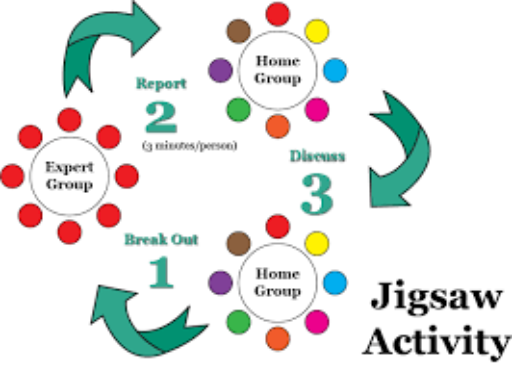
Jigsaw is a cooperative learning technique that is used in the learning of any subject, and specifically brings good results in learning English as a foreign language. It consists of an instructional cycle of activities, they include reading, grouping, regrouping, expert group discussion, team reporting, testing, and finally team recognition (Namaziandostet, Gilakjani, and Hidayatullah, 2020).

In this technique students take active roles during the lesson. They feel more confident in contributing ideas and arguments that will be useful to create an environment for discussion and analysis. The teacher must monitor the entire process of the activity and provide help in solving doubts and guiding the process.

is for

SKETCH AND SPEAK
An Expository Intervention Using Note-Taking and Critical thinking. Sketch and Speak strategy is used to improve student performance in expository reporting and gives direction for strengthening Critical Thinking (Ukrainetz, 2018).

FISHBOWL
Yustiati et al., (2015) point out that fishbowl is a teaching strategy that helps students practice being contributors and listeners in a discussion. Students ask questions, present opinions, and share information when they sit in the “fishbowl” circle, while students on the outside of the circle listen carefully to the ideas presented and pay attention to the process. Then the roles reverse.

1. The teacher identifies a focus for class discussion in order to students more interest and enjoy in the learning and teaching process.
2. Ask students to turn to a neighbor and talk about their ideas and opinions related to the issue. Tell students to take notes on their discussion.
3. Demonstrate the format and expectations of fishbowl discussion.
4. Get the discussion started by telling the discussants sitting in a cluster to talk among themselves about the ideas and opinions they raised when conversing with a partner.
K-W-L CHART
Step 1
Choose a general topic and create a table with three columns. Label the first column with a K for “What I Know,” the second with a W for “What I Want to know,” and the third with an L for “What I Learned” or a variation of this.
Step 2
As a class group to brainstorm what students already know about a specific subject topic. Write these ideas under the K column.

Step 3
Now have students generate a list of what else they want to learn or questions they want answered. Students can also turn textbook headings and subheadings into questions for the W column. Students now read (or listen) the text and actively look for answers to their questions as well as to verify their knowledge.
Step 4
After reading with the purpose, they discuss and record what they learned in the L column, especially paying attention to W questions that were answered from the text or activity.


THE SOCRATIC SEMINAR
The Socratic seminar is a strategy that engages students in a kind of structured discussion, and in order to carry out the activity it is necessary to assign each student a specific task (NSW, 2020).

1. Arrange the students in two circles, one inside and one outside.
2. Make sure all students have resources that allow them to take notes.
3. Pose a question/topic to the class.
4.Inner circle of students discusses the question/topic. They can only address each other, not the teacher. The teacher only intervenes if it is necessary to redirect the discussion.
5.The outer circle listens to the discussion and takes notes, focusing on points they would like to expand on/questions they have.
6.When the comments begin to slow down, ask the inner circle to end their discussion.
7.At the end of the discussion, the outer circle uses their notes to comment on the discussion. Members of the outer circle offer comments or raise more questions.
8.At the end, repeat steps 4 and 5 creating new discussions.

GAP FILL IN
Gap-filling tasks is a strategy that requires the test taker to fill in gaps in the text with a word that the test developer has eliminated. The examiner must complete the text by selecting a word from a series of choices provided for each gap. This gap-filling format is known as a multiple-choice form


1. Read the text carefully before and after.
2.The words are usually in a box.
3. Be careful with spelling and words that are not part of the text.
4. Start with the words you know and mark them so you know which ones you have used.


5. If you write a word in the wrong hole, it is possible that another word in the exercise is also wrong.
6.When you finish, read the whole text to see how it sounds.
7.By creating a text-level representation forming a text-based structure and being able to create an intertextual representation.

THINK PAIR SHARE
The think-pair-share activity has several advantages, including engaging all students in the classroom (giving voice to shy students who have difficulty sharing in public), providing quick feedback to the teacher (e.g., revealing student misconceptions), and encouraging and supporting students' higher levels of thinking (Gupta, 2016)

SILENT SHARING

Silent paper is also known as big paper. This teaching strategy use writing and nonverbal communication to interact or share information. It allows students explore a topic in depth, exchange ideas and extend their thinking. In this collaborative strategy, students write some ideas about a specific topic helping to develop some cognitive skills (Warstillo, 2021).

THE FIVE W’S

This strategy allows to students, writers, and researches to understand the full scope of the topic being discussed. In academic context, students could use this strategic to guide a graphic organizer or even to make academic projects (Lynch, 2021).
ROLE -PLAY

A role play is defined as the projection in real life situations with social activities (Xu, 2011).
In the role play, students represent different roles of different real-life problems that they will have to find a solution for the problem selected.
This strategy helps students to improve their participation in the classroom, communication, as well as their critical thinking skills.
Reading Strategies
READING STRATEGIES


Note-Taking
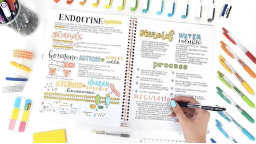
Note-taking is the practice of writing information systematically since by taking notes, we combine reading and listening with selecting, summarizing, and writing
Ways of Note-taking
Linear, or moving from one section to the next on the page in a logical way, using headings and subheadings.
Diagrammatic, using boxes and flowcharts to help you move around the page; and
Patterns, such as mind maps, which allow a large amount of information to be included in a single page but rely on you to remember the underlying information.
How to apply
Record publication details: Always note publication details of any text you may use. Specifically, record such things as the title, author, date, publisher, place of publication, URL, and page numbers.
Preview the text before you take notes: Scan, skim, and ‘surface read’ the text before noting to help you develop an understanding of the text and awareness of what is important to note.
Choose how you will save your notes: Where to record your notes is up to you. Some people prefer using a computer, while others use flash cards, folders, or exercise books. What is important is that you will be able to find the notes and understand their layout and content a few weeks or months later.
Paraphrase and summarize ideas: Read the key points in your own words out loud and then write them down. Finish by checking if your paraphrase is clear and accurate.
Note your thoughts: Don’t forget the great value of noting beyond just what is said in the text. Note down such things as your ideas, points you agree or disagree with, relevant experiences, questions, examples, and relationships with other texts.
Be creative: Consider how you should note different parts of texts as well as just what you should note. Depending on the nature of the information you wish to note, you may choose to use diagrams, concept maps, titles, columns, dot points, numbers, symbols, colors, pictures, or columns for your reflections.
Review your notes: Once you have completed some notes, always look back at them and check: they are accurate, they are readable, you will be able to use them later and they contain full reference details (Davies, Beaumont & Palgrave, 2007).

INFERRING MEANING FROM CONTEXT
When you encounter an unfamiliar word, a good strategy is to guess the meaning from the context (how the word is used). You might not guess the exact meaning, but enough to continue reading with understanding.
Unfamiliar Word
They are words that the reader does not know, therefore readers will not comprehend or understand the meaning of the reading.
Inferring meaning from the context is usually known as “reading between the lines “. When you use all the information that you have available at a time to guess what is “behind” the literal information of a text. People must pay attention to certain “clues”.

Benefits of inferring
-It allows you to continue reading
-It helps you better understand vocabulary
-It helps you remember the word in the future

COHESIVE DEVICE STRATEGY
Cohesive devices, also known as cohesive ties, are considered a reading strategy in which words or phrases are used to connect ideas between different parts of a text. Cohesive devices help to improve reading comprehension by allowing readers to integrate information between sentences. The pronoun, synonym, or transition word is linked to a previous word, phrase, or clause (the antecedent). It is helpful for teachers to draw attention to this strategy, especially for students who have difficulty understanding a series of sentences that include cohesive links (Sedita, 2020).

SKIMMING

According to Liao (2011), skimming is done at a speed three to four times faster than normal reading. In other words, it is a fast-reading technique used to obtain the main ideas or the gist of a text (Brown, 2003).
How to apply
Three steps (Abdelrahman & Bsharah, 2014):
-Read the first sentence of paragraph
-Read the last sentence of pararaph
-Ready keywords

SCANNING
According to Diaz & Laguado (2013) these are the steps you must follow to scan:
State the specific information you are looking for.
Try to anticipate how the answer will appear and what clues you might use to help you locate the answer.
Use headings and any other aids that will help you identify which sections might contain the information you are looking for.
Selectively read and skip through sections of the passage.

Study Strategies
- Full access to our public library
- Save favorite books
- Interact with authors
- < BEGINNING
- END >
-
DOWNLOAD
-
LIKE(2)
-
COMMENT()
-
SHARE
-
SAVE
-
BUY THIS BOOK
(from $12.39+) -
BUY THIS BOOK
(from $12.39+) - DOWNLOAD
- LIKE (2)
- COMMENT ()
- SHARE
- SAVE
- Report
-
BUY
-
LIKE(2)
-
COMMENT()
-
SHARE
- Excessive Violence
- Harassment
- Offensive Pictures
- Spelling & Grammar Errors
- Unfinished
- Other Problem





COMMENTS
Click 'X' to report any negative comments. Thanks!