
Table of Contents
Causes of WW2 ------------------------------------- 4
Leaders of WW2 ---------------------------------- 10
Weapons and Technology -------------------- 17
Strategies/Battles -------------------------------- 19
Propaganda ---------------------------------------- 22
Genocide -------------------------------------------- 29
Impacts of WW2 ---------------------------------- 40
Causes of WW2
Failure of the Treaty of Versailles
Failures of the Treaty of Versailles: The Treaty of Versailles was an attempt to bring peace back to Europe, and it utterly failed. One of the reasons it did so was because it was not tough enough on Germany. Germany, which was ruled by Hitler at the time, didn’t abide by the treaty, and made rules of their own.
Totalitarianism
Totalitarianism, widely known by its Italian name (fascism) is when the government attempts to take total control over their citizens and does not permit individual freedom. Under totalitarian rule, traditional social institutions and organizations are discouraged and suppressed, thus weakening the social fabric.
Fascism
However, in the 1920s, the wave of the future appeared to be a form of nationalistic, militaristic totalitarianism known as fascism in Italy. It promised to better serve people's needs than democracy and positioned itself as the only sure defense against communism. During the interwar period, Benito Mussolini established the first Fascist, European dictatorship in Italy in 1922.
Policy of Appeasement
Appeasement is a foreign policy that seeks to pacify an aggrieved country through negotiation in order to avoid war. The prime example is Britain's 1930s policy toward Fascist Italy and Nazi Germany. Appeasement was the name given to Britain's policy of allowing Hitler to expand German territory unchecked in the 1930s in the hope of avoiding war. It is most closely associated with British Prime Minister Neville Chamberlain, but it is now widely regarded as a weak policy.
Failure of League of Nations
Decisions had to be made with unanimous consent. The League's ability to act was hampered by unanimity. The League suffered greatly from the absence of major powers — Germany, Japan, and Italy eventually left — as well as the absence of US participation.
Leaders of WW2
Hitler
Adolf Hitler was Germany's chancellor from 1933 to 1945, serving as dictator and leader of the Nazi Party, or National Socialist German Workers Party, for the majority of his reign. Hitler's fascist policies precipitated World War II and resulted in the Holocaust, a genocide that killed six million Jews and another five million noncombatants.
Stalin
After the death of Vladimir Lenin, Joseph Stalin rose to power as General Secretary of the Communist Party of Russia, becoming a Soviet dictator. Stalin compelled rapid industrialization and the collectivization of agricultural land, resulting in millions of deaths from famine and the internment of others. During World War II, his Red Army aided in the defeat of Nazi Germany.
Mussolini
Amilcare, Benito Andrea Mussolini, nicknamed "Il Duce" ("the Leader"), was an Italian dictator who founded the Fascist Party in 1919 and eventually held total power in Italy as prime minister from 1922 to 1943. As a young man, Mussolini was an ardent socialist who followed in his father's political footsteps but was expelled from the party for his support of World War I. During World War II, as dictator, he overextended his forces and was eventually assassinated by his own people in Mezzegra, Italy.
Churchill
Sir Winston Leonard Spencer-Churchill was a British politician, military officer, and author who was Prime Minister of the United Kingdom from 1940 to 1945 and again from 1951 to 1955. After becoming Prime Minister in 1940, Churchill helped lead a successful Allied strategy to defeat the Axis powers and forge postwar peace with the United States and the Soviet Union during World War II.
Tojo
Soldier and statesman who served as Prime Minister of Japan (1941–44) for the majority of World War II's Pacific theater and was later tried and executed for war crimes.
FDR
Franklin Delano Roosevelt was the 32nd President of the United States. FDR, as he was commonly referred to, led the United States through the Great Depression and World War II, greatly expanding the federal government's powers through a series of programs and reforms known as the New Deal.
Weapons and Technology
Enigma Machine
Prior to and during World War II, the German military command used it to encrypt strategic messages. Poles, led by mathematician Marian Rejewski, broke the Enigma code for the first time in the early 1930s. With the threat of a German invasion growing, the Poles handed over their information to the British, who established a secret code-breaking group known as Ultra, led by mathematician Alan M. Turing. Ultra also contributed to Allied victories in the Pacific because the Germans shared their encryption device with the Japanese. Also see Cryptology: Evolution During World Wars I and II.
Strategy and Battles
European Theater of War: Blitzkrieg
Blitzkrieg is a term used to describe a type of offensive warfare in which mobile, maneuverable forces, such as armored tanks and air support, are used to strike a quick, focused blow at an enemy. Such an attack should ideally result in a quick victory while minimizing the loss of soldiers and artillery. Blitzkrieg is most famous for describing Nazi Germany's successful tactics in the early years of World War II, when German forces swept through Poland, Norway, Belgium, Holland, and France with astonishing speed and force.
Pacific Theater of War: Island Hopping
To defeat Japan, the United States devised a strategy known as "Island Hopping." The United States hoped to gain military bases and secure as many small Pacific islands as possible through this measure. The "Island Hopping" plan would last three years and would take the United States military almost completely around the Pacific Islands. The United States defeated a large Japanese force in the Battle of Midway, which took place in early June 1942. This battle is regarded as a watershed moment in the history of the US-Japanese conflict at the time, as the Navy was able to inflict massive damage on Japanese fleets.
Propaganda
Why/How Important
In a democracy, the Nazis used propaganda effectively to gain the support of millions of Germans, and later in a dictatorship, to facilitate persecution, war, and, eventually, genocide. The stereotypes and images found in Nazi propaganda were not new, but they were well known to their intended audience.
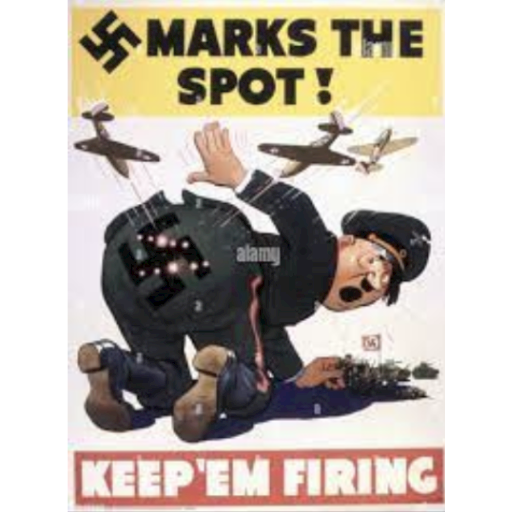
Poster
The focus of this online exhibit is posters, which are based on a larger exhibit that was presented in the National Archives Building in Washington, DC, from May 1994 to February 1995. It investigates persuasion strategies as seen in the form and content of World War II posters.
Painting
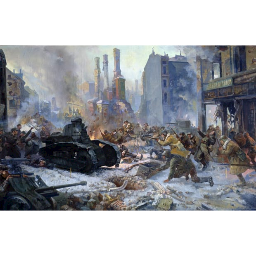
Following the German invasion of the Soviet Union, Nazi propaganda emphasized themes linking Soviet Communism to European Jewry to both civilians at home and soldiers, police officers, and non-German auxiliaries serving in occupied territory by painting an apocalyptic picture of what would happen if the Soviets won the war.
Newspapers
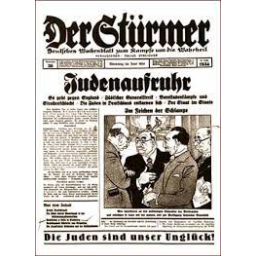
Newspapers in Germany, particularly Der Stürmer (The Attacker), published cartoons depicting Jews with antisemitic caricatures. After the Germans invaded Poland in September 1939, the Nazi regime used propaganda to convince German civilians and soldiers that Jews were not only subhuman, but also dangerous enemies of the German Reich.
Movies
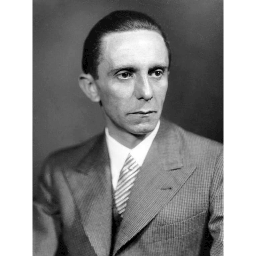
For Germany, it was Joseph Goebbels who came up with this brilliant idea. Goebbels' task was to create propaganda, so he combined his love of film with propaganda to create films that blew people's minds and, some might say, "brain washed" the Germans. He believed that movies and newsreels would be the most effective means of reaching Germany's general public.
Radio Messages
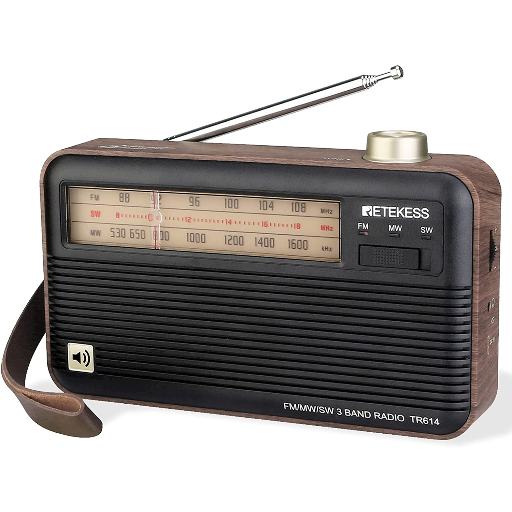
Radio was the most affordable form of entertainment and the most popular medium during World War II. Because of its ease of access and availability, it fueled propaganda and could reach a large number of citizens. Radio provided entertainment and information to the public, encouraging citizens to participate in the war effort.
Genocide
Nuremberg Racial Laws
The Nuremburg Laws of 1935 denied Jews German citizenship, prohibited Jews from marrying non-Jews, and stripped them of most political rights. Jews were made scapegoats for everything bad that had happened to Germany in the preceding decades, including inflation, economic depression, World War I defeat, and the punitive Treaty of Versailles.
Jewish Population
When Hitler began his march of conquest in 1939, Jews in fascist-ruled countries, beginning with heavily Jewish Poland, were herded into filthy ghettos, walled-off sections of the city where they were denied proper food, medical care, and heat. Hundreds of thousands of Jews died as a result of starvation and disease in Warsaw and Lodz, two of Poland's largest ghettos. Many Jews fled the ghetto and went into hiding, often relying on the kindness and bravery of non-Jewish companions.
ghettos
There were valiant attempts to resist the Holocaust. The Nazis were surprised by a number of armed uprisings in the ghettos and camps, but they were all crushed with fanatical brutality. Some Jews escaped from ghettos to join partisan movements fighting the Nazis from forest enclaves. Acts of defiance, large or small, were suppressed within the ghettos and killing camps, and brave dissidents were brutally punished.
Warsaw
The inhabitants of the Warsaw Ghetto rose up in armed revolt, fed up with deportations, disease, and constant hunger. The Warsaw Ghetto Uprising, which lasted from April 19 to May 16, 1943, resulted in the deaths of 7,000 Jews and the deportation of 50,000 survivors to extermination camps. However, the resistance fighters had held off the Nazis for nearly a month, and their revolt sparked revolts in camps and ghettos throughout German-occupied Europe.
Concentration Camps
After years of Nazi rule in Germany, during which Jews were consistently persecuted, Hitler's "final solution"—now known as the Holocaust—came to fruition under the guise of World War II, with mass killing centers built in occupied Poland's concentration camps. The Holocaust killed approximately six million Jews and approximately five million others who were targeted for racial, political, ideological, and behavioral reasons. More than a million of those killed were children.
- Full access to our public library
- Save favorite books
- Interact with authors
- < BEGINNING
- END >
-
DOWNLOAD
-
LIKE(1)
-
COMMENT()
-
SHARE
-
SAVE
-
BUY THIS BOOK
(from $10.39+) -
BUY THIS BOOK
(from $10.39+) - DOWNLOAD
- LIKE (1)
- COMMENT ()
- SHARE
- SAVE
- Report
-
BUY
-
LIKE(1)
-
COMMENT()
-
SHARE
- Excessive Violence
- Harassment
- Offensive Pictures
- Spelling & Grammar Errors
- Unfinished
- Other Problem






COMMENTS
Click 'X' to report any negative comments. Thanks!