
This book was created and published on StoryJumper™
©2010 StoryJumper, Inc. All rights reserved.
Publish your own children's book:
www.storyjumper.com

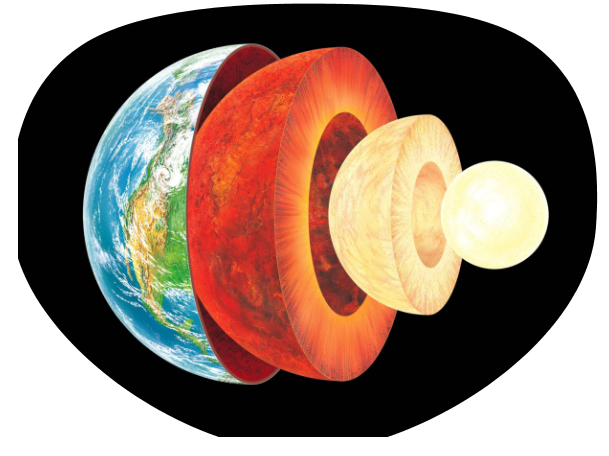
The Earth is made up of 8 layers which include the
core, crust, mantle, lithosphere, asthenosphere,
mesosphere, inner core, and outer core. While
going to the center of the Earth we traveled
through these layers and saw and experienced
many things throughout the journey through these
layers.
When the journey started we entered though Earths
crust which is the thinnest of all of the layers. When
we first entered this layer there was just rock and
stone but as we got about 25 miles down because
that's about the depth of the crust, we noticed that
things started to get hot. Temperatures reached up to
1600 degrees Fahrenheit and also we noticed that the
material which consisted of mostly granite rocks was
becoming more dense. The crust is the least dense of
all of the layers because it consists mostly of granite
rock. Since the crust is different lengths under the
oceans and continents since we were under a
continent the pressure was 2.7 g/cm^3, if we were to
be under the ocean it would be 3.0 g/cm^3.

After leaving the crust we entered the
lithosphere which is the next thinnest layer
from the crust and is the upper most solid
mantle. This layer was starting to get hot at
1,000 degrees Celsius. It was getting more
dense with ranges around 3.4 to 4.4 g/cc. The
lithosphere was a hard layer to travel through
because it was very rocky and hot, this is
where the rocks cycle through. The pressure is
quite similar to the crust but a little higher due
to its depth.



After leaving the Lithosphere we definitely started
noticing changes. Now the layers started to get thicker
and the one we were in now was the asthenosphere.
The asthenosphere consisted of rock but started to get
more vicious towards the end of it. It was 50 to 124
miles thick and temperatures reached up to 1300
degrees Celsius. The density of the asthenosphere was
4.4 to 5.6 g/cc which definitely a change from the
lithosphere. The pressure is high in this layer so
combined with the temperature rock starts to melt.
Mostly this layer consisted of partially molten rock and
tar.


The next layer was the upper mantle which
consisted of molten rock. This layer was also
starting to show more thickness than the other
layers so far. It was very hot and the
temperatures were at 1,652 degrees
Fahrenheit at the upper mantle near the crust.
This layer consisted mostly of a silicate rocky
shell that is a plastic consistency. The density
of this layer was 3.3 g/cm3 which increases
with depth of the mantle. The pressure also
has a big change in this layer and is very high
as it goes deeper.



You've previewed 11 of 17 pages.
To read more:
Click Sign Up (Free)- Full access to our public library
- Save favorite books
- Interact with authors


- < BEGINNING
- END >
-
DOWNLOAD
-
LIKE(3)
-
COMMENT()
-
SHARE
-
SAVE
-
BUY THIS BOOK
(from $3.39+) -
BUY THIS BOOK
(from $3.39+) - DOWNLOAD
- LIKE (3)
- COMMENT ()
- SHARE
- SAVE
- Report
-
BUY
-
LIKE(3)
-
COMMENT()
-
SHARE
- Excessive Violence
- Harassment
- Offensive Pictures
- Spelling & Grammar Errors
- Unfinished
- Other Problem





COMMENTS
Click 'X' to report any negative comments. Thanks!