
This book was created and published on StoryJumper™
©2014 StoryJumper, Inc. All rights reserved.
Publish your own children's book:
www.storyjumper.com



 Oh my, this is too much work to do.
 Ahoy there, matey! What seems to be the problem?

 Aarg! Me teacher gave me work! I don't
understand it, like this symbol here!√
 Not a problem, I can help you. Show
 me a problem you don't understand.


 This one says to simplify it.
 This be a easy one.
Watch carefully now.
√(189)
3
First, we must see if there's any
perfect cubes it"s divisible by. You
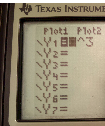
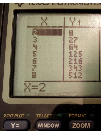
can make a list by typing "x^3" in
your calculator in the y= section
then do "2nd graph" to pull up a
list like this:

Now then, let's try 27.
√(27)* √(7)
3
3
189/27 = 7
it works

√(27)* √(7)
3 √7
3
3
3
The perfect cube of 27 is 3 and
since √(7) has no perfect cube, it
remains in the radicand.
Therefore it simplifies as: 3
√7.
3

 This be most helpful. May I ask you for some more assistance?
I don't know how you divide or add these "radicals"(√).
 Why of course me'hartey! This is a bit more
 complicated, but I think the we can manage.

It's actually a very simple rule we must follow. We can only
divide/multiply things in the same place. For example.
2√ * 3√
6√ is the
answer we get.
Now, we must
reduce this.
12
In this situation, we can only multiply
by what's inside the radicand and what's
outside:
Outside: 2*3 = 6
Inside: 3*12 = 36
36
36/4 = 9
6 * √ * √ = 36 final answer
4
9
The rule that we must only div./mult.
numbers in the same place applies to
division as well
Only mult./div.:
Inside * Inside/Outside * Outside

3


 Now I have to be going now. I have to go get me booty!!!!
  Wait! I have one more question to ask.
 Don't you have a math teacher?


 Mrs. Betts, can you help me with my homework?
It's about adding and subtracting roots and radicals.


 Sure why not. Let's
 start, shall we?

Adding and subtracting
radicals is a like regular
addition and
subtraction.


The first thing to
do is to make sure
that what you are
adding or
subtracting have
like terms.

Make sure they
have the same
radical. Next, you
add or subtract the
coefficients, not
the radicals.

Finally reduce your
answer and you're
done! Here's an
example:
Adding
1) √7 +4√7
=
1√7+4√7
= 5√7
2)√36+√64
= 6+8
=14
The first problem has
like terms, making it
easier to add. The
second problem has
two perfect squares, 36
and 64.
Subtracting
1) 6√8-2√8-√44
=4√8-2√11
=-2√11+8√2
2) 2√20 -4√5-4√20
=-4√5 -4√5
=-8√5
Like the addition
examples, these problems
also have like terms,
making subtracting easier
as well.
Multiplying Binomials
When you multiply binomials with a radical, it
is the same as if you were multiplying without
it.
Example: (-3-5√3)(-1+√3)
-3-5√3
-1+√3 *
_________
-3√3-5√3
-3√3-5√9
_________
-12-8√3




Rational exponents



Rational exponents are another way to right a radical
expression but just look like a fraction in the
exponent's place
_
25
1
2
In this example, I will show you how to read
this problem and how to put it into radical
form.
Now some basic rules for these types of
problems are simple.
Numerator=the number's power
Denominator=index
integer= what's in the Radicand
so with these rules you would write it like this:
Now this is technically correct, but math
notation dictates we don't need the index of
2 or the power of 1 to show. so your real
answer is
25
√
2
1
√
25
Now the other way around:
√
5
24
2
So all we need to find is the index and see if the
radicand goes any certain power as well as what the
radicand is.
index=5
power=2
radicand=24
When we put this all together we get:
2
24
_
5
and this is the correct answer.
Another way to write this would be 24
Don't be caught off guard when you come
across this as it's just a fraction in its
decimal form.

.4

Keep in mind these rational exponents are
still well.. EXPONENTS so the same rules/
laws apply to them
ex)
9 9 = 9 + 9 = 9 = √
_
_
1
1
2
4
.
_
_
1
1
2
4
4
9
4
3
When you multiply exponents with like bases
you must add the exponents and if you divide
them you must subtract the exponents.
Bottom line ALL LAWS OF EXPONENTS APPLY
TO RATIONAL EXPONENTS!
_
3

 Can you explain these "laws of exponents"
 you're referring to?


 Here be the laws of exponents.
 Note that there's seven of 'em.
 1.Product (Multiplication) Rule:(x^a)(x^b)=x^a+b
2.Quotient (Division) Rule:(x^a)/(x^b) = x^a-b
3. Inverse Rule: x^-a= 1/x^a
4. Zero Rule: x^ 0 = 1
5. Power of a product: (ab)^x = (a^x)(b^x)
6. Power of a power: (x^a)^b = x^ab
7. Power of a quotient: (x/x)^a =(x^a/x^a)


1.Product Rule:
(4 )(4 )= 4 =4
3.Inverse Rule:
((5x y ) ) = 1/ 25x y
= y /25x
5.Power of a product:
((4)(5)) = (4 )(5 )
7. Power of a quotient:
()
2. Quotient Rule:
(7 )/(7 )= 7 = 7
4. Zero Rule:
27 = 1
6.Power of a power:
(8^3)^2= (8)^(3)(2)= 8^(6)
5 3 5+3 8 10 5 10-5 5
n
2 -8 2 4 -16 0
16 4
2 2 2

 Well how do you solve an
equation with a radical or rational exponent?

 There are 4 steps:
1. Isolate the radical:
meaning get the root by itself.
2. Do the opposite to both sides:
like if you square everything on one side, square everything on the other.
3. Finish solving:
it's as simple as that, make sure everything is simplified and you get your answer.
4. Check for extraneous solutions:
those are tricky because you could do all the work right, but the answer wouldn't work when you plug it back in, making it extraneous.
Examples:
Square Root:
12= 10+ √ 2b-10 (Subtract 10 on both sides)
(2) =(√ 2b-10) (Square both sides)
4= 2b-10 (Add 10 on both sides)
14=2b (Divide 2 on both sides )
7=b (Final answer)
Cube Root:
15=11+√ 3b+10 (Subtract 11 on both sides)
(4) =(√ 3b+10) (Cube both sides)
64= 3b+10 (Subtract 10 on both sides)
54=3b (Divide by three on both sides)
18=b (Final answer)
(-10-2x) = -125
((-10-2x) ) =(-125)
-10-2x=25
-2x=35
x=-17.5 or -35/2
6p-2 =p+1
6p-2=p +2p+1
p -4p+3
(p-3)(p-1)
p=3 and 1
3
2
_
3
2
2
3
2
3
1
2
2
2

Graphing Radical Functions
 Arrr! Off to to sea.
 No, I'm not ready, Captain!!!
 I still can't graph functions with radicals.
 What is it now me lad?



 You are a Pirate that
only needs to know how
to count money!
 True, but you never know
when you'll need it.


 Alright, if I tell you
will you shut up?
 Maybe, but it better be
 good so I can pass
Algebra 2.

First, you have to look at your equation.
For example:
y=

x+6+3
Remember what is added or subtracted to x is your x
coordinate. Also, whatever your adding or subtracting
is opposite. The number outside the radical is your y
coordinate and that number stays the same.
x+6
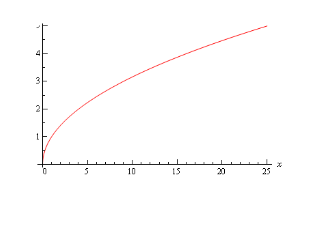
The shape of a square root is a parabola on its
side but only the positive side. This is do to
that a square root has 2 answers but a
function can only use one.
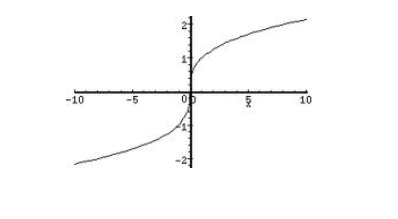
The shape of a cube root is an s shape on its
side. Because a cube root has one answer no
matter if its negative or positive so there sare
no limits on its domain.
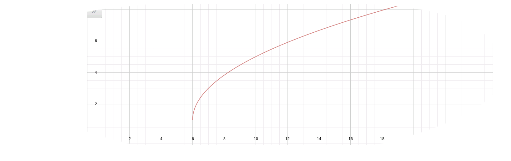

To start graphing a square root start with the
the vertex from your equation. y= x-6 +3
which is (6,3), start with your vertex and
follow the pattern of 1,3,5, so it up 1 over 1,
up 1 over 3, etc until you run out of graph
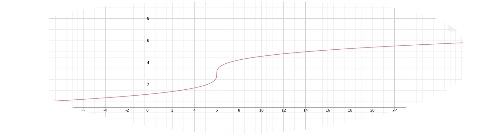

3
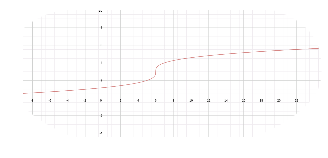
To graph a cube root you star with the vertex
of the equation,
y= x-6 +3, which is still (6,3). Then you
follow the pattern of 1, 3, 7 both for the
positive and negative. so it up 1 over 1, up 1
over 3. Then you start from the vertex and do
the opposite

And finally to graph a stretch graph is the
same way like the other 2, the only difference
is the number of spaces you go up or down.
y=2 x-6 +3. Your vertx is (6,3)
next you go up and over but this time instead
of 1 up over 1, 1 up over , it will be up 2 over
1, up 2 over 3... etc
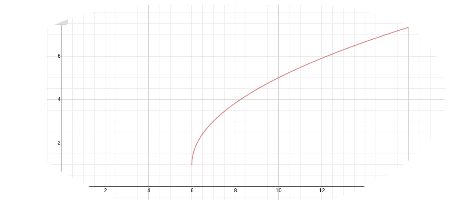



 Was that good enough.
 Can we go now?
 Yes and thank you, I can
now pass Mrs. Parker's
math test

 I should throw you overboard
 and not do math
 Well at least now I can
better count your booty.
You've previewed 35 of 54 pages.
To read more:
Click Sign Up (Free)- Full access to our public library
- Save favorite books
- Interact with authors


- < BEGINNING
- END >
-
DOWNLOAD
-
LIKE(3)
-
COMMENT()
-
SHARE
-
SAVE
-
BUY THIS BOOK
(from $10.79+) -
BUY THIS BOOK
(from $10.79+) - DOWNLOAD
- LIKE (3)
- COMMENT ()
- SHARE
- SAVE
- Report
-
BUY
-
LIKE(3)
-
COMMENT()
-
SHARE
- Excessive Violence
- Harassment
- Offensive Pictures
- Spelling & Grammar Errors
- Unfinished
- Other Problem





COMMENTS
Click 'X' to report any negative comments. Thanks!