eTwinning project:
"About us, our schools and where we live."
Penny John
Joanna Alex
Mary Andrew
Andriana Stavros
Irene
Despina

Christmas is the most beautiful time of the year, for children and adults.
In this book, we present you some Greek Christmas traditions.
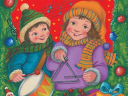
On Christmas Eve, children get up early and go from house to house , to sing the Greek Christmas Carols or "Kalanta." They have the traditional triangle and they knock on the doors. The person who opens,lets the children sing the Carols and gives them a little money. In Greece, children sing carols on 24th December, 31st December and 5th January.
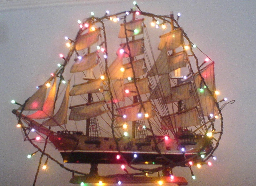
old custom is disappearing.
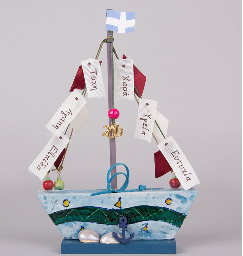
Greeks, have a long history as sailors. The boat symbolizes the new trip in a man's life, after the birth of Christ. This tradition is also related to Saint Nicholas, who protects sailors and ships.
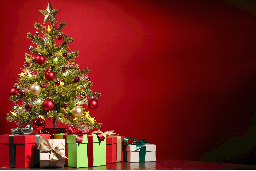
At Christmas, it is very common to decorate the tree. A lot of families start decorating their houses, from the first week of December. They put a lot of ornaments, lights and a star at the top. The first Christmas tree, was decorated by King Othona in 1833.
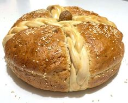
A traditional Christmas table, has the "Christopsomo" or "Christmas bread".
On Christmas Eve, housewives make this special bread. It is a round, sweet bread and there is a cross. The householder cuts the bread in pieces by hand, as it is said, that no knife should be used.
Santa Claus brings presents to children.
One version, is that Santa gives presents only to those who have been "good" during the year.
In Greece, "Aghios Vassilis" brings the presents on 1st January, on his name day. So that day, the whole family sits around the tree, opening the presents and exchanging wishes.
He is the same "Santa Claus-St. Nicholas for the English, "Per Noel" for the French, "Sinter Klaus" for the Dutch and "Babbo Natale" for the Italians.
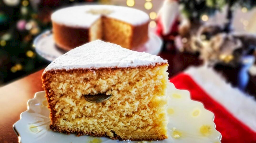
Vasilopita, according to Greek custom, is the name of the pie made on New Year's Eve. It contains a gold coin which, according to tradition, will bring good luck to whoever finds it. It is cut and shared in a family gathering immediately upon the arrival of the New Year. The number of the New Year is written on the Vasilopita with a row of peeled chocolate or sugar almonds. So just before midnight, when the change of the year is about to happen, the lights go out and everyone is counting down from ten to one and when the lights are back on, they wish each other happy new year.
Vasilopita comes onto the table where the host, after crossing it with the knife three times, begins to cut it with the first piece for Christ, his mother Mary, the House, the Poor, Saint Basil and then to all the family members by age.
An easy recipe for the Vasilopita is:
Components:
500 gr. Flour
250 gr. butter at room temperature
3 large eggs
2 cups of sugar
1 tbsp baking powder
1 tbsp liquid vanilla flavoring
250 ml of milk
Zest of one orange
½ cup Orange juice
A little butter and a little flour for the pan
Instructions:
Preheat the oven to 180˚C. Grease a 25 cm mold well with butter and sprinkle it with a little flour.
We are carefully buttering the sides of the form so that the cake rises evenly.
Pour the butter into the mixer bowl and beat it together with the sugar, until the sugar melts well and the mixture turns white. Add the eggs, vanilla flavoring and orange zest one by one.
Mix and add the milk and juice. Then, slowly, pour the flour sifted and mixed with the baking powder.
Mix well with a spatula. Bake the cake for 45-50 minutes, on the high rack. Before baking, add the flour!!!
When it's ready, take it out of the mold and put it on a rack to cool. Once cooled, sprinkle with powdered sugar and serve!
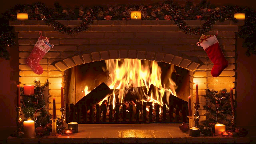
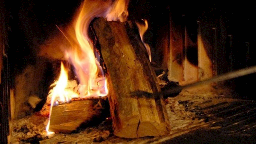
In the villages of Macedonia, on Christmas Eve, the man of the house, looks for the most beautiful and strong wood, from pine or olive tree and takes it home. This is the Christoxylo.
The housewife cleans the fireplace, so that there are not old ashes.
On Christmas Eve, all the family sits around the fireplace, the man of the house lights the new fire and puts the Christoxylo in the center.
Every family, tries to keep the fire for the twelve days of the holidays,from Christmas to Epiphany.They believe that as the Christoxylo burns, it warms little Christ in the cold cave.
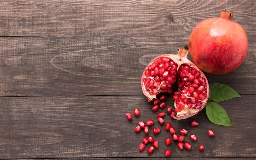
In some parts of Greece, they have the tradition of breaking the pomegranate (rodi).
On New Year's morning the man of the house goes to church,holding his pomegranate.
Then, he goes home and when the door opens, he smashes it with force,so that its seeds are all over the house.
They also give the wish: " with health, hapiness and joy in the new year, and as strong and beautiful the seeds are,so happy to be the days of the new year."
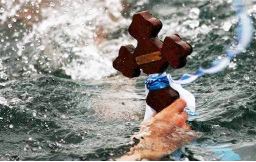
Epiphany is a Christian celebration for the Baptism of Christ. It is celebrated on January 6th and it is the third and last holiday,of the Christmas holidays.
In Greece, children say the Epiphany carols on 5th January. Finally, on 6th January, a big event takes place "The Blessing of the Waters."
A priest prays and throws a wooden croos into the water (sea, lake,river).
Men, women and children, dive in and swim quickly to grab the cross first.
It is said, whoever gets it first, gets a special blessing from the priest and he/she is going to be lucky.
Greek Christmas sweets.
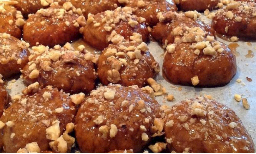
Melomakarona
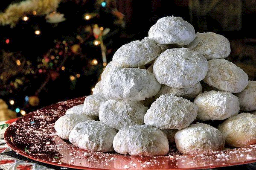
Kourampiedes
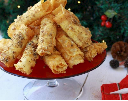
Diples
We wish you
Merry Christmas
and a
Happy New Year,
With joy,
health, happiness
and peace.
The 5th grade of the
8th Primary School of Kallithea
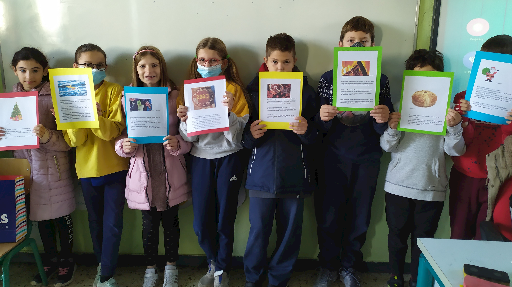
The little authors of the book.
- < BEGINNING
- END >
-
DOWNLOAD
-
LIKE
-
SHARE
-
BUY THIS BOOK
(from $3.59+) -
BUY THIS BOOK
(from $3.59+) - DOWNLOAD
- LIKE
- SHARE
- Report
-
BUY
-
LIKE
-
SHARE
- Excessive Violence
- Harassment
- Offensive Pictures
- Spelling & Grammar Errors
- Unfinished
- Other Problem
"Greek Christmas Customs"
"About us, our schools and where we live."





COMMENTS