Source of the texts:
Ioannis Koliopoulos, Iakovos Michaelidis, Athanasios Kallianiotis, Charalambos Minaoglou, 6th Grade History History of the modern and modern world, "DIOFANTOS" INSTITUTE OF COMPUTER TECHNOLOGY AND PUBLICATIONS
http://ebooks.edu.gr/ebooks/v/html/8547/2188/Istoria_ST-Dimotikou_html-empl/
Narration by Chris Petalidis

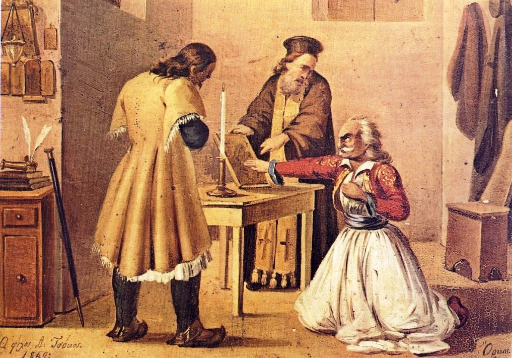
The Oath, oil painting by D. Tsokos (1849) CC BY-SA 3.0
Credits to Mourad Ben Abdallah / Wikimedia Commons
https://commons.wikimedia.org/wiki/File:Serment_Tsokos.jpg
Since the Fall of Constantinople in 1453, the Greeks have been enslaved by the Turks for 400 years. Rigas Feraios and other teachers of the genus tried to awaken the Greeks and make them rise up.
In 1814, Emmanuel Xanthos, Athanasios Tsakalov and Nikolaos Skoufas secretly founded the Friendly Society whose purpose was to prepare the revolution. Those who participated swore before God. Theodoros Kolokotronis swears on Tsoko's painting.
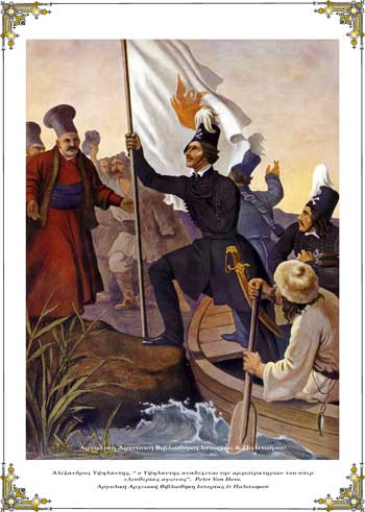
Alexandros Ypsilantis, "Ypsilantis assumes the master strategy of the pro-freedom struggle" by Peter von Hess, Public domain
https://commons.wikimedia.org/w/index.php?curid=12535830
In 1820, Alexandros Ypsilantis, aide to the Tsar of Russia, was appointed as the leader of the Friendly Society.
In January 1821, Ypsilantis crosses the Pruthos river and the revolution in Moldowallachia begins. Ypsilantis and the Holy Company were defeated by the Turks in June 1821 and this revolution was suppressed in Dragatsani. Al. Ypsilantis was imprisoned.
Palaion Patron Germanos blesses the flag of the Revolution, 1865, by T. Vryzakis
Public domain
https://www.nationalgallery.gr/artwork/o-palaion-patron-germanos-evlogei-ti-simaia-tis-epanastasis/
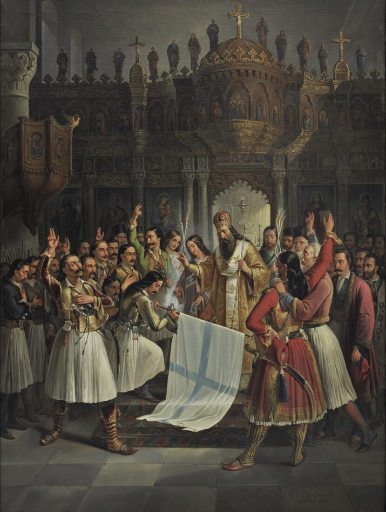
The Revolution starts again in March 1821 in the Peloponnese. The German of Old Patras blesses the flag of the Revolution.
The Greeks are achieving many successes. They attack Kalavryta and Vostitsa (Aegio) and liberate them. On March 23, Kalamata was handed over to the Greeks. The following month the Turks were defeated once more at Levidis in Arcadia.
https://upload.wikimedia.org/wikipedia/el/d/d5/%CE%97_%CE%9C%CE%AC%CF%87%CE%B7_%CF%84%CE%B7%CF%82_%CE%91%CE%BB%CE%B1%CE%BC%CE%AC%CE%BD%CE%B1%CF%82._%CE%9B%CE%B9%CE%B8%CE%BF%CE%B3%CF%81%CE%B1%CF%86%CE%AF%CE%B1._%CE%91%CE%BB%CE%AD%CE%BE%CE%B1%CE%BD%CE%B4%CF%81%CE%BF%CF%82_%CE%97%CF%83%CE%B1%CE%AF%CE%B1%CF%82.jpg
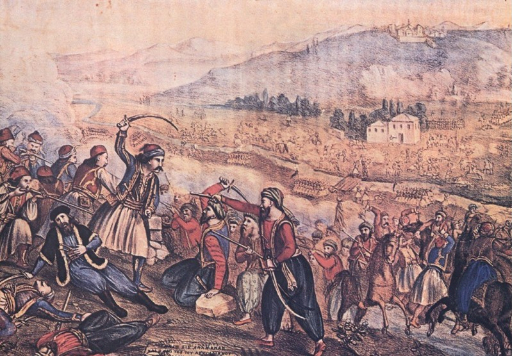
At the same time, the Revolution also begins in Central Greece. Battles that have gone down in history are the battle in Alamana, where Athanasios Diakos met a horrible death and the battle in Hani tis Gravia, where the heroism of Odysseus Androutsos was highlighted.
Bouboulina on the ship "Agamemnon", painting by the German painter Peter von Hess, public domain https://upload.wikimedia.org/wikipedia/commons/b/b9/Bouboulina_painting_by_Von_Hess.jpg
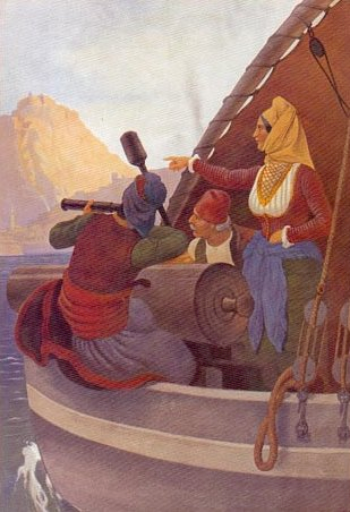
The revolution also spreads to the Aegean islands. First, Spetses revolted with Bouboulina, in April 1821, followed by Hydra, led by captain Antonio Oikonomou. Then Psara, Samos, Kasos and the Dodecanese revolted. Revolutionary activity also took place in Crete.
The burning of the Turkish flagship from Kanaris. Painting by Nikiforos Lytra, Averof Gallery, Metsovo. Common Estate
https://commons.wikimedia.org/wiki/File:The_burning_of_the_Turkish_flagship_by_Kanaris.png#/media/File:The_burning_of_the_Turkish_flagship_by_Kanaris.png
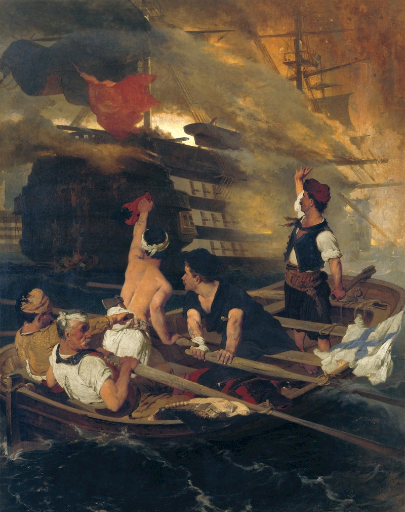
The Greek sailors a) besieged the coastal castles thus supporting the land battles from the sea, b) made raids on the coasts of Asia Minor, where they captured or destroyed enemy ships and c) fought naval battles in the open sea, where with the famous fire-ball boats filled with flammable material, they hit and set fire to the Ottoman ships.
Among others, the captain Dimitrios Papanikolis and Konstantinos Kanaris from Psara, as well as Andreas Miaoulis from Hydra, developed significant action at sea.
The Greek victory at Dervenakia (1822) by Th. Vryzakis, public domain
https://el.wikipedia.org/wiki/%CE%9C%CE%AC%CF%87%CE%B7_%CF%84%CF%89%CE%BD_%CE%94%CE%B5%CF%81%CE%B2%CE%B5%CE%BD%CE%B1%CE%BA%CE%AF%CF%89%CE%BD#/media/%CE%91%CF%81%CF%87%CE%B5%CE%AF%CE%BF:Dervenakia_1822.JPG
https://www.nationalgallery.gr/artwork/i-machi-sta-stena-ton-dervenakion/
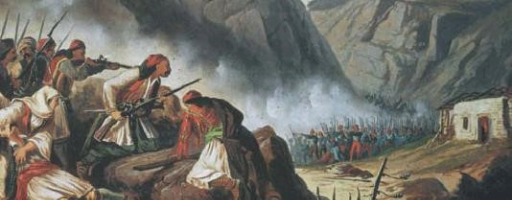
In the spring of 1822, Dramalis, with a large army, was sent to Central Greece and from there with the intention of advancing to the Peloponnese, to suppress the Revolution. But he was trapped and suffered a heavy defeat at Dervenakia, thanks to the clever plan of Theodoros Kolokotronis on July 26, 1822.
Dervenakia reminded of the Thermopylae of Leonidas and the 300 Spartans.
Massacre in Chios (1824). Louvre, Paris
Eugene Delacroix
Public Domain
https://el.wikipedia.org/wiki/%CE%97_%CE%A3%CF%86%CE%B1%CE%B3%CE%AE_%CF%84%CE%B7%CF%82_%CE%A7%CE%AF%CE%BF%CF%85_(%CF%80%CE%AF%CE%BD%CE%B1%CE%BA%CE%B1%CF%82)
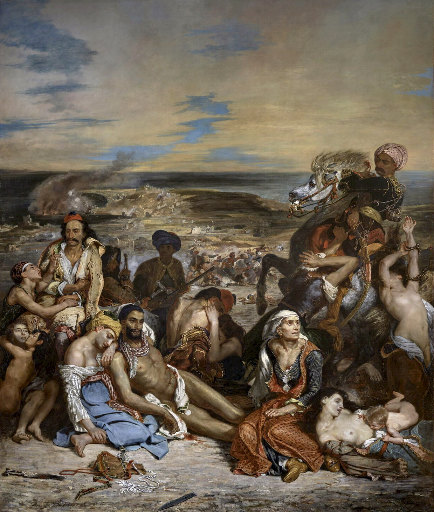
The Turks reacted by retaliating against the Greek population living on the coasts of Asia Minor and on the islands. In April 1822, Chios was completely destroyed by Turkish soldiers and most of its inhabitants were massacred. It was an event that shocked the Christian peoples of Europe.
The fishing obituaries of Nikiforos Lytra Public Domain
https://www.europeana.eu/en/item/2063620/GRE_280_05
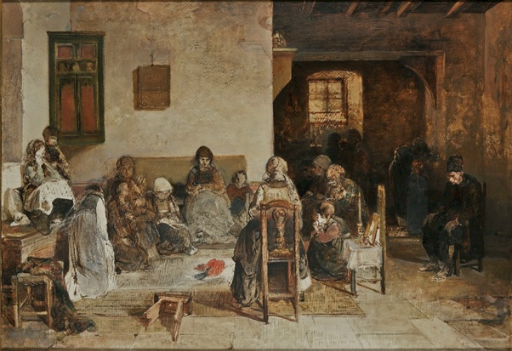
In the following years, the conflicts at sea intensified. In the months of May and June 1824, the united Turkish-Egyptian fleet attacked Kasos and Psara. The destruction of the Fishermen shocked Europe and many painters rendered its image.
At the end of August 1824 in the naval battle in the Gulf of Gerontas, off the coast of Asia Minor, the Greek fleet managed to defeat the massive Turkish-Egyptian. Admiral Miaoulis caused confusion among the enemy ships, the pyrotechnics were also successfully used, destroying a frigate with 1,000 soldiers and sailors. After the Naval Battle of the Elder, the Turco-Egyptian forces scattered and retreated.
The Reception of Lord Byron at Messolonghi by Theodoros Vryzakis - 1861 - National Gallery - Alexandros Soutsos Museum, Greece - Public Domain.
https://www.europeana.eu/item/2063620/GRE_280_0
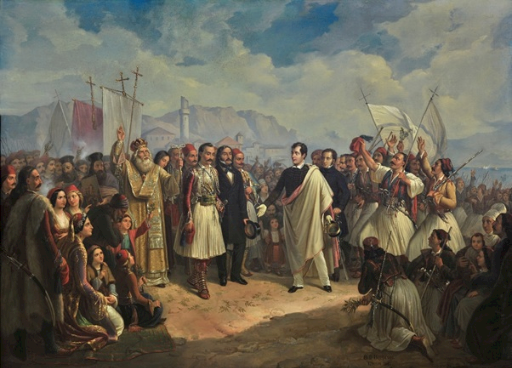
The Exodus of Messolonghi, 1853, by Th. Vryzakis, Public Domain
https://www.nationalgallery.gr/artwork/i-exodos-tou-mesolongiou/
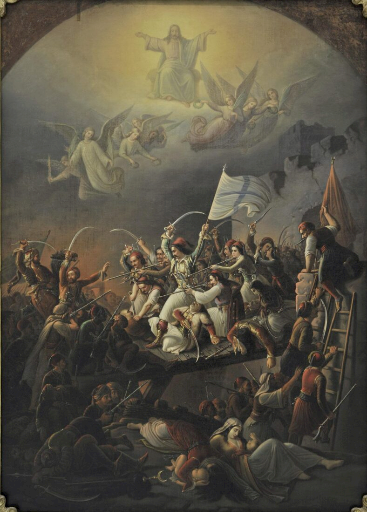
In April 1825, the second siege of Messolonghi began, initially by Kioutachi and then by Ibrahim Pasha. Despite the heroic resistance of the Messolongites, the city was captured in April 1826. The exit of Messolonghi was one of the leading moments of the Greek Revolution, causing deep emotion throughout the world.
The Naval Battle of Navarino, National Historical Museum, Athens, Greece
Aquatint by R. Smart and H. Pyall from a painting by Sir Theophilus Lee
https://commons.wikimedia.org/wiki/File:Battle_of_Navarin_(4552424940).jpg
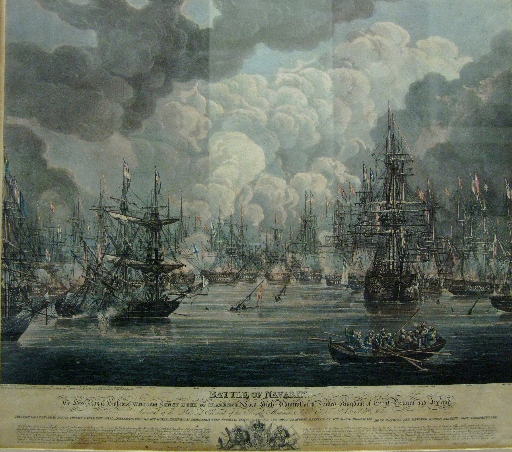
In the Naval Battle of Navarino, in October 1827, English, French and Russian warships faced off against the fleets of the Turks and the Egyptians. The victory of the allied naval forces contributed decisively to the liberation of Greece.
After the Naval Battle of Navarino, diplomatic actions led in February 1830 to the London Protocol by which Greece gained its independence. The victories of the Greek army as well as the effort of Kapodistrias, the first governor of Greece, helped to expand the borders of the Greek state. The Governor sent warships to the Gulf of Amvrakikos, so that this area could be included in the borders of the new state.
Topographical Europe, a map showing the states which had prepared large maps of their territory and the scales of those maps / by C. Maunoir, (1872)
Public domain https://www.europeana.eu/item/9200517/ark__12148_btv1b84413223
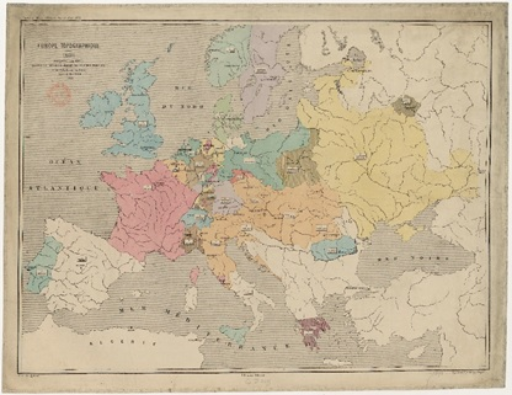
In February 1830, the political independence of Greece was signed in London by the three Allied Powers (England, France, Russia), with its borders on the line of the Achelous - Sperchios river. Two years later, in 1832, the borders of the Greek state were extended to the line Amvrakiko gulf - Pagasitiko gulf. The new borders were also recognized by the High Gate. After ten years of conflicts, the existence of an independent Greek state, recognized by the Great Powers of the time, was now a fact.
- < BEGINNING
- END >
-
DOWNLOAD
-
LIKE
-
COMMENT()
-
SHARE
-
BUY THIS BOOK
(from $5.19+) -
BUY THIS BOOK
(from $5.19+) - DOWNLOAD
- LIKE
- COMMENT ()
- SHARE
- Report
-
BUY
-
LIKE
-
COMMENT()
-
SHARE
- Excessive Violence
- Harassment
- Offensive Pictures
- Spelling & Grammar Errors
- Unfinished
- Other Problem






COMMENTS
Click 'X' to report any negative comments. Thanks!