
This book was created and published on StoryJumper™
©2014 StoryJumper, Inc. All rights reserved.
Publish your own children's book:
www.storyjumper.com

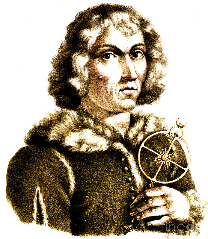


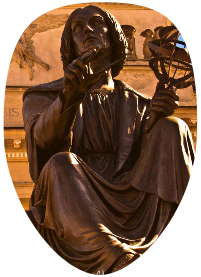
 Early LifeNicolaus Copernicus was born on February 19, 1473 in Torun, Poland.
The fourth and youngest child born to Nicolaus Copernicus Sr. and
Barbara Watzenrode, an affluent copper merchant family in Torun,
Poland, Copernicus was technically born of German heritage, but by the
time he was born, Torun had ceded to Poland, rendering him a citizen
under the Polish crown.

 EducationIn 1491, Copernicus entered the
University of Cracow, where he
studied painting and mathematics.
Though he did not take astronomy
classes at that time, he took interest in the
subject.


 college experience
In 1496, Copernicus took leave and traveled to
Italy, where he enrolled in a religious law
program as the University of Bologna. There,
he met astronomer Domenico Maria Novara—a
fateful encounter, as the two began
exchanging astronomical ideas and
observations. In 1500, after completing his law
studies in Bologna, Copernicus went on to
study practical medicine at the University of
Padua.
 Inspiration
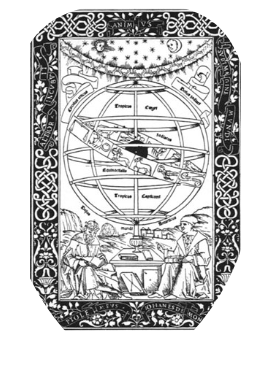
Throughout the seven years he
spent in Lidzbark-Warminski,
Copernicus read several books
on the subject of astronomy.
Among the sources, Copernicus
looked at Regiomontus's
Epitome of the Almagest, which
presented something different to
astrologist Claudius Ptolemy's
model of the universe, and
influenced his research.
 What did he do?
By 1508, Copernicus had begun developing his
own celestial model, a heliocentric planetary
system. Ptolemy had previously invented a
geometric planetary model, which was
inconsistent with Aristotle's idea that celestial
bodies moved in a circular motion at different
speeds around a fixed point, the earth. In an
attempt to reconcile such inconsistencies,
Copernicus's heliocentric solar
system named the sun, rather than the earth, as
the center of the solar system. Subsequently,
Copernicus believed that the size of each planet's
orbit depended on its distance from the sun.



 What happens next?
Though his theory was viewed as revolutionary
and met with some concern, Copernicus was
not the first astronomer to propose such a
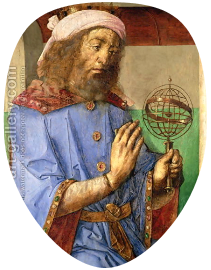
theory. In 270 B.C., ancient Greek astronomer
Aristarchus of Samos had identified the sun as
the solar system's central unit.
 So what took so long!?
Both ideologies were dismissed or not
excepted at the time, because it interrupted
the religious beliefs. (ex. Roman Catholic
church.) There would be severe punishments if
the word spread of such news.
Around 1514, Copernicus completed a written work,
Commentariolus. The sketch set forth seven axioms,
each describing an aspect of the heliocentric solar
system: 1) Planets don't revolve around one fixed point;
2) the earth is at the center of the moon's orbit; 3) The
sun is at the center of the universe, and all celestial
bodies rotate around it; 4) The distance between the
earth and sun is only a tiny fraction of stars' distance
from the earth and sun; 5) Stars do not move, and if
they appear to, it is only because the earth itself is
moving; 6) Earth moves in a sphere around the sun,
causing the sun's yearly movement; and 7) Earth's orbit
around the sun causes the planets to orbit in the
opposite direction.
 extra information
You've previewed 10 of 16 pages.
To read more:
Click Sign Up (Free)- Full access to our public library
- Save favorite books
- Interact with authors

- < BEGINNING
- END >
-
DOWNLOAD
-
LIKE(2)
-
COMMENT()
-
SHARE
-
SAVE
-
BUY THIS BOOK
(from $3.19+) -
BUY THIS BOOK
(from $3.19+) - DOWNLOAD
- LIKE (2)
- COMMENT ()
- SHARE
- SAVE
- Report
-
BUY
-
LIKE(2)
-
COMMENT()
-
SHARE
- Excessive Violence
- Harassment
- Offensive Pictures
- Spelling & Grammar Errors
- Unfinished
- Other Problem





COMMENTS
Click 'X' to report any negative comments. Thanks!