When the internal pressure of a celestial body cannot overcome its own gravity, the star begins to collapse. If the mass of the star is above a certain value, there is no known mechanism that can stop the collapse. In this case, the collapse of the star results in the formation of a black hole.

Created & published on StoryJumper™ ©2026 StoryJumper, Inc.
All rights reserved. Sources: storyjumper.com/attribution
Preview audio:
storyj.mp/agriaxj6gn2p
Some people use the term "surface of the black hole" instead of the term "event horizon", although it is not very appropriate for a black hole. (The reason why the term is not appropriate is that it does not have a surface composed of solids and gases like a planet or star.) But there is no region showing some special properties here; If an observer were to get close enough to the black hole to exceed the horizon, he would not be able to sense any features or changes that would give him the impression of a surface. However, when he attempted to return, he would realize that he could
2
no longer escape from this region. This is literally the "point of no return". This situation can be compared to the situation of a swimmer in a strong sea, unaware of the current.
3
When the internal pressure of a celestial body cannot overcome its own gravity, the star begins to collapse. If the mass of the star is above a certain value, there is no known mechanism that can stop the collapse. In this case, the collapse of the star results in the formation of a black hole. The supermassive black holes at the ce|nters of most galaxies probably formed this way.
4
In the age we live in, high densities that can cause the formation of black holes exist only in stars. However, high matter densities in various parts of the universe shortly after the Big Bang may also have caused the formation of black holes. Estimates made using conditions in the early universe show that the masses of black holes that could form in this way could range from the Planck mass (approximately 2x10⁻⁸ kilograms) to thousands of times the mass of the Sun (approximately 2x1030 kilograms).
5
In addition, it has been suggested that black holes with masses smaller than the Planck mass may form during high-energy collisions of particles. However, there is no consensus on the accuracy of these inferences made based on some theories that are still under development.
6
A black hole has a mass concentrated at a point called a “gravitational singularity”. This mass forms a sphere called the "event horizon of the black hole" centered on the singularity in question. This sphere can also be thought of as the place occupied by the black hole in space. A black hole with a mass equal to the mass of the Sun has a radius of only about 3 km.
7
As far as interstellar distances are concerned, a black hole does not exert a gravitational force on any celestial object greater than that of a celestial object of the same mass. In other words, black holes should not be thought of as an irresistible celestial aspirator. For example, if a black hole of the same mass were located in the place of the Sun, there would be no change in the small time performance of the orbits of the planets in the Solar System.
8
There are many types of black holes. The type of black hole formed by a star collapsing in on itself is called a "stellar black hole". When these black holes are located at the centers of galaxies, they can have a huge mass of up to several billion "solar masses", in which case they are called "supermassive black holes" (or galactic black holes). Between these two types, which constitute the two extreme points of black holes in terms of mass, it is thought that there is a third type with a mass of several thousand "solar masses" and this type is called "intermediate black holes" . The lowest
(TO BE CONTİNED)
(TO BE CONTİNED)
9
mass black holes are thought to have formed in the Big Bang at the beginning of the universe, and these are called "primordial black holes". However, the existence of primordial black holes has not been confirmed so far.
10
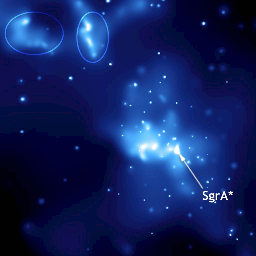
It is impossible to observe a black hole directly. In order for an object like this to be seen, light must come from it or the light coming into it must be reflected; In regions, black holes even swallow very diffuse air. However, their coexistence is evident from the influence of the amplification effect, especially in microquasars (pulsars) and active galaxy nuclei, by the extremely heated and strong emission of X-rays from nearby craters falling on the black hole. Thus, observations reveal the existence of such units in giant or small sizes. The only objects covered by these observations that
TO BE CONTiNED
11
comply with the general theory of relativity are black openings.
12
It can be said that the concept of black hole was first born at the end of the 18th century, within the scope of Newton's law of universal gravitation. But at that time, the only question was to know whether there were objects massive enough to ensure that the "escape velocity" was greater than the speed of light. Therefore, the concept of black hole ceased to be an imaginary concept only in the early 20th century, and especially with the introduction of Albert Einstein's general theory of relativity. Shortly after the publication of Einstein's work, a solution to the "Einstein field equations"
(TO BE CONTİNED)
13
involving the existence of a central black hole was published by Karl Schwarzschild. [5] However, the first fundamental studies on black holes date back to the 1960s, following the observations of the first solid signs of their existence. The first observation of an object containing a black hole was made by the Uhuru satellite in 1971. The satellite had detected a source of X-rays in the double star Cygnus X-1, the brightest star in the constellation Cygnus. However, the term "black hole" was coined before by American physicist John Wheeler in the 1960s. Before this term was established in
(TO BE CONTİNED)
(TO BE CONTİNED)
14
terminology, the terms "Schwarzschild object" and "closed star" were used for black holes.
15
The limiting zone from which light and maddening can no longer escape is called the “event horizon” . The event horizon is a part that we cannot make any physical examination of. There is no understanding of what lies beyond the horizon of the event by known rules, nor is there any way of knowing what is going on there. The event horizon of a star is the extent of the star before its collapse. For example, when a star with 10 solar colors collapses and becomes a black hole, its diameter is 60 km. It has an event horizon. As a black hole absorbs matter, it expands its event horizon, and as
16
the event expands, it has a stronger gravitational field. Theoretically, time stands still completely at the event horizon of a black hole. Some black spaces have two event horizons.
17
A black hole is an astrophysical object like other astrophysical objects. It is characterized by being very difficult to observe directly and by the fact that its central region cannot be satisfactorily described by physical theories. The most important factor why the central region cannot be defined is that it contains a "gravitational singularity" at its center. This gravitational singularity; It can only be described with a "quantum gravity" theory, which does not exist today. On the other hand, thanks to the various indirect methods applied, the physical conditions prevailing in its immediate
(TO BE CONTİNED)
18
surroundings and its impact on its environment can be perfectly defined
19
On the other hand, black holes are surprising objects in that they can be defined by a very small number of parameters. Their definition in the universe we live in depends on only three parameters: mass, electrical charge and angular momentum. All other parameters of black holes (size, shape, etc.) are determined by them. To make a comparison, for example, hundreds of parameters are involved in defining a planet (chemical composition, differentiation of elements, convection, atmosphere, etc.). Therefore, since 1967, black holes have been defined with only
(TO BE CONTİNED)
20
these three parameters, which was introduced by Werner Israel in 1967. We owe it to the "hairlessness theory" . This also explains why the only long-range fundamental forces are gravity and electromagnetism; The measurable properties of black holes are given only by the parameters that define these forces, namely mass, electrical charge, and angular momentum.
21
The properties of a black hole related to mass and electrical charge are the usual properties to which "classical" (without general relativity) physics can be applied: The black hole has a "gravitational field" in proportion to its mass and an electric field in proportion to its electrical charge. On the other hand, the angular momentum effect has a feature specific to the general theory of relativity: Some cosmic bodies rotating around their own axis tend to "drag" (tilt) the space-time in their immediate surroundings . This phenomenon, called the "Lense-Thirring effect" , is not observed in our
(TO BE CONTİNED)
22
Solar System yet. This phenomenon occurs to incredible extents in the near space around the “spinning black hole” type around its axis, which is called the “force region” (ergorégion) or “force sphere”
23
A black hole has three elements that determine all its properties: its mass, angular momentum and electrical charge. The mass of a black hole is always greater than zero. It is possible to divide black holes into four classes, depending on whether the other elements are zero or greater than zero.
24
Benefits:
- Full access to our public library
- Save favorite books
- Interact with authors
READ
Thank you for read...
(Uras)
storyjumper.com
loading...
- < BEGINNING
- END >
-
DOWNLOAD
-
LIKE(4)
-
COMMENT()
-
SHARE
-
SAVE
BUY THIS BOOK (from $7.39+)
-
BUY THIS BOOK
(from $7.39+) -
BUY THIS BOOK
(from $7.39+) - DOWNLOAD
- LIKE (4)
- COMMENT ()
- SHARE
- SAVE
- Report
Liked By
X
Encourage this author
-
BUY
-
LIKE(4)
-
COMMENT()
-
SHARE
Problem with this book
X
- Excessive Violence
- Harassment
- Offensive Pictures
- Spelling & Grammar Errors
- Unfinished
- Other Problem
Which pages have problems?
Please describe the problem:
left text
right text
"Blackhole"

This story discusses the concept of black holes, including their formation and properties. It explains how black holes are difficult to observe directly and describes their gravitational singularity and event horizon.
(38 pages)
Privacy level:
PUBLIC
13 reads
4 fans
Report





COMMENTS
Click 'X' to report any negative comments. Thanks!