
LEGEND OF THE II COUNT OF MEDELLÍN( IES Luis Chamizo.Spainb)
According to this legend, upon the death of D. Rodrigo Portocarrero, I Count of Medellín, some events occurred that had great importance...
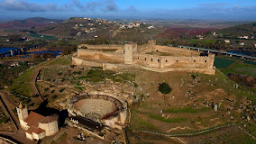
The I Count of Medellín, married to Mrs. Beatriz Pacheco, daughter of the powerful Marquis of Villena, Don Juan Pacheco, was succeeded by his first-born son, Don Juan Portocarrero y Pacheco. His mother disputed the rights of the County by locking him for his safety in a secret and almost underground room on the ground floor of the cube or tower that occupies the central part of the wall that faces the Guadiana.
For no less than five years, according to tradition, the unfortunate Don Juan was locked up in that small prison with no more light than the very little that came through the loophole that still exists, nor more ventilation and air than that of that small space inside. from which he had to satisfy all his bodily needs and without seeing or speaking to anyone other than the servant who, from time to time, came
down - also hanging - to clean the room.
Once the negotiations were started, it seems that Don Juan demanded that the wall be broken as it is today and the break is still preserved, trying to prove his innocence by leaving on his feet and not hanging as he entered."
IES Luis Chamizo. Spain
Legend of Magacela Castle (IES Luis Chamizo, Spain)
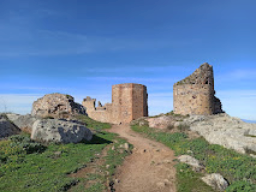
According to the legend of Beautiful Leila and the taking of Magacela Castle, during the time of the Reconquista, in the 13th century, Arias Pérez, master of the Order of Alcántara, was in charge of leading the Christian troops that were trying to expel to the Muslims of what is today known as the region of La Serena (Badajoz).
The Order of Alcántara had already managed to conquer some of the castles in the region, such as the castle of Medellín and the castle of Zalamea de la Serena. Their next objective was the fortress of Benquerencia de la Serena. Not far from the place, Ahmed Ben Ali lived in Magacela Castle, along with his beautiful and brave daughter Leila. Because of her beauty, the young woman was known as "Beautiful Leila", but among all her qualities, the most outstanding was her bravery.
At that moment, Ahmed Ben Ali, observing how the Christian troops were approaching, wanted to anticipate. The Muslim warden drew up a plan that would divide his army into two, one would remain in the castle itself under the command of his daughter Leila and the other, led by himself, would go to meet the Christians to catch them off guard and ambush them.
The army led by Ahmen Ben Ali and the Order of Alcántara met on a plain near Quintana de la Serena, where after hours of combat and hundreds of deaths on both sides, the Christians emerged victorious, putting an end to the lives from Leila's father. The Muslim soldiers who managed to survive ran to inform Leila of her father's fatal outcome, and she, overcome with anger, swore revenge.
Taking advantage of the weakness of the Muslim army and not knowing what awaited them in the castle, the Christian army decided to advance towards the castle of Magacela. The Muslims knew how to resist the attack of the Christians. After several days of combat, seeing that the Christian army did not emerge victorious, Arias Pérez hatched a plan that would divide his troops into groups, one made up of horsemen who would approach the castle with lit bundles of straw, while another group He would storm the castle while the Muslims worried about putting out the flames.
Meanwhile, Leila, oblivious to the new attack, was enjoying her dinner. When he found out that they were being attacked, he shouted in an angry voice: “Bitter dinner, bitter dinner for me. Resist my lions! But it was too late, the Christian troops managed to penetrate the castle.
In the midst of the chaos, Leila went out to the tower, looked Arias Pérez in the eyes and, taking out her dagger, she pierced his chest with it. His body rolled down the stairs until he reached the maester's feet. The young and beautiful Leila decided to take her own life before falling into the arms of the Christians.
Narrated presentation from Omiš
https://shorturl.at/cjxHL

NAME OF THE CITY(İZMİR/TÜRKİYE)
According to one legend, the name İzmir comes from the word “İsmira”, which means “princess” in the ancient Luwian language. The princess was the daughter of the king of Ephesus, who fell in love with a fisherman named Tefkros. The king did not approve of their relationship and ordered Tefkros to be killed. The princess then threw herself into the sea and became a mermaid.
The city was named after her as a tribute.

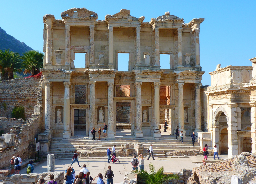
Another legend says that İzmir was founded by the Amazon warriors, who were a tribe of female warriors in Greek mythology. The Amazons settled in the region and built a temple for their goddess Artemis, who was also the patron goddess of Ephesus.
The temple of Artemis in
Ephesus was one of the seven
wonders of the ancient world.

FORTUNE TELLING(İzmir/Türkiye)
Coffee fortune telling is a traditional
practice that is especially popular in
Turkey and the Balkans, where Turkish
coffee is commonly consumed. The
method involves drinking the coffee, turning the cup upside down on a saucer, and then reading the shapes and meanings that are left in the cup after the coffee is finished.

Some people believe that coffee fortune telling can reveal insights into one’s past, present, and future, as well as answer questions or give advice. Others enjoy it as a fun and entertaining pastime, or as a way of socializing and bonding with friends. Coffee fortune telling is usually done by a professional fortuneteller or by someone who has some experience with it, but anyone can try it with some intuition, imagination, and knowledge of the symbols.

HIZIR AND İLYAS(İzmir/Türkiye)
Hızır and İlyas are believed to be immortal and benevolent beings who help people in need and bring blessings and abundance. Hızır was a servant of God who was granted wisdom and knowledge, and İlyas was a prophet who was sent to guide the people. They are said to meet once a year on the day of Hıdrellez, which is celebrated as a spring festival on May 6th.
On this day, people make wishes, perform
rituals, and enjoy nature.

ERGENEKON(İzmir/Türkiye)
The myth of Ergenekon, a valley where the ancestors of the Turks were trapped by their enemies for four hundred years. They managed to escape by melting the iron mountain that blocked their way with the help of a blacksmith and a pregnant wolf.
The wolf led them to a new land,
where they founded the own nations.

KELOĞLAN(İzmir/Türkiye)
Keloğlan is a bald and clever hero who goes on various adventures. He often faces challenges from evil rulers, witches, giants, and other enemies, but he always manages to overcome them with his wit and courage. He also seeks to marry a princess and help the poor and oppressed people.

Keloğlan finds a magic lamp, and he uses it to make his wishes come true. He wishes for a palace, a princess, and a feast, but he also faces some troubles from a greedy vizier who wants to steal his lamp. Keloğlan manages to outsmart the vizier with the help of his animal friends and lives happily ever after.


Naples is the regional capital of Campania and the third-largest city of Italy,after Rome and Milan.
Naples' historic city centre is the largest in Europe and has been designated as a UNESCO World Heritage Site.
The city is situated on the Gulf of Naples.
The islands of Procida, Capri and Ischia can all be reached from Naples by hydrofoils and ferries. Sorrento and the Amalfi Coast are situated south of the city. At the same time, the Roman ruins of Pompeii, Herculaneum, Oplontis and Stabiae, which were destroyed in the eruption of Mount Vesuvius in 79 AD
Tales of Naples
The history of Naples is fantastic, rich, mysterious, enchanting, made of stories where reality and fantasy often merge, giving rise to a particular narration all Neapolitan.
The tales of Naples are precisely this: pieces of history of ancient Greek-Roman Naples or Naples of the eighteenth century, myths and legends about the foundation of Naples, stories of ghosts set in Naples, tales of Neapolitan folklore in short, all the pieces that, put together, trace the history of Naples, a story a bit real and a little magic.

NAPLES
INTRODUCTION
Between Munaciello, Bella 'Mbriana, the magic egg of Castel dell'Ovo, the ghosts in the palaces and in the fortresses and the witches, there are many stories that are handed down from many generations and that make Naples a city full of mystery.
The myth and the legend have always covered Naples and the history of the city is rich in secrets, ghost stories, benevolent spirits or evil ghosts that even today are part of citizens' beliefs. The history of the foundation of the city has its roots in one of the most famous legends, that of the Sirena Partenope, so much so that one of the adjectives to identify the citizens is still Neapolitan. Another thing that attracts many tourists is the Maradona murals found in the Spanish Quarter

O MUNACIELLO
"O Munaciello" (or monaciello), which in Neapolitan literally means little monk, is one of the most famous and characteristic esoteric figures of the Neapolitan tradition together with Janara. It is a legendary spirit from the folklore of the city in the shadow of Vesuvius, represented as a deformed boy or a person of short stature, a sort of gnome, dressed in a habit and with silver buckles on his shoes. Even today we wonder whether this figure was invented by popular tales or whether, instead, it really exists. His manifestations would be numerous: of sympathy, when he leaves coins and money hidden inside homes, or plays small pranks that turn into numbers to play the Lotto; of appreciation, when he touches beautiful women, or of spite, when he hides and breaks objects or blows into the ears of those who sleep. One of the legends has it that Munaciello was the son of Caterina Frezza, a woman of a noble family and Stefano Mariconda, a man of the people who the Frezza family did not look favorably on. The man was killed in 1445 and Caterina decided to move to a convent where she gave birth to a deformed child. The child lived in the convent wearing the monks' clothes (hence the term Munaciello) until his mysterious death. After his death, the spirit was spotted in various places and homes and the people of Naples began to attribute magical powers to him. Another version of the legend tells us about Munaciello in the guise of an old water well manager. Thanks to his height, he was able to enter homes by passing through the canals and tunnels that were used to lower the bucket. When he wasn't paid for his services, he took revenge by teasing the inhabitants of the house and stealing precious objects
- Full access to our public library
- Save favorite books
- Interact with authors
Thanks...
The team of ''Whispers from the past''
- < BEGINNING
- END >
-
DOWNLOAD
-
LIKE
-
COMMENT()
-
SHARE
-
SAVE
-
BUY THIS BOOK
(from $6.39+) -
BUY THIS BOOK
(from $6.39+) - DOWNLOAD
- LIKE
- COMMENT ()
- SHARE
- SAVE
- Report
-
BUY
-
LIKE
-
COMMENT()
-
SHARE
- Excessive Violence
- Harassment
- Offensive Pictures
- Spelling & Grammar Errors
- Unfinished
- Other Problem





COMMENTS
Click 'X' to report any negative comments. Thanks!