
Castles and Antique Buildings

1 floor
A staircase with oak steps connects the vestibule and the antechamber of Queen Marie’s bedroom, located on the 1 floor of the Castle.
The antechamber of Queen Marie’s bedroom –
This space leads to the sovereign’s bedroom, and the exhibition includes the biography of Queen Marie, which reveals important aspects of her personality, a shield and a flag, painted by hand using natural colours, as well as the deed by which the Castle was donated to the Queen, a replica thereof, done by hand on special paper, carefully rendering all the decorative elements of the original document.
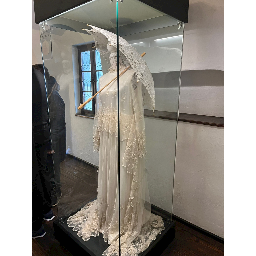
Queen Marie’s bedroom
The two wrought-iron doors that open onto the sovereign’s bedroom represent the oldest decorative piece in the Castle, dating from 1693. On the sides of the room, Queen Marie adorned the windows with two pieces of Byzantine fretwork (masonry with holes for natural ventilation – A.N.) carved in marble, brought from Greece. On the wall behind the steps, but also inside the bedroom, there are fragments of the original painting of the Castle, prior to the restoration carried out during the interwar period. The Queen’s bust, displayed in the centre of the room, was made by Milița Petraşcu, student of the great modernist sculptor Constantin Brâncuşi. The decoration of the room recalls the aesthetic preferences of the sovereign, combining neo-Romanian pieces, Oriental art, sacred Orthodox objects and pieces of Romanian folk art. A precious orthodox icon painted by Princess Ileana after joining the monastery is displayed near the bed. The icon comes from the private collection of the heirs of the Castle. The bed is decorated with brocade pillows and covered with an embroidered bedspread that belonged to Queen Marie.
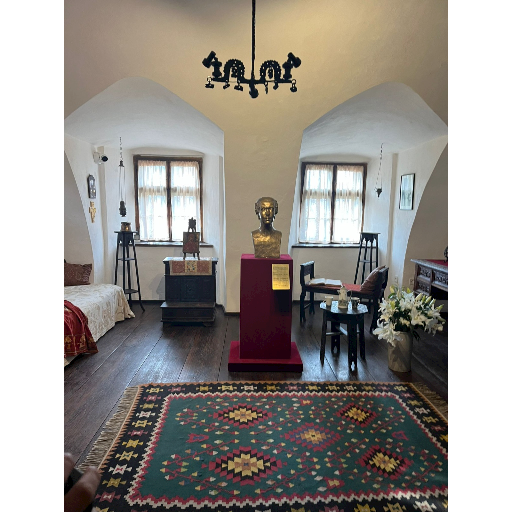
The passageway
It received this name during the interwar period, given that it connected Queen Marie's quarters on the 1 floor. During medieval times, the room served as vestibule for the Fortress chapel, the next room on the tour. Currently, the hall is dedicated to the 19 century history of the Bran Castle and to temporary exhibitions.
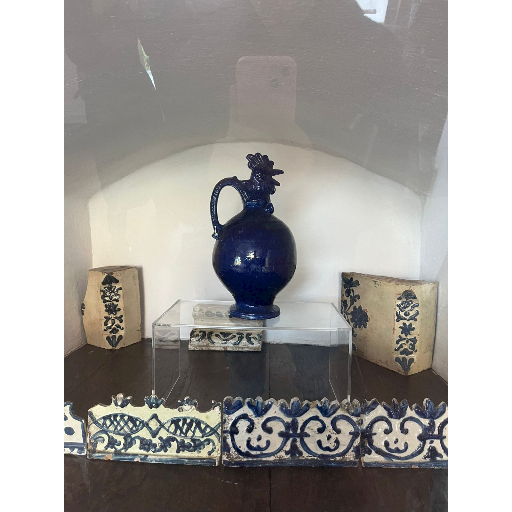
The Gothic Hall e the chapel of the fortress. It was preceded by a vestibule (today, the passageway). The room has a trapezoidal shape, with groin vaults with uneven arms. It is belived that, around 1512, the chapel was painted by Master Dominic, from Brașov. After 1920, in the room with the vaulted ceiling, Queen Marie arranged the Yellow Lounge, where she used to read or have breakfast. The name was given because of its yellow carpets and curtains. A Late Renaissance-style table is exposed in the centre of the room, supported by two legs in the form of carved panels from the 19th century, along with a living room suite, composed of sofa, armchairs and chairs with spirals typical of the baroque style, from the 18th century. The wooden sculpture of St. Joseph, exhibited in the main recess near the fireplace, is of Dutch origin. The evolution of Bran Castle between 1600 and 1800 is explained in the Gothic Hall, highlighting the historical and political turning points. We also find fragments of the original masonry, prior to the restauration of 1920.
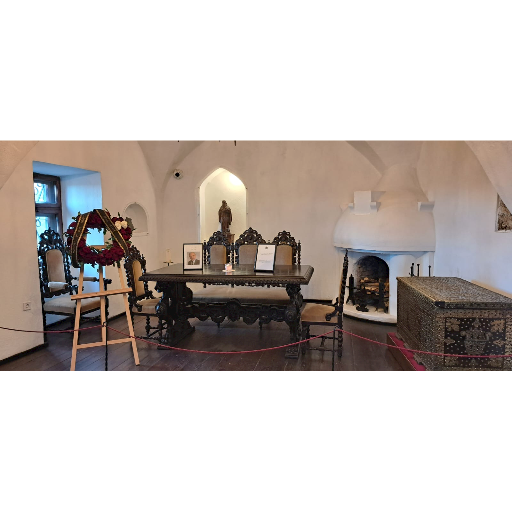
The Council Hall
The door carved with the motifs of the tree of life and the two-headed eagle marks the passage to the former Council Hall of the Bran Castle. The most important decisions regarding the economic and strategic aspects of the region were taken here. The ceiling is made of wood and the windows have very deep embrasures, recalling the medieval firing holes.
During the renovation works carried out by Queen Marie, a secret staircase was discovered here, dug deep into the wall. The staircase, with narrow, steep steps and low lighting, makes the connection between the 1 and 3 floors, giving the impression of a catacomb.
On the wall that hid the secret staircase, traces of an old painting can be seen, showing several silhouettes, probably female ones. The documents of that time speak of the visit of Princess Stanca, the wife of voivode Mihai Viteazul (Michael the Brave), who came to Bran together with her son, Nicolae Pătrașcu, on 7 July 1600. On this occasion, the Castle's burgrave, Hannes Conrad, prepared 12 dishes, over 200 trout, wines and precious dishes. It seems that the fresco is a testimony of this visit, made during the short period when the three Romanian provinces - Wallachia, Transylvania and Moldavia were under the leadership of a single ruler: Mihai Viteazul.
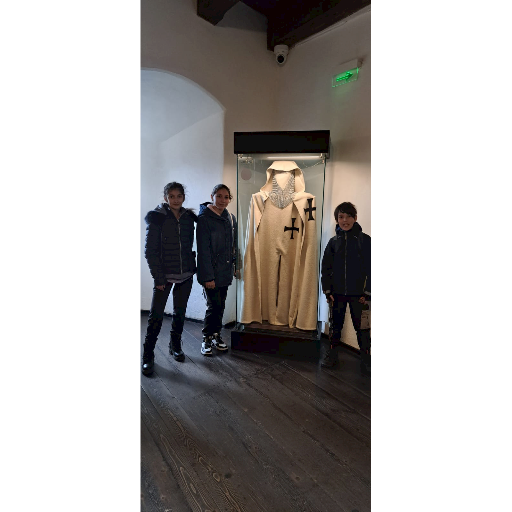
The Council Hall reveals the beginnings of Bran Castle and its evolution during its first centuries of existence, between 1377 and 1600, together with a replica of a Teutonic knight's costume and a shield representing the birth of Transylvania, through the union of the seven fortress-cities (Siebenburgen).
3rd floor
The secret staircase that starts from the Council Hall on the 1st floor connects it with the 3rd floor of the Castle.
The Music Hall
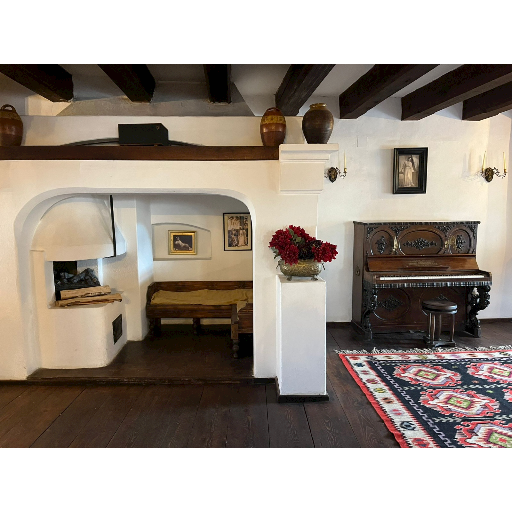
Designed by architect Karel Liman, the Queen's Music Hall is located in the old attic of the medieval fortress. The room has a rectangular plan, with beamed ceiling, windows deep in the wall and, on the east side, an open fireplace. The fireplace, built in 1921, was provided with a hearth, flue and benches becalling the Romanian traditional benches. Pots for milk or oil, of popular ceramics are displayed on the fireplace. Next to it, there is an 18th-century brasero, brass vessel used to heat the rooms. Books belonging to Archduke Dominic Habsburg, but also objects used in the past, such as marble weights, now become mere decorative pieces, are displayed on the shelves of de bookcase. The stove next to the bookcase is decorated with Saxon tiles from the 19th century. The Music Hall became one of Queen Marie’s favourite places. In this room, the sovereign listened to George Enescu, the greatest Romanian musician, and to pianist Cella Delavrancea. The upright piano near the windows was manufactured in Dresden in the 19th century.
In the display case, we can see the Dominic collection, made by Archduke Dominic Habsburg-Lothringen and consisting of three unique models of pots and glasses of lead-free glass, highlighting the inner qualities of the crystal and giving each piece personality and a natural aspect.
Archduke Dominic Habsburg was born at Sonnberg Castle in northern Austria. Together with his family, he was exiled by the Communists at the end of World War II, fled to Switzerland, lived in Argentina for a while, eventually settling in the United States. There he completed his studies in industrial design and sculpture at the Rhode Island School of Design. He founded and led the product research, development and design department of Semperit AG. The United Nations Industrial Development.
Organization and the World Bank have used his expertise in the field in Central America and Africa. As an artist, designer the author, his works are extremely diverse and have been exhibited in Europe, USA, Antigua and Japan. Together with his design office, he currently holds over thirty system patents. Currently he works in Venice, Italy, and has studios in Austria and San Francisco.
- Full access to our public library
- Save favorite books
- Interact with authors
- < BEGINNING
- END >
-
DOWNLOAD
-
LIKE
-
COMMENT()
-
SHARE
-
SAVE
-
BUY THIS BOOK
(from $3.19+) -
BUY THIS BOOK
(from $3.19+) - DOWNLOAD
- LIKE
- COMMENT ()
- SHARE
- SAVE
- Report
-
BUY
-
LIKE
-
COMMENT()
-
SHARE
- Excessive Violence
- Harassment
- Offensive Pictures
- Spelling & Grammar Errors
- Unfinished
- Other Problem





COMMENTS
Click 'X' to report any negative comments. Thanks!