This eBook was created as part of the eTwinning project Flipping History...What if? by the students of the partner schools.
Enjoy your reading!


WHAT IF? - Content:
Chapter 1: Hitler and Mussolini.........................................................................................4
Chapter 2: There was no 2nd World War in Romania...................................................12
Chapter 3: Library of Alexandria......................................................................................16
Chapter 4: Columbus never discovered America .........................................................20
Chapter 5: The Battle of Adwa.........................................................................................24
Chapter 6: What If the Romanian Monarchy remained?..............................................30
Chapter 7: What if ….. Pericles hadn’t die and continue his work? ............................34
Chapter 8: Colonel S. Petrov had responded to the nuclear attack............................40
Chapter 9: Attack in Capaci, Sicily (1992) .......................................................................44
Chapter 10: Queen Maria ................................................................................................48
Chapter 11: Art in the Greek War of Independence ....................................................52
Chapter 12: What if the Romanian treasury had not been stolen? ...........................64
Chapter 13: What if Italy hadn't participated in World War I?..........................................66
Chapter 14: What if there had not been any Revolution? .................................................70
Chapter 15: The Parthenon Marbles ...................................................................................74
Chapter 16: What if the First World War not have been started? ....................................82
Chapter 17: What if Mircea cel Bătrân never existed?.......................................................84
Chapter 18: What if Italy had not gone to war with Germany? .......................................90
Chapter 19: What if Ceausescu didn`t die? ........................................................................94
Chapter 20: What if Tsar Neculai II didn`t die? ..................................................................98
Chapter 21: What if Vlad the Impaler won the war with Ottomans ?............................102
Hitler and Mussolini,
by Gabriella and Ginevra
Scuola Secondaria di l grado ‘V. Alfieri’I.C. Alessandria Spinetta- Alessandria Italy
Alliance between Hitler and Mussolini
In 1939, international politics showed a world that was going to war.
Many European states were now under dictatorial governments that exalted imperialist ideology and war. Germany was starting its territorial expansion and developping racist ideology.
Between 1938 and 1939, Hitler had taken over Austria and Czechoslovakia. There were protests in France and Great Britain, but they proved weak: the Spanish Democratic Republic had been defeated and the right-wing force of General Francisco Franco was governing. On August 23rd, 1939, the communist USSR and Nazi Germany signed the “Molotov-Ribbentrop Pact,” a non-aggression treaty that was useful for both: on one hand, Hitler was about to attack Poland and was afraid of having to go to war with France and Great Britain and did not want to fight against the Russians as well. Stalin, on the other hand, feared that Hitler would make agreements with France and Great Britain to attack the USSR and was also driven by imperialist ambitions: the agreement established that the Soviet Union would not oppose the occupation of Poland and in exchange would obtain the territories of eastern Poland, Lithuania, Latvia and Estonia.
On 1st September 1939 the German army invaded Poland and on 30th November the USSR attacked Finland, and then occupied, in 1940, the Baltic republics of Estonia, Lithuania and Latvia. This time France and Great Britain reacted to Germany's military initiatives and on 3rd September declared war.
According to the “Steel Pact”, Italy should have intervened alongside Germany, but it was not militarily and economically ready; therefore, it agreed with Hitler not to enter the war immediately.
In the spring of 1940 the fighting flared up again. In April, Germany attacked Norway and Denmark, to gain control of the North Sea. On May 10th, Hitler attacked France, and on June 14th, the troops of the Third Reich entered Paris. On June 10th, Mussolini, seen the German successes, declared war on France and Great Britain, remaining faithful to the “Steel Pact”.
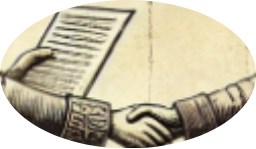
What if…
Berlin, May 22nd, 1939.
The Duce is about to meet Hitler, the man he had also called a “puppet,” despite their ideological affinities. The German Foreign Minister, von Ribbentrop, had been in Rome the previous autumn and met Mussolini and the Prime Minister of Foreign Affairs, Galeazzo Ciano. Ribbentrop had spoken of a possible alliance pact between Germany and Italy, arguing that, perhaps within three or four years, an armed confrontation against France and the United Kingdom would be inevitable.

The Duce had asked many questions, but the German Foreign Minister had explained that there was an alliance between the English and the French, that they had begun to rearm together, that there was a mutual assistance pact between the Russians and the French, that the USA was not in a position to interfer and that Germany had excellent relations with Japan, concluding as follows: "All our dynamism can be directed against Western democracies. This is the main reason why Germany is proposing the Pact and now considers it timely."
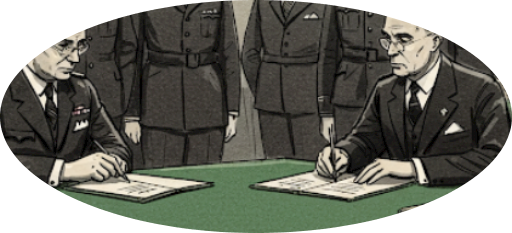
The Duce did not seem convinced then, and he did not seem convinced on May 22nd, 1939, either.
Breaking the agreements made with Hitler, Mussolini decides not to side with Nazi Germany because that would mean Italy entering the war and the Duce does not want his country to be destroyed. Hitler's racial laws, moreover, which had initially thrilled him, now seem like a crazy project: even the king, who should have signed them in 1938, did not want a "Nazified" state.
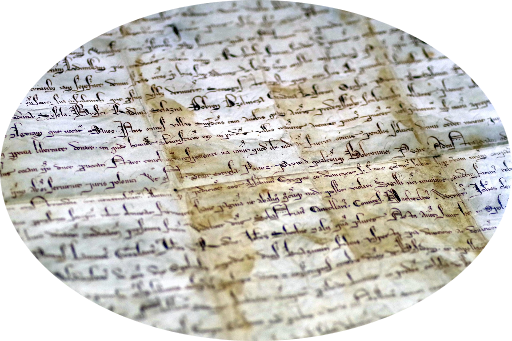
Hitler thus throws his revenge and attacks Italy, as well as Holland, Belgium (which is neutral) and France, because his plan is to dominate the whole of Europe. In 1940 the Fuhrer tried to make a pact with Great Britain, but the government, led by Winston Churchill, rejected the compromise, knowing full well what Hitler was capable of, and prepared to resist the enemy, trusting above all in the air force, the RAF. At this point, Italy had no choice but to side with England and France to contain German enemies.
In 1941, Japan's attack at Pearl Harbor caused the United States to enter the war. The latter intervened in Europe and came to the aid of the allied nations against Germany.
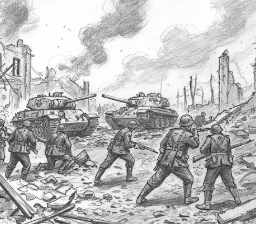
In this way, Italy, thanks to Mussolini, avoided defeat and destruction in its own country. In Italy, however, the partisans were rampant, and fought a bloody battle against the fascists.
It was the Americans who, landing in Sicily in 1943, managed to suppress the partisan struggle, leading to the death of thousands of young people throughout the peninsula. The allies, moreover, by helping Italy, then forced Germany to surrender, thus ending the conflict.
Mussolini, as head of the fascist party, was celebrated as a hero and the party became the largest national party. After the Second World War, Italy
thus became a constitutional monarchy: a model similar to the United Kingdom, which was so popular with the heads of government.
Today we have the king, Emanuele Filiberto of Savoy and the current Prime Minister still belongs to the Fascist Party, which over the years has remained the largest Italian party, precisely in memory of the events that occurred during the Second World War. Even though we escaped a terrible defeat, in Italy there is no freedom of speech, thought, or press. We, women rarely manage to have high-level jobs, we are mostly teachers or housewives.
Was it worth it? Who knows. But that's the story!
What if…?
There was no 2nd World War in Romania
by Antonia
There was no 2nd World War in Romania
If the Second World War had not taken place in Romania, the course of the country would probably have been quite different.
For example:
Without the war, the pre-war political system might have persisted longer. Romania could have maintained its monarchy and avoided the rise of communism that followed the war. Political stability could have led to different economic policies and social developments.
Romania lost territories during and after the war (for example: Bessarabia, Northern Bucovina). If the war had not taken place, they might have kept these areas.
The war and the subsequent communist regime had a serious impact on the Romanian economy. A peaceful period might have allowed for industrial growth, modernisation, and possibly a more diverse economy.
The war brought significant trauma and loss. The lack of conflict may have led to a more stable cultural environment that allowed for greater artistic and intellectual development.
Romania's position in Europe could have changed, possibly aligning more closely with Western powers rather than falling under Soviet influence.
The absence of war would have allowed for better treatment and integration of minority populations, potentially reducing ethnic tensions.
Overall, a peaceful Romania started in the early to mid-20th century could have led to a very different national identity and development path that could shape the wider history of Eastern Europe.
Although Romania's non-participation in the Second World War would have avoided human and material losses, foreign policy influences, especially Soviet pressure, would have prevented a major change in history. Romania would have fallen under the influence of Russia.
Junior Highschool of Egio - Egio, Greece
LIBRARY OF ALEXANDRIA
.
by Nicole and Alithini
If the Library of Alexandria had not been destroyed in 48 BC by Julius Caesar, the course of history and, more generally, the development of science would have changed radically. The library was one of the most important centers of knowledge in the ancient world, containing texts from various civilizations and covering subjects such as mathematics, philosophy, and literature.
The destruction of the library resulted in the loss of priceless works and historical records from various cultures, such as the Egyptian and Greek civilizations. The preservation and dissemination of ancient Greek, Egyptian, Persian, and Indian scientific and philosophical works would have been broader, which would have accelerated the progress of science during the Middle Ages and the Renaissance, ultimately leading to the faster development of modern science and technology. Progress in fields such as mathematics, astronomy, medicine, engineering, and architecture would have developed more quickly as scholars would have had access to a rich collection of knowledge. Since the library was a center of cultural exchange, its survival could also have strengthened the transmission of cultural and philosophical ideas. It is estimated that the library included records covering the history and culture of ancient peoples, which were lost forever.
This means that many cultural bridges were destroyed, and our understanding of ancient history remains incomplete. According to researchers, if the Library of Alexandria had been preserved, human knowledge could have been 1,000 years ahead of where it is today.
Furthermore, the scientific method would have developed earlier, avoiding the "Dark Ages." Two of the most important hypotheses later confirmed were related to astronomy, specifically a theory by Aristarchus that proposed the Earth revolves around the Sun. However, this idea was lost for centuries until it was revived by Copernicus in the 16th century. Had this theory been confirmed earlier, astronomy would have progressed much more quickly, influencing space exploration. As for medicine, which had made significant advancements with the contributions of Hippocrates and Galen, there were theories suggesting that the diseases that struck the Middle Ages could have been dealt with more successfully. Later, hypotheses were also made regarding the development of technology, geography, and philosophy.
The destruction of the Library of Alexandria was one of the greatest blows in human history and remains an unsolved mystery.
Scoala Gimnaziala „Sfanta Cuvioasa Parascheva” - Smardan County, Galati, Romania
What if Columbus never discovered America,
by Corina and Manuela
In the year 1492, Christopher Columbus set sail across the ocean and arrived in the Americas. But basically, what if it didn't happen? What other ways would it have forever changed the course of our world? The Native American kingdoms and empires, such as the Mayans, Toltecs, Aztecs, Incas, and countless other tribes of North America, could have continued to develop without the interruption. Mostly, there would be no wars, less diseases, and fewer forced changes of people if the Spanish conquerors had not invaded the Americas after Columbus. Firstly, many another explorer would have still discovered the New World, such as the English or maybe the Portuguese. Thereafter, Europe's countries may have controlled the continent differently, not as it is now. Perhaps the USA wouldn't be speaking English but speaking Portuguese or another language instead! Another significant difference lies with the trade. Columbus brought about the huge interchange of goods between Europe and the Americas, which is also called the Columbian Exchange.
In the absence of him, many crops such as tomatoes, potatoes, and even chocolate would have been exported to Europe after a long period. It would certainly have been a far different Europe. The world in the aftermath would have looked unlike any corner of the world we are familiar with today. In spite of the fact that some other country would have probably discovered the Americas before long, the world would not have been steered in the same direction.
The United States of America, the country that we recognize today, would probably not have come into existence! Would the future of the over 1700 languages worldwide be different if Columbus had not ventured into the new way?
What do you think?
Scuola Secondaria di l grado ‘V. Alfieri’I.C. Alessandria Spinetta- Alessandria Italy
The Battle of Adwa,
by Ivan
The battle of Adua
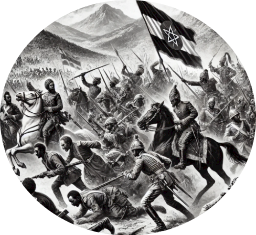
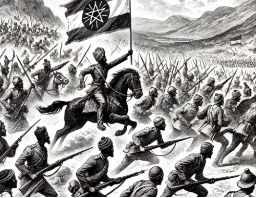
March 1st, 1896: in Abyssinia is the day of the Italian military disaster of Adua, in which 14,000 soldiers of General Baratieri are attacked and defeated by 120,000 Ethiopians under the command of Negus Menelik. Surrender comes at the end of a terrible battle.
What if?
On February 29th and March 1st, 1896, Francesco Crispi ordered the Italian army to attack.
Shortly before the battle, however, a spy from the Ethiopian army explained all the plans of his army to the Italian soldiers, with this information they surrounded the opposing army and won the battle.
This was yet another victory of a European army on African territory, but the European armies knew that they could still lose battles and in this case lose men and therefore, become more vulnerable to possible attacks by other nations.
To avoid all this, all the representatives of each country, African and European, met together to discuss the matter in Tunisia (in the area of present-day Bizerte).
In the end, the representatives decided that it was better to leave those territories as they were, trying to avoid the risk of creating wars.
After this pact between continents, the PO (peace organization) was born to maintain peace in these territories, it was also agreed that every time a European or African state was attacked, both continents had to intervene as a sign of protection.
After this decision, when the representatives of the state returned to their country, they were all appreciated for their decisions of peace by their citizens.

The states of the two continents incredibly never faced other wars again, this is because the other continents did not have the necessary power to face two such powerful continents, so they did not attack, and there was no risk of being outclassed by this alliance.
At the beginning, it was not easy for the citizens to start living together with the inhabitants of the lands colonized by their country, but after several decades this thing becomes normal.
Dumbrāvita Secondary School - Timis County, Romania
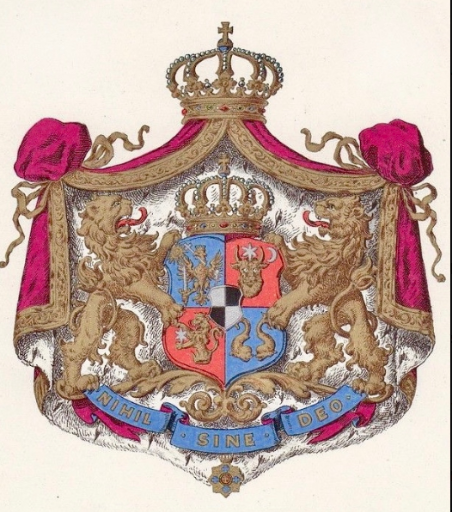
What If the Romanian Monarchy remained?
By Amos and Dragos
The Romanian Monarchy plays a big part of our history and it started around the 18th hundreds. What if it wasn’t history? What if Monarchy still existed ‘till this day in our country?
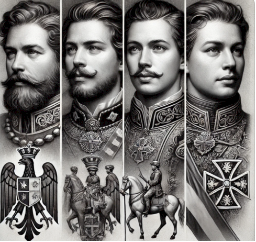
First we need to mention that Romania had 4 kings:
-Carol the 1st
-Ferdinand
-Carol the 2nd
-Michael
Carol the 1st being the king that
ruled this country for the longest
period of time (48 years)
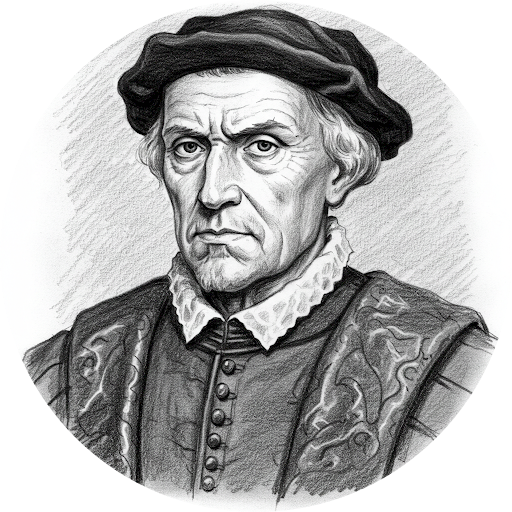
If Monarchy still existed in our country, it probably would have ended in 2017 because the last king was Michael the 1st and we can assume that he would have continued to be the king until he died in 2017.
What if he had a successor named Michael the 2nd? There are about two options: he would have died later or he would have still died in 2017, but his son, Michael the 2nd, would have continued to rule ‘till present. If so Romania would have turned in a kingdom like U.K., Belgium or like other countries that are still ruled by king and queens to this day. By that I mean that we would have more freedom than we had 200 years ago, when the Monarchy started.
We don’t think that if the Monarchy would be back it would be necessarily bad, but we think that Romania is better as a republic.
Junior Highschool of Egio - Egio, Greece
What if ... Pericles hadn’t die and continue his work?
by Harry and Elpida
Pericles, one of the most important leaders of ancient Athens, lived in the fifth century BC and played a crucial role in the development of the city-state. He was a general, statesman, and orator known for his wisdom, justice, and vision for Athens.
Pericles assumed power during a period when Athens was thriving after the Persian Wars. His goal was to make Athens the center of the Greek world and to strengthen it politically, militarily, and culturally. One of his most significant achievements was the enhancement of democracy. Pericles believed that Athenian citizens should have the right to participate in governance, and he enacted laws that made civic participation more accessible, even to the poorest citizens.
One of the most well-known moments of his leadership was the era of great projects, the most famous of which is the Parthenon, a temple dedicated to the goddess Athena located on the Acropolis. These projects were not only a display of wealth but also a way to provide jobs to many Athenians and boost the city’s economy.
Pericles also led Athens into a period of cultural development. During his time, the arts, philosophy, and theater flourished. Great artists like Phidias worked on the Acropolis projects, while philosophers like Socrates began to spread their ideas.
However, Pericles’ leadership was not without challenges; Athens came into conflict with Sparta during the Peloponnesian War. Pericles tried to keep Athens strong, but the city experienced a major plague that ultimately led to his death in 429 BC.
The question arises: what if… Pericles hadn’t died at that time and continued his work? If he had lived longer, Athens may have emerged victorious in the Peloponnesian War.
Pericles had a defensive strategy based on Athens’s naval strength and avoidance of direct confrontations with Sparta. By the war's end, Athens might not have suffered so many devastations and could have maintained its power for more years.
Moreover, the continuation of his leadership could have led to the completion of even more projects in Athens, reinforcing its position as a cultural and spiritual center. New temples, theaters, and other public buildings might have been constructed, making the city even more impressive. The Acropolis could have been expanded even further, and Athens might have become an unparalleled example of culture.
Pericles also had a vision for the unity of the Greek cities. If he had lived, he might have succeeded in establishing an alliance among the Greek city-states, thereby preventing internal conflicts that ultimately weakened Greece.
This unity could have protected Greece from external foes like Macedonia under Philip and later Alexander.

Regarding education and culture, the influence of Athens on history could have been even deeper. Athens would likely have remained the center of philosophy and science for a longer time, promoting new ideas and discoveries. The philosophies of Socrates, Plato, and Aristotle might have gained greater popularity and influence earlier in history.
Under the leadership of Pericles, Athens could have become a power not just militarily but also culturally, leaving an even greater legacy for humanity. Perhaps the idea of democracy would have spread more quickly and had a deeper impact on the world.
Ultimately, if Pericles had continued to lead Athens, the history of Greece and possibly the entire Western world could have been shaped differently. However, his legacy remains alive, and his work continues to inspire us even today.

Scoala Gimnaziala „Sfanta Cuvioasa Parascheva” - Smardan County, Galati, Romania
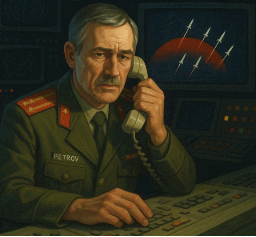
Colonel Stanislav Petrov had responded to the nuclear attack,
by Gabriel and David
What if Colonel Stanislav Petrov had responded to the nuclear attack warning by launching a Soviet nuclear missile in 1983?
If he had done so, it could have led to a chain of catastrophic events, resulting in a nuclear war. The Soviet Union would have lunched a counter offensive attack, thinking the US had fired the missiles first. The United States would have interpreted this as a direct attack, and fire its own nuclear missiles. This exchange could have started a nuclear war.
The consequences would be much more then the explosions, the war could have started a nuclear winter, that could make the earth unliveable. Basically the war would destroy our environment, and collapse the society, and for the lucky ones that survive the war, the long term radioactive ecosystem would most likely end mankind.
Luckily, Petrov didn’t follow the protocol; he chose to trust his instincts and didn’t report the alarm. If he had acted differently, the world might have faced a tragedy. Petrov’s story just shows us how much a guy’s judgment can impact the course of history.
Scuola Secondaria di l grado ‘V. Alfieri’I.C. Alessandria Spinetta- Alessandria Italy
Attack in Capaci, Sicily (1992),
by Christian Biancotto
Saturday, May 23rd, 1992, with a charge composed of TNT, is killed the magistrate anti-mafia Giovanni Falcone. The bombers blew up a section of the A29 highway while the escort’s motorcade with the judge, his wife, and police officers was passing over it. In addition to the judge, four other people died: his wife Francesca Morvillo, also magistrate, and the agents of the escort Vito Schifani, Rocco Dicillo and Antonio Montinaro. There were twenty-three wounded, including agents Paolo Capuzza, Angelo Corbo, Gaspare Cervello and the judicial driver Giuseppe Costanza.
Giovanni Falcone and his men drive away with their cars; the judge is in a white Fiat Croma. Everyone sees a police car going at a very high speed chasing the car of La Barbera and this makes all suspicious, who then try to get further away, going faster and so end in a ditch. Fortunately, everyone is fine. Only after a few hours they will find out that they have foiled a bomb attack. La Barbera is arrested by the police, he gives other names of members of Cosa Nostra. Brusca, his accomplice, is arrested by a patrol stationed in Capaci.
To find out who is the “chef of chiefs”, Falcone devised a plan and, in agreement with his men, they infiltrated the house of the boss Totò Riina.
He has a grandson named Paolo, who has become friend to Emanuele, the son of Vito Schifani, agent of Falcone’s escort. While the two children are playing, Paolo tells Giovanni that his grandfather wants to paint the house and is also looking for a waiter and cook. Through a repentant agents, he manages to infiltrate and win the trust of Totò Riina. They show up at his place shortly: Vito is hired as a painter, Rocco as a waiter, and Antonio as a cook. Vito, having to paint all the rooms of the house, hides microchips, so that the police can know in advance the boss’s plans. One afternoon, mafiosi come to the house Riina; Vito, who is in the next room, listens to the conversation and so he discovers the name of the mander of the escaped massacre of Capaci, which is precisely Totò Riina.
From this moment, the trap is set: Vito enters the inner circle of the boss’ collaborators and, after days of interceptions, the police manages to catch him. It’s a big blow to the mob.
The major trial begins shortly, with all the bosses of Cosa Nostra and presided by judge Giovanni Falcone. Riina has been the Leader of Cosa Nostra since 1982: he will die in prison in 2017, while serving one of 26 life sentences for which he is accused. The three officers, after the trial, proudly continued to wear the uniform and protect all citizens. Today, Vito, Antonio, and Rocco are retired. Giovanni Falcone is a widower from some years and spends much time in Palermo with those guys that were with him that day and saved his life. They are often together, with the children of Falcone, Lucia, Manfredi and Fiammetta, sitting at the table chatting and laughing. Sometimes, there are also Gaetano and Giovanni, the sons of Antonio, with children. Sometimes, they also join Emanuele, the son of Vito, who today is always very busy, since he is a captain of the Italian Guardia di Finanza. Rocco always comes with his wife, Alba, who married in July 1992. And when between a meal and the other, between a glass of wine and a laugh, they stop thinking about that 1992, remember the great operation that freed Italy from the yoke of the Mafia, not even imagining how things could have gone…
Dumbrāvita Secondary School - Timis County, Romania
Queen Maria,
by Mara
If Queen Maria of Romania had not been sidelined from political life in 1930, Romanian history might have taken a different course.
When her son, King Carol II, returned to the throne in 1930, he distanced Maria from court politics. Had she remained active, she might have acted as a moderating force against Carol II’s increasingly authoritarian tendencies and personal scandals, potentially improving the monarchy’s reputation.
Maria had strong ties with Britain (as the granddaughter of Queen Victoria) and other Western allies. She could have used her influence to maintain Romania’s pro-Western alignment, possibly strengthening diplomatic and military ties before World War II.
Maria was a popular and politically savvy queen, often involved in state affairs, especially during World War I. Suppose she had continued to be politically active. In that case, she might have played a role in balancing the power struggles between political factions, preventing Carol II from centralizing power through his royal dictatorship in 1938.
Carol II’s reign was marked by corruption and political instability. Maria, as a respected public figure, might have tempered his worst excesse or even influenced him to adopt a more constitutional approach, preventing some of the discontent that eventually led to his abdication in 1940.
Maria’s political instincts leaned toward Western alliances. While Romania eventually sided with Nazi Germany, her presence might have pushed for a more cautious foreign policy, possibly delaying or altering Romania’s role in the war. Ultimately, while Maria’s influence might not have entirely changed Romania’s fate in the tumultuous 1930s and 1940s, her continued political involvement could have strengthened the monarchy, stabilized domestic politics, and reinforced Romania’s ties to the West.
Junior Highschool of Egio - Egio, Greece
Art in the Greek War of Independence of 1821,
by Anastasios and Hristina
Art is an integral part of the cultural heritage of every nation, serving as a mirror of the historical moments that shape its identity. During the Greek War of Independence in 1821, art was not merely a means of expression or documentation of events; it functioned as a source of inspiration, a vehicle for spreading ideas, and a bridge connecting the Greeks with the international community. It played a crucial role in disseminating the ideals of freedom and independence, inspiring the Greek people and strengthening the Philhellenic movement worldwide. Through painting, poetry, music, and literature, the spirit of the struggle for freedom transcended Greek borders, moving Philhellenes and bolstering the Greek cause.
In this text, we will examine the contribution of art to the Greek War of Independence, both through the works of artists and through the power of art to mobilize the masses and unite cultures.
The Greek War of Independence, proclaimed on March 25, 1821, was a landmark event in the struggle for the liberation of the Greeks from the Ottoman Empire. Although the Revolution faced resistance from the great powers of the time, the intellectual world of Europe played a decisive role in shaping a strong Philhellenic movement. Art—particularly painting and poetry—was one of the primary means of expression and support for the Greek cause.
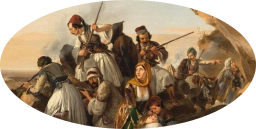
1. Painting in the Greek War of Independence
Painting served as a powerful medium for spreading the Greek struggle, capturing the tragic moments of the revolution and glorifying the heroes of the fight.
Greek Painters:
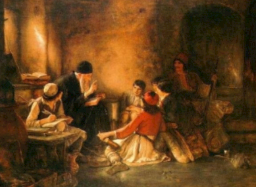
Nikolaos Gyzis, one of the most significant Greek painters of the 19th century, depicted the importance of education and intellect through works such as Hellenic School in the Time of Slavery. This painting, now widely known as The Secret School, was created between 1885 and 1886 and was first exhibited in Athens in 1888 under its original title. The artwork portrays an elderly teacher secretly educating young children during the period of Ottoman rule, emphasizing the significance of education and the preservation of Greek identity under challenging circumstances.
Nikiforos Lytras, one of the most important Greek painters of the 19th century, captured the sacrifice and heroism of Konstantinos Kanaris in his work "The Burning of the Turkish Flagship by Kanaris." This painting, created around 1873, depicts the moment when Kanaris and his companions set fire to the Turkish flagship off the coast of Chios on the night of June 6-7, 1822. In the painting, the burning flagship is placed in the background, while the figures of Kanaris and his fellow fighters in the boat are realistically portrayed in the foreground, with an emphasis on their clothing and the intensity of the moment. Based on accounts from Kanaris himself, Lytras sought to accurately depict this heroic act, highlighting the superhuman effort of the fighters.
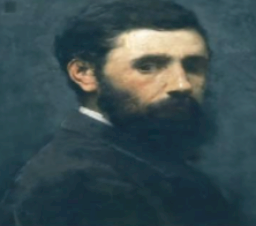
Nikiforos Lytras
The work was exhibited in 1873 at the Vienna International Exhibition and later, in 1878, at the Paris International Exhibition, receiving wide recognition. Today, it is housed in the E. Averoff Gallery in Metsovo.
European Painters and Philhellenes: Ο Eugène Delacroix, the leading French painter of the 19th century, was deeply inspired by the Greek War of Independence of 1821, creating works that awakened European public opinion and strengthened the Philhellenic movement. His works, such as "The Massacre of Chios," "Greece on the Ruins of Missolonghi," and "The Battle of Giaour and the Pasha," powerfully captured the atrocities and heroism of the Greek people, mobilizing international support for the Greek cause.
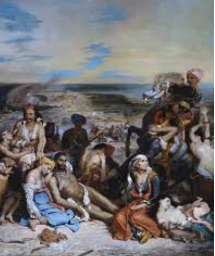
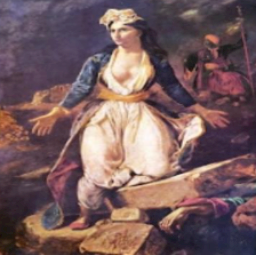
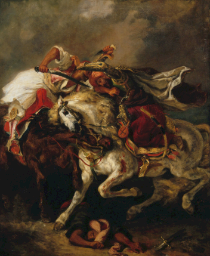
The massacre of Chios Greece on the Ruins of Missolonghi The Battle oh Giaour and Pasha
Ludovico Lipparini (February 17, 1800 – March 10, 1856) was an Italian painter and philhellene, known for his works depicting scenes from the Greek War of Independence of 1821. Inspired by the events of the time, he created paintings such as "The Archbishop of Patras Germanos Raises the Flag of Independence" and "The Oath of Lord Byron”. These works by Lipparini contributed to raising awareness among the European public about the Greek struggle and strengthened the Philhellenic movement.
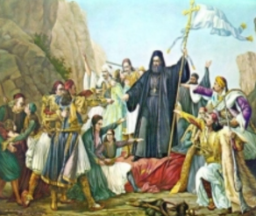
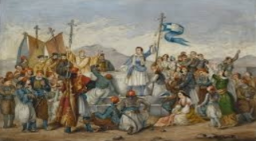
The Archbishop of Patras Germanos Raises the Flag of Independence
The Oath of Lord Byron
Music in the Greek Revolution
Music, both Greek and European, played an important role in boosting the morale of the revolutionaries and promoting their struggle.
Classical Music and Philhellenism:
Foreign Composers: Ludwig van Beethoven, although he did not compose works specifically for the Greek Revolution, was a passionate supporter of struggles for freedom. His works, such as Symphony No. 3, "Eroica," reflect the ideals of heroism and independence, which were aligned with the Greek fight for freedom. A supporter of liberty and independence, Beethoven's name became associated with revolutionary ideas through works like the "Eroica Symphony." Although he did not write compositions dedicated specifically to the Greek Revolution, Beethoven was known for his support of struggles for freedom and independence. His Symphony No. 3, known as "Eroica" (Sinfonia Eroica), reflects the ideals of heroism and independence, which resonate with the Greek struggle for freedom.
Poetry and Literature in the Greek Revolution
Poetry and literature highlighted the ideals of freedom and sacrifice, inspiring both Greeks and philhellenes. Greek poets used language as a weapon to boost the morale of the Greeks.
The English poet Lord Byron wrote inspired poems, such as Childe Harold's Pilgrimage, that celebrated Greek independence and the heroism of the Greeks. Byron’s poem that most clearly praises the Greek struggle and the heroism of the Greeks is The Isles of Greece, which was written during the period of the Revolution.
Dionysios Solomos, with his Hymn to Liberty, became the poet of the Greek struggle. His poetry continues to inspire the Greek people to this day. In addition to the Hymn to Liberty, his significant works include excerpts from The Free Besieged, The Woman of Zakynthos, and Lampros. Despite the fragmentary nature of many of his works, his contribution to the formation of modern Greek poetry is immense.
Andreas Kalvos (1792-1869) was one of the most significant Greek poets of the 19th century, known for his lyrical odes inspired by the Greek War of Independence in 1821. In his collections The Lyre (1824) and Lyricals (1826), he included poems that praise the struggle for freedom and the ideals of the Greek nation.
Aristotelis Valaoritis (1824-1879) was one of the most important Greek poets of the 19th century, known for his works that praise the sacrifices. And the ideals of the fighters of the Greek War of Independence of 1821. In his poems, such as "Kira Fosyni" (1859), "Athanasios Diakos" (1867), and "Astrapogiannis" (1867), he vividly depicts the heroism and self-sacrifice of the revolutionaries. His last work, "O Fotinos," remained unfinished due to his death in 1879.

Philhellenism as an Artistic Movement
Philhellenism became a significant artistic movement during the Greek Revolution, with art serving as a means to promote philhellenic messages and strengthen international support for Greece..
Fundraising and Financial Support: Jean-Gabriel Eynard: The Swiss banker Jean-Gabriel Eynard played a decisive role in the financial support of the Greek struggle. He established philhellenic committees in Switzerland and donated significant amounts from his personal fortune to assist the Greek revolutionaries.
Artistic Initiatives: Many European artists contributed through their art to raise funds in support of the Greek Revolution. Composers such as Hector Berlioz with his work "La Révolution grecque" and Gioachino Rossini with the opera "Le Siège de Corinthe" presented pieces inspired by the Greek struggle, with the proceeds being donated to fundraisers for the Greeks.
CONCLUSION
Through music, painting, and literature, art served as a catalyst for raising awareness and mobilizing the international community in support of Greek independence, highlighting philhellenism as a multifaceted movement with deep cultural and political influence. Art functioned as a means of expressing philhellenism and national pride, shaping the image of the Greek Revolution both in Greece and abroad.
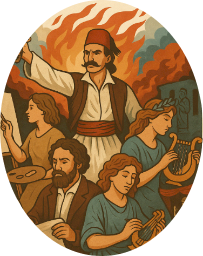
Through painting, literature, music, and theater, the Greek struggle found international resonance, playing a decisive role in shaping modern Greek identity.
Scoala Gimnaziala „Sfanta Cuvioasa Parascheva” - Smardan County, Galati, Romania
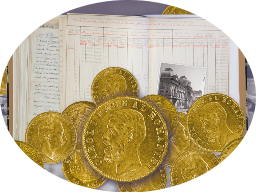
What if the Romanian treasury had not been stolen by The Russians?,
by Gabriel and Tudor
What if The romanian treasury had not been stolen by The Russians?
*If the Romanian treasury had not been stolen by the Russians, the country’s economy would not have been affected.
*At the same time in Romania, The army would increase , education would evolve and tourism services would improve because the pieces of the Romanian treasury are museum pieces.
*And last but not least, if the Romanian treasury had not been stolen by the Russians, pollution in Romania would decrease considerably because the non-polluting means of transport, the objects and habits of everyday life, in order to be sustainable, they depend on considerable amounts of money.
Scuola Secondaria di l grado ‘V. Alfieri’I.C. Alessandria Spinetta- Alessandria Italy
What if Italy hadn't participated in World War I?
By Lorenzo
What if Italy hadn't participated in World War I?
Before World War I, Italy was a relatively young nation, having only been unified in 1861. Economically, Italy was experiencing a period of industrial growth but was still heavily dependent on agriculture. The working class was beginning to grow and organize in terms of alliances. Italy was part of the "Triple Alliance" along with Germany and Austria-Hungary, but when war broke out in 1914, the country decided to remain neutral. This decision was influenced by an internal division between the "neutralists," who wanted to avoid the conflict, and the "interventionists," who wanted to join the Allies. The situation changed in 1915 when Italy signed the "Treaty of London" and declared war on Austria-Hungary, thus entering the conflict.
But if...
If Italy had not entered the war, things might have gone differently.Italy could have focused more on internal economic growth, developing industries and infrastructure without the devastation and military expenses associated with the conflict. This development, in turn, would not have led to the subsequent discontent, which, along with other factors, led to the rise of Fascism. Italian culture could have thrived even more, without the human and material losses. We could have seen an even greater blossoming of art, literature, and sciences, which would have been absolutely free in the 1920s and 1930s. Italy could have maintained more stable and peaceful relations with other European countries. It might have become an important mediator in Europe and the Mediterranean. In domestic politics, not participating in the war could have influenced the political landscape, preventing the rise of Fascism. It's interesting to imagine how things could have changed, but of course, it's just a hypothesis. History took its course and shaped the country we live in today.
What if there had not been any Revolution?
by Sara
- Full access to our public library
- Save favorite books
- Interact with authors
- < BEGINNING
- END >
-
DOWNLOAD
-
LIKE
-
COMMENT()
-
SHARE
-
SAVE
-
BUY THIS BOOK
(from $21.39+) -
BUY THIS BOOK
(from $21.39+) - DOWNLOAD
- LIKE
- COMMENT ()
- SHARE
- SAVE
- REMIX
- Report
-
BUY
-
LIKE
-
COMMENT()
-
SHARE
- Excessive Violence
- Harassment
- Offensive Pictures
- Spelling & Grammar Errors
- Unfinished
- Other Problem






COMMENTS
Click 'X' to report any negative comments. Thanks!