For one who wants to explore Texas!!!

David Crockett was born in eastern Tennessee on August 17, 1786, one of nine children of pioneer parents John and Rebecca (Hawkins) Crockett. John Crockett struggled to make ends meet, and the family moved several times throughout Crockett’s childhood. Davy was often hired out to help pay his family’s debts.
Crockett received no significant academic education. For much of his teenage life, his teacher was the frontier, where he became a skilled woodsman, scout and hunter.Military Career
In 1813, Crockett joined the Tennessee militia as a scout and fought against the Creek Indians in Alabama. He participated in the Indian massacre at Tallushatchee in retaliation for a Native American attack on fort mims.
During the war of 1812, Crockett re-enlisted as Third Sergeant under Captain John Cowan. He went to Spanish Florida to help Andrew Jackson clear British forces, including British-trained Indians, from the region.
After being discharged in 1815, he returned home, where his wife Polly soon died. He remarried, moved his family to Lawrence County, Tennessee, started several businesses and began his political career.
Sam Houston was an American general and statesman who played a prominent role in the Texas Revolution. He served as the first and third president of the Republic of Texas and was one of the first two individuals to represent Texas in the United States Senate. He also served as the sixth governor of Tennessee and the seventh governor of Texas, the only individual to be elected governor of two different states in the United States.
Born in Rockbridge County, Virginia, Houston and his family relocated to Maryville, Tennessee, while he was a teenager. Houston later ran away from home, spending about three years living with the Cherokee, becoming known as "Raven". He served under General Andrew Jackson in the War of 1812; afterwards, he was appointed as a sub-agent to oversee the removal of the Cherokee from Tennessee into Arkansas Territory in 1818. With the support of Jackson, among others, Houston won election to the United States House of Representatives in 1823. He strongly supported Jackson's presidential candidacies and, in 1827, Houston was elected as the governor of Tennessee. In 1829, after divorcing his first wife, Houston resigned from office, and moved to the Arkansas Territory to live with the Cherokee once more.
Houston settled in Texas in 1832. After the Battle of Gonzales, he helped organize Texas's provisional government and was selected as the top-ranking official in the Texian Army. He led the Texian Army to victory at the Battle of San Jacinto, the decisive battle in Texas' war for independence against Mexico. After the war, Houston won the 1836 Texan
presidential election.
He left office due to term limits in 1838, but won another term in the 1841 Texas presidential election. Houston played a key role in the annexation of Texas by the United States in 1845 and, in 1846, was elected to represent Texas in the United States Senate. He joined the Democratic Party and supported President James K. Polk's prosecution of the Mexican–American War.
His Senate record was marked by his unionism and opposition to radicals from both the North and South. He voted for the Compromise of 1850, which settled many of the residual territorial issues from the Mexican–American War and the annexation of Texas. Houston owned slaves throughout his life. He voted against the Kansas–Nebraska Act, as he believed it would lead to increased sectional tensions over slavery, and his opposition to that act led him to leave the Democratic Party. He was an unsuccessful candidate for the presidential nomination of the American Party in the 1856 presidential election, as well as for the Constitutional Union Party in the 1860 presidential election. In 1859, Houston won election as the governor of Texas. In this role, he opposed secession, and unsuccessfully sought to keep Texas out of the Confederate States of America. He was forced out of office in 1861, and died two years later in 1863. Houston's name has been honored in numerous ways, and he is the eponym of the city of Houston, the fourth-most-populous city in the United State .
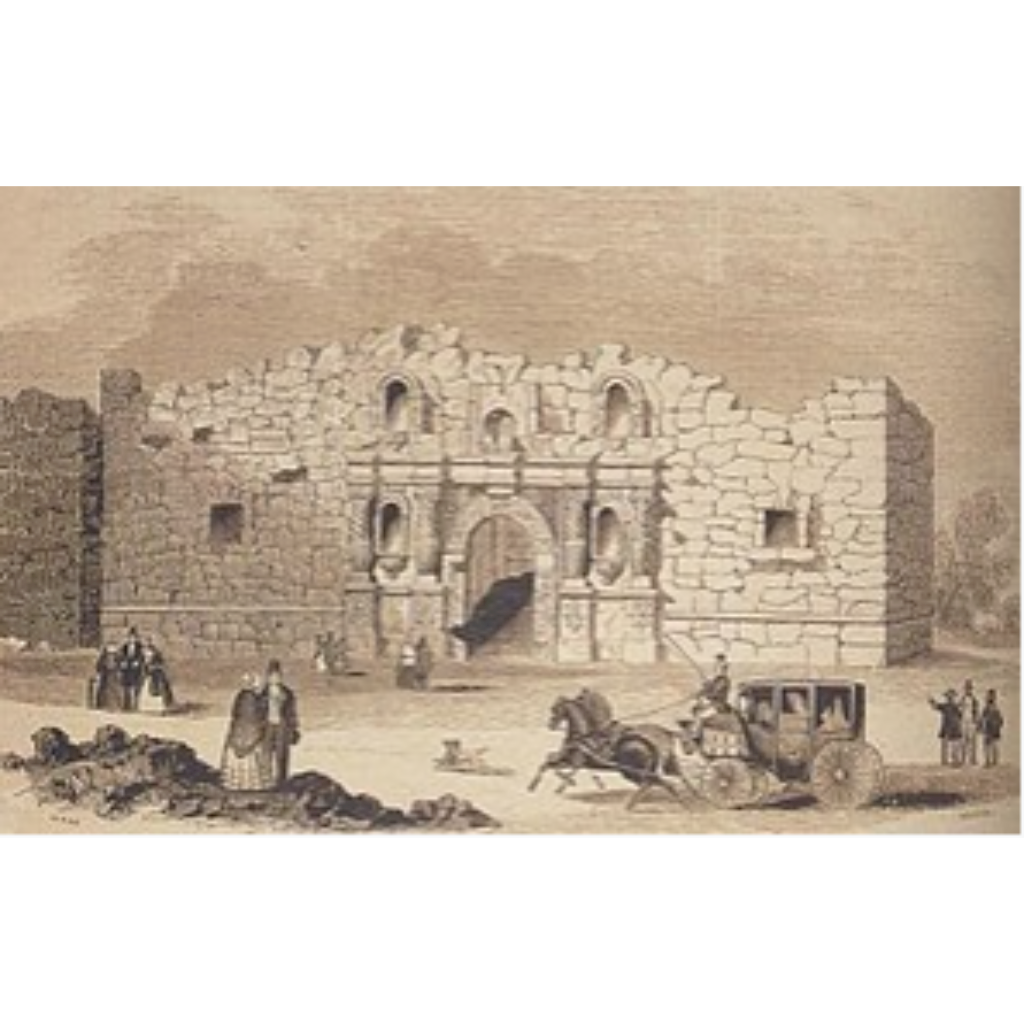
The Battle of the Alamo (February 23 – March 6, 1836) was a pivotal event and military engagement in the Texas Revolution. Following a 13-day siege, Mexican troops under President General Antonio López de Santa Anna reclaimed the Alamo Mission near San Antonio de Béxar (modern-day San Antonio, Texas, United States). About one hundred Texians were then garrisoned at the mission, with around a hundred subsequent reinforcements led by eventual Alamo co-commanders James Bowie and William B. Travis. On February 23, approximately 1,500 Mexicans marched into San Antonio de Béxar as the first step in a campaign to retake Texas. In the early morning hours of March 6, the Mexican Army advanced on the Alamo. After repelling two attacks, the Texians were unable to fend off a third attack. As Mexican soldiers scaled the walls, most of the Texian fighters withdrew into interior buildings. Those who were unable to reach these points were slain by the Mexican cavalry as they attempted to escape. Almost all of the Texian inhabitants were killed.
- Full access to our public library
- Save favorite books
- Interact with authors

- < BEGINNING
- END >
-
DOWNLOAD
-
LIKE(3)
-
COMMENT()
-
SHARE
-
SAVE
-
BUY THIS BOOK
(from $2.99+) -
BUY THIS BOOK
(from $2.99+) - DOWNLOAD
- LIKE (3)
- COMMENT ()
- SHARE
- SAVE
- Report
-
BUY
-
LIKE(3)
-
COMMENT()
-
SHARE
- Excessive Violence
- Harassment
- Offensive Pictures
- Spelling & Grammar Errors
- Unfinished
- Other Problem





COMMENTS
Click 'X' to report any negative comments. Thanks!