This book belongs to:
*Ceylan BAL *Doreen BARR
*Ioanna PATIOU *Maria SOURVALOU
*Elif GÜRBÜZ *Maria PENLİDİ *Retsiou ELEFTHERIA *Tzavla DESPOINA

Sound Experiment
Materials
-5 glass bottles of the same size
-Water
-Wooden spoon
-food coloring
Ceylan BAL,Cemil Meriç Anaokulu,TÜRKİYE
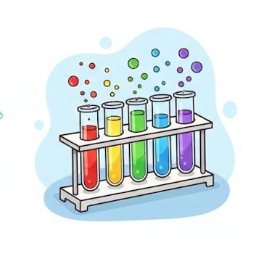
1.Put different amounts of water in the bottles.
2.Add a different color of food coloring to each one.
3.Tap the bottles one by one with a wooden spoon. Listen to the sounds. Identify which bottles produced the highest and lowest pitched sounds.
Ceylan BAL,Cemil Meriç Anaokulu,TÜRKİYE

Why do the bottles make different sounds even though they are identical?
Bottles contain air along with water. When bottles are tapped, the water and air inside vibrate. We hear the vibration in the air as sound. Since the amount of water and air in each bottle varies, they all produce different sounds.
Ceylan BAL,Cemil Meriç Anaokulu,TÜRKİYE
Ceylan BAL,Cemil Meriç Anaokulu,TÜRKİYE
The Upside-Down Cup Experiment
Ceylan BAL,Cemil Meriç Anaokulu,TÜRKİYE
Materials
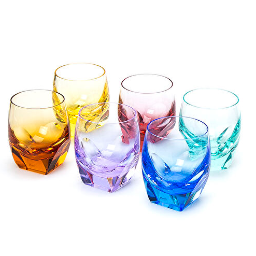
-glass of water
-water
-A4 paper
Ceylan BAL,Cemil Meriç Anaokulu,TÜRKİYE
1.Fill the glass with water to the brim.
2.Place the paper gently on top of the glass.
3.Gently press down on the paper with your hand and turn the glass upside down.
Ceylan BAL,Cemil Meriç Anaokulu,TÜRKİYE
No water spilled, right? Why?
Ceylan BAL,Cemil Meriç Anaokulu,TÜRKİYE
When a glass is inverted, the water creates downward pressure. The outside air also exerts pressure into the glass.However, the paper sealing the mouth of the cup prevents air from entering. Because the pressure exerted by the air is greater than the pressure created by the water inside, the paper stays in place and the water doesn't spill.
Three clear glasses
Water
Cold water
Warm water
Hot water
A small leaf (or food coloring )
A notebook (optional)
A pencil (optional)
Maria Sourvalou, 103rd kindergarden of Thessaloniki

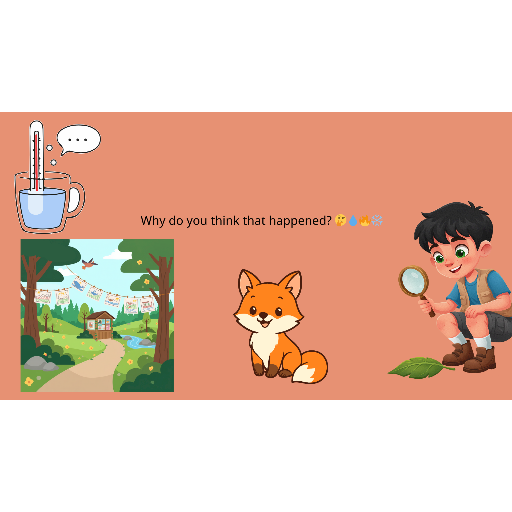
Once upon a time, in a tiny village , there lived a curious little fox named Luna . Luna loved science and magic , especially anything with water .
One sunny day , Luna found three clear glasses .
“Let’s try a water experiment!” she said excitedly .
She filled the first glass with cold water , the second with warm water , and the third with hot water . Then she gently dropped a blue leaf into each glass.


Magic happened!
The leaf moved very slowly in the cold water , faster in the warm water , and danced quickly in the hot water !
Luna clapped her paws and laughed.
“Water can move differently!” she learned .
As the sun set , Luna wrote her discovery in her notebook , knowing that science is just another kind of magic .
The end


The Cup Phone
Materials:
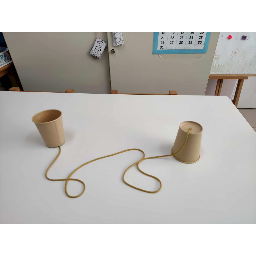
2 plastic cups
1 string
Ioanna Patiou, 3rd Kindergarten School of Mytilene, Greece
Let's experiment...
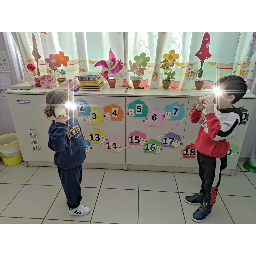
1. Every child holds one cup
2. They both pull the string tight
3. One child speaks into the cup
4. The other child listens
Ioanna Patiou, 3rd Kindergarten School of Mytilene, Greece
What do we observe?
1. When we speak our voice moves
2. The cup moves too
3. The string takes the movement and sends it to the other cup
4. The other child hears the voice!
Our voice goes on a journey
Ioanna Patiou, 3rd Kindergarten School of Mytilene, Greece
How does this work?
Ioanna Patiou, 3rd Kindergarten School of Mytilene, Greece
The cup telephone works because sound is vibration and vibrations can travel through solid materials like a tight string.
The sound is a movement that travels!!!
-6 clear jars
-Water
-Red, blue and yellow food colouring
-6 paper towels
-Tray (optional)
Retsiou Elefteria, Kindergarten of Kalo Chorio Greece

Step 1: Prepare the coloured water
Fill 3 jars with water (about ¾ full). Add red, blue and yellow food colouring, one colour in each jar.
Step 2: Arrange the jars
Place the 3 coloured jars and 3 empty jars in a circle, alternating coloured and empty jars.
Step 3: Add the paper towels
Fold each paper towel into a long strip. Place one end into a coloured jar and the other end into the neighbouring empty jar.
Step 4: Observe
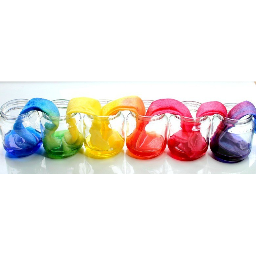
Watch the water “walk” along the paper towels. The colours slowly travel and mix, creating new colours in the empty jars.
Results
-All jars slowly fill with coloured water
-The water travels through the paper towels
-Primary colours mix together
-New secondary colours are formed
-A rainbow appears
Why does this happen?
-The water moves up the paper towels because of capillary action.
-The tiny spaces inside the paper towel help the water travel upwards.
-As the water moves, it carries the colours with it.-When the colours meet in the empty jars, they mix and create new colours.
Catch the Loop challenge (Air Pressure Experiment)
1. Water
2. Large plastic bottle
3. Straw
4. Small metal paperclip
5. Medium metal paperclip
6. Plasticine
7. Thin plastic cord or string (with a hole)
8. Scissors
Tzavla Despoina, Kindergarten of Kalo Chorio, Greece
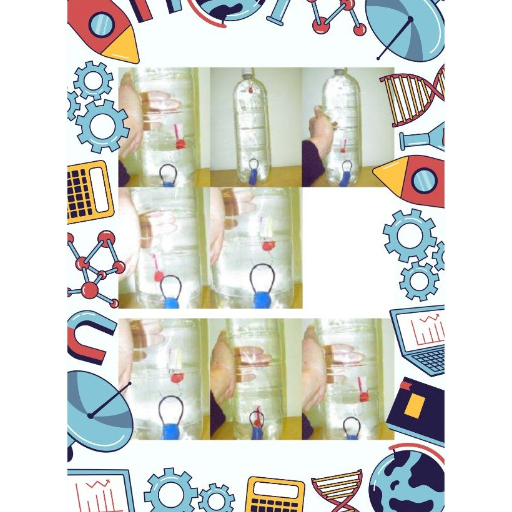
1. Fill the plastic bottle with water, leaving a small air space at the top
2. Cut a short piece of straw
3. Attach the paper clip and washers to the straw to make the diver.
4. Shape the paper clip into a small hook.
5. Add a little plasticine to balance the diver so it floats upright.
6. Cut a small piece of string and form a loop.
7. Place the loop inside the bottle.
8. Carefully put the diver into the bottle.
9. Close the bottle tightly.
10. Squeeze the bottle to make the diver sink.
11. Release the bottle to make the diver rise.
12. Try to catch the loop with the diver.
Procedure
Observations-What Happend?
* The diver floats because it contains air
* When we squeeze the bottle, pressure increases
* The air inside the diver is compressed
* The diver becomes heavier and sinks
* When pressure is released, the diver rises again
* We control the diver’s movement using pressure
> Children explore water pressure and buoyancy
> Children observe cause and effect
*Try pressing the bottle at
the top, middle, or bottom.
*See which spot works
best to make the loop move.
*Try different ways of
pressing and see who
can do it fastest!
Tzavla Despoina,
Kindergarten of Kalo Chorio, Greece

Bending Light with Water
Materials
A clear glass
Water
A flashlight
A white wall or paper
Dark room
Maria Penlidi, 103rd Kindergarten of Thessaloniki, Greece

Steps
1.Fill the glass with water
2. Make the room a little dark
3. Turn on the flashlight
4. Shine the light through the glass of water
5. Point the light at the wall or white paper
6. Watch what happens to the light
Maria Penlidi, 103rd Kindergarten of Thessaloniki, Greece
Results
When we shine the flashlight through the glass with water, the light does not travel in a straight line.
On the wall , we can see a bright curved shape instead of a straight beam.
The light changes direction and spreads out.
When the glass is empty, the light goes straight and makes a sipmle round or straight shape on the wall.
Maria Penlidi, 103rd Kindergarten of Thessaloniki, Greece
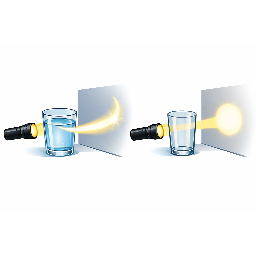
Explanation
Light usually travels in a straight line. When light goes through water, it bends. This is called rafraction.
Water changes the way light moves.
That is why we can see bright shapes and sometimes colors.
Light can move, bend and make beautiful patterns!
Maria Penlidi, 103rd Kindergarten of Thessaloniki, Greece
Materials
* vinegar, water
*baking soda
*4 glasses
*4 finger paints
*deep plate
* 4 spoons
Elif GÜRBÜZ-Strateji ve Bütçe Başkanlığı Kindergarten, Türkiye

STEPS
1. The glasses are placed side by side in a deep saucer
2. One color of finger paint is placed in each glass
3. A spoonful of baking soda is added to each glass
4. Then vinegar is slowly poured in
Elif GÜRBÜZ-Strateji ve Bütçe Başkanlığı Kindergarten, Türkiye
RESULTS
Elif GÜRBÜZ-Strateji ve Bütçe Başkanlığı Kindergarten, Türkiye
Elephant Toothpaste Experiment
Materials
Egg white
Food Coloring
Bicarbonate of Soda
White vinegar
Two cups/glasses
Tray
Doreen Barr, Smart from the Start, MALTA



Steps
1. Fill one glass with vinegar and add a drop of food colouring. Set aside.
2. Add 2 table spoons of bicarbonate of soda onto the egg white in the other glass. Mix well.
3. Get both glasses on the tray. Pour slowly the vinegar onto the egg white mixture.
4. Watch the magic!
Doreen Barr, Smart from the Start, MALTA

Results
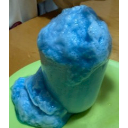
When vinegar was added to the mixture of egg white, bicarbonate of soda, and food colouring, the mixture reacted immediately. A large amount of foam was produced and quickly rose out of the glass, resembling toothpaste being squeezed out.
Doreen Barr, Smart from the Start, MALTA
Explanation
When vinegar was added to the bicarbonate of soda, the two substances reacted together. This reaction produced a gas called carbon dioxide.
The gas formed lots of tiny bubbles. These bubbles got trapped in the egg white, which made the mixture expand and turn into thick foam. As more gas was made, the foam grew bigger and spilled out of the container, looking like elephant toothpaste.
Doreen Barr, Smart from the Start, MALTA
- < BEGINNING
- END >
-
DOWNLOAD
-
LIKE
-
COMMENT()
-
SHARE
-
BUY THIS BOOK
(from $7.19+) -
BUY THIS BOOK
(from $7.19+) - DOWNLOAD
- LIKE
- COMMENT ()
- SHARE
- Report
-
BUY
-
LIKE
-
COMMENT()
-
SHARE
- Excessive Violence
- Harassment
- Offensive Pictures
- Spelling & Grammar Errors
- Unfinished
- Other Problem





COMMENTS
Click 'X' to report any negative comments. Thanks!