Students from all around the world gathered in a large hall for The Great Mind Conference.
This was a very special event where the greatest mathematicians in history would meet and share their ideas.
Everyone was excited to hear their stories, discoveries, and thoughts about mathematics.
When the lights slowly dimmed, the room became silent.
The first speaker walked onto the stage.
She was a symbol of wisdom, courage, and knowledge.
Her name was Hypatia.

Everyone was excited to hear their stories, discoveries, and thoughts about mathematics.
When the lights slowly dimmed, the room became silent.
The first speaker walked onto the stage.
She was a symbol of wisdom, courage, and knowledge.
Her name was Hypatia.
Students from all around the world gathered in a large hall for The Great Mind Conference.
This was a very special event where the greatest mathematicians in history would meet and share their ideas.
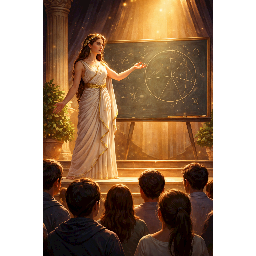
Hypatia smiled warmly at the students and invited them to sit closer.
She told them that she had lived in Alexandria, one of the greatest centers of learning in the ancient world.
She explained that mathematics was not only about numbers. “For me,” she said, “mathematics is a way to understand the universe.”
The students listened carefully as she spoke about her work on geometryand her love for teaching young people. She encouraged them to always ask questions and never be afraid of curiosity.
One student asked how she stayed brave when life was difficult.
Hypatia answered gently, saying that knowledge and kindness were her strongest tools.
As her talk came to an end, she looked toward the next speaker and smiled.
“Now,” she said, “you will meet another brilliant mind who changed mathematics forever.”
She stepped aside, and Leonhard Euler walked confidently onto the stage.
Leonhard Euler
Leonhard Euler stepped forward with a calm and confident smile.
He greeted the students and said that he had loved mathematics from a very young age.
Even when he lost his sight later in life, his mind continued to see numbers and ideas clearly.autiful story written with symbols.”
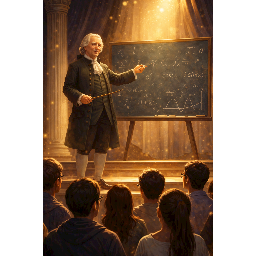
Euler explained that he helped create the language of modern mathematics.
He introduced symbols that students still use today, such as e, i, and many important formulas.“For me,” he said, “mathematics is like a beautiful story written with symbols.”
The students listened closely as he talked about patterns, equations, and how mathematics can explain both simple and complex ideas.
He reminded them that making mistakes is a natural part of learning and that patience is the key to success.
One student asked how he could work so much without giving up.
Euler smiled and answered, “Because curiosity never let me stop.”
At the end of his talk, Euler thanked the students and turned toward the next speaker.
“With curiosity and imagination,” he said, “mathematics can change the world.”
He stepped back, making space for another great mind.
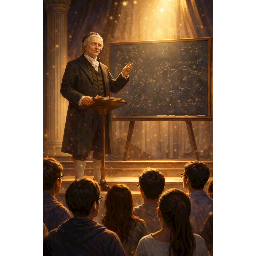
The conference continued with the great mathematician and physicist Carl Friedrich Gauss.He stepped onto the stage and welcomed the students warmly. He said that it was an honor to be with such great mathematicians and curious young minds.
One student asked him to share his thoughts about mathematics.
Gauss smiled and began to speak calmly.
He explained that mathematics is not only about memorizing formulas and rules.
“For me,” he said, “mathematics is a way of thinking and a search for truth.”
Gauss encouraged students to always ask why a rule or theorem works.
He said that understanding the reason behind an idea is more important than remembering it.
He also reminded them that making mistakes is a natural part of learning.“Many discoveries,” he said, “begin with a mistake.”
Gauss talked about the importance of patience, precision, and curiosity.
He explained that science rarely has quick answers, but careful thinking always brings progress.
At the end of his talk, Gauss looked at the students and smiled.
“Do not be afraid of difficulties,” he said. “The deepest truths are often hidden in the simplest ideas.”
The students listened with great interest and applause filled the hall.
As Gauss left the stage, he turned toward the next speaker.
“Now,” he said, “you will meet a brilliant thinker who connected mathematics with philosophy and probability.”
With these words, Blaise Pascal stepped forward to continue the conference.
“Dear students,” Pascal began,
“I listened to others speak about curiosity. Today, I will speak to you about doubt. Not the doubt that stops you, but the doubt that helps you see more clearly.”
He explained that doubt is the beginning of wisdom, because it pushes people to search for the truth beyond appearances.
“Mathematics taught me rigor,” he said, “but life taught me the limits of reason. Human beings do not only calculate. They feel, hope, and fear.”
He reminded the students of his famous words:
‘The heart has reasons that reason does not know.’
“Do not forget this,” he said, “when you look for truth only in formulas.”
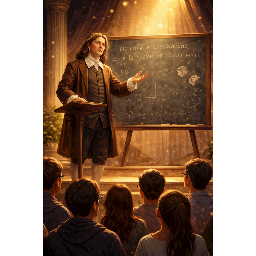
A student once asked him:
— Mr. Pascal, does mathematics explain everything?
Pascal answered:
— No, but it teaches us how to think correctly. And thinking correctly is a big step toward living correctly.
He explained that he studied probability to understand chance, but later understood that life is not a game of dice.
“Every choice you make matters,” he said. “Even when you are unsure, choosing to learn, to be kind, and to seek the truth is already a victory.”
Pascal encouraged students to ask difficult questions.
“Sometimes,” he said, “one good question is worth more than a hundred answers.”
He reminded them not to give up if they could not find a solution immediately. “Perseverance,” he said, “is the sister of genius.”
He concluded by saying that science and mathematics are great gifts, but they must always be guided by modesty and morality.
“Human beings are thinking reeds,” he said. “Fragile, but able to understand the universe.”
“Use your intelligence to build, not to dominate. To unite, not to divide,” he added.
“Knowledge without goodness can be dangerous, but knowledge with kindness becomes hope.”
In the end, Pascal looked at the students and said:
“Do not only try to be the best. Try to be truthful. Even when truth is difficult, it will set you free.”
As Sophie Germain was welcomed onto the stage, the audience began to cheer loudly.
She was a successful mathematician who had faced many difficulties in her life, yet never gave up.
Sophie Germain was known for her important work in
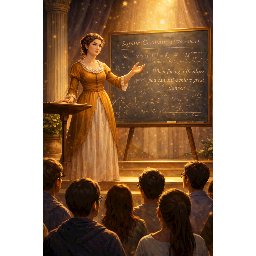
mathematics and for her contribution to elasticity theory.
She explained that even when people face serious difficulties, they can still achieve great things.
“I was born in Paris, France,” she said, “in a house on Rue Saint-Denis, on April 1, 1776.”
“Although it may seem that I was alone on this journey,” she continued, “my mother secretly supported me.
Sophie smiled and added, “It was not only my family who helped me succeed. I was a hardworking child who never stopped, even during the hardest moments of my life.”
She emphasized that hard work is one of the most important keys to success. “I was also always eager to learn from others,” she said. “You could often find me reading books, studying, and gaining knowledge. I wanted to become a mathematician known around the world.”
She looked at the other great mathematicians and said proudly,
“And today, I stand here among them.”
The hall filled with applause as Sophie Germain stepped back, making room for the next speaker.
As the applause slowly faded, a young woman stepped onto the stage with grace and confidence.
She was known for seeing possibilities where others saw only machines.
Her name was Ada Lovelace.
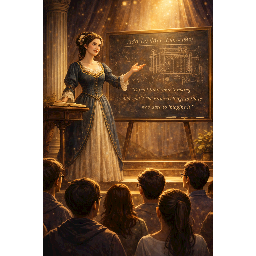
Ada greeted the students with a gentle smile and spoke about her love for numbers and imagination.
She explained that she lived in the 19th century and worked with Charles Babbage on a machine called the Analytical Engine.
“Many people saw it as just a calculator,” Ada said, “but I imagined it as something more.”
She believed that machines could follow instructions, create patterns, and even compose music one day.
Ada explained that she wrote the first algorithm designed for a machine.
For this reason, she is known today as the world’s first computer programmer.
“For me,” she said, “mathematics is not only logic. It is also creativity.”
One student asked how she managed to think so differently from others.
Ada answered, “I learned to combine poetry with mathematics. Imagination is just as important as calculation.”
She encouraged the students to explore new ideas, even when others doubted them.
“Do not limit your thinking,” she said. “The future belongs to those who dare to imagine.”
As her speech came to an end, Ada looked proudly at the audience.
“Mathematics and technology together,” she said, “have the power to change the world.”
The students applauded with admiration as Ada Lovelace stepped aside, leaving behind a message of creativity, courage, and innovation.
“Dear students,” Alan Turing began,
“The greatest power of our time is knowledge—knowledge built on observation, analysis, and constant questioning. Scientific progress never comes from accepted truths alone.
It begins with doubt, with searching for new paths, and with the courage to think differently.”
He explained that when he worked on the idea of computing machines, his goal was not only to solve a technical problem.
“I wanted to understand,” he said, “whether a machine could think—and more importantly, what thinking truly means.”
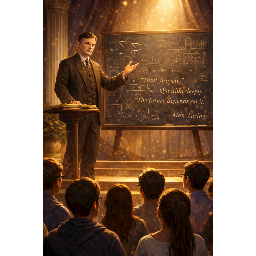
Turing reminded the students that today, as their generation develops artificial intelligence, this question is still deeply important.
“Science is not only formulas and algorithms,” he said.
“It is a combination of human intuition, creativity, and logic.”
He encouraged the students to never stop asking questions, researching, and experimenting.
“Curiosity,” he said, “is the engine of discovery.”
“You are the creators of the future,” Turing continued.
“Your task is not only to repeat what has already been done, but to imagine and create what has never existed
before.”
He paused and looked at the students.
“Think bravely,” he said. “Question deeply. The future depends on it.”
“Dear students,”
“Alan Turing’s words remind us that the future is shaped by imagination and courage. I would like to take you one step further—into the hidden beauty of complexity.”
What if irregularity
He explained that while studying mathematics, he noticed something unusual.
“The world,” he said, “is not made only of smooth lines and perfect shapes.”
Nature, he explained, is full of irregular forms—clouds, coastlines, mountains, and trees.
“Classical mathematics could not fully explain them,” he said. “So I asked a simple question: also has its own order?”
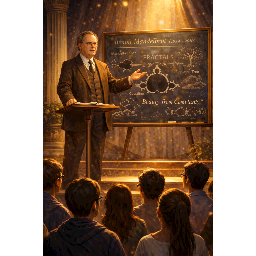
This question led him to fractals—shapes that repeat themselves at different scales. “A small part,” he explained, “looks like the whole.”
Through fractals, Mandelbrot discovered a new way to describe nature, chaos, and complexity.
“Mathematics is not only about simplicity,” he said. “Sometimes, beauty comes from complexity. Sometimes, order hides inside chaos.”
He encouraged students to observe the world more carefully.
“Do not be afraid of complex problems,” he said. “Ask new questions. Explore unusual ideas. Look for patters where others see disorder.”
“As mathematics grows,” he concluded, “so does our understanding of the universe.”
He smiled gently. “And now,” he said, “another great mind will continue this journey with you.”
One quiet night, a curious student named Leo fell asleep while reading about the stars.
Suddenly, he found himself standing inside an old observatory.
A man with kind eyes and a long coat was drawing circles and triangles on the floor.
It was Johannes Kepler.
Kepler smiled and said,
“Geometry is one and eternal, shining in the mind of God.”
He explained that mathematics was not just numbers, but a language that helps humans understand the universe.
Leo watched as planets moved in perfect paths, guided by invisible mathematical rules.
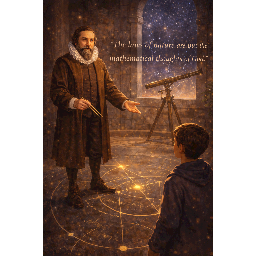
Kepler continued,
“The laws of nature are but the mathematical thoughts of God.”
He showed Leo how planets travel in elliptical orbits and how careful calculations reveal hidden harmony in space.
Leo realized that mathematics was everywhere—in the sky, in nature, and even in music.
Before Leo woke up, Kepler shared one final thought:
“Nature uses as little as possible of anything.”
When Leo opened his eyes, the stars outside his window looked different.
They were no longer just lights in the sky, but part of a great mathematical story—a story Kepler helped the world understand.
One quiet afternoon, Leo drifted into a dream while listening to soft music.
When he opened his eyes, he was standing in a peaceful seaside town.
White stone buildings surrounded him, and the sound of waves mixed with gentle melodies.
A bearded man in a simple robe was arranging pebbles into shapes on the ground.
It was Pythagoras.
He looked up and said warmly,
“All is number.”
Pythagoras explained that numbers are not only for counting, but the hidden order behind everything in the world.
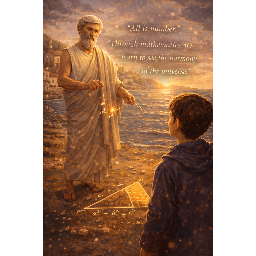
Leo watched as triangles formed perfect patterns, each side connected to the others in a special way.
Pythagoras showed him a right triangle and revealed a beautiful truth.
“The square of the longest side,” he said,
“is equal to the sum of the squares of the other two sides.”
“This is not just a rule,” he added, “but a truth that never changes.”
Then Pythagoras picked up a string and gently plucked it.
The sound was clear and harmonious.
He explained that music follows mathematical ratios, and harmony comes from simple numerical relationships.
“The same order that shapes numbers,” he said, “also shapes sound, nature, and the soul.”
Before the dream faded, Pythagoras shared one final thought:
“Through mathematics, we learn to see the harmony of the universe.”
When Leo woke up, he listened more carefully to the world around him.
Every rhythm, every shape, and every pattern felt connected—as if the universe itself was quietly counting.
As the echoes of Pythagoras’s strings faded, a man with bright, soulful eyes and a modest appearance stepped forward.He did not come from a grand university, but from the quiet streets of India, carrying nothing but a slate and a mind filled with infinite series.
Srinivasa Ramanujan greeted the students with a humble bow.
“Pythagoras saw numbers in shapes and music,” he began softly,
“but for me, numbers are my closest friends. They speak to me in dreams.”
He told the students how he filled notebooks with formulas—not because anyone asked him to, but because he saw a divine beauty in them that others could not yet explain.
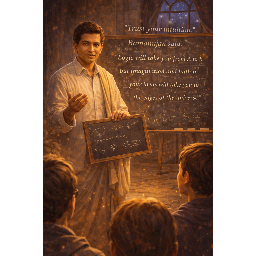
“An equation has no meaning for me,” he said,
“unless it expresses a thought of the eternal.”
Ramanujan described mathematics as an endless ocean, where every wave hides a new discovery waiting for a curious heart.
He spoke of the number 1729, the famous taxicab number, reminding students that even the most “ordinary” numbers can carry extraordinary stories.
One student asked how he discovered such complex formulas without a teacher.
Ramanujan smiled and replied,
“Trust your intuition. Logic will take you from A to B, but imagination and faith in your ideas will take you to the edges of the universe.”
As he concluded, he encouraged the students to find their own language
in mathematics.
“Genius,” he said, “often hides in the most unexpected places.”
As his voice softened, a deep sense of wonder filled the room.
He whispered one final thought:
“Remember, the most beautiful patterns are those that remain hidden until someone with a brave heart seeks them.”
With a knowing smile, Ramanujan turned toward the next speaker.
His eyes met the sharp, brilliant gaze of Emmy Noether, ready to reveal the invisible laws that hold the universe together.
Emmy smiled gently at Ramanujan and greeted the students with quiet confidence.
She began to speak about her life with mathematics—and partly with physics.She explained that algebra has hidden beauty and very unusual names. Then she asked the students a simple question:
“Do you know what a ring is? What about a field?”
The students looked confused. Of course they knew!
They had walked through fields and worn rings on their fingers.
Emmy laughed. She had expected this reaction.“This,” she said, “is exactly how my students reacted at the universities of Erlangen and Göttingen.”
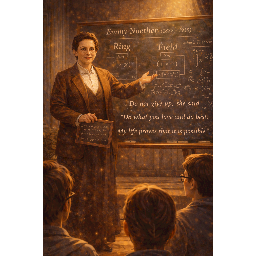
She then explained that in mathematics, rings and fields have very special meanings.
Slowly, the students began to understand her passion.
She then explained that in mathematics, rings and fields have very special meanings.
Slowly, the students began to understand her passion.
Emmy shared that she worked without pay for seven years, driven only by her love of learning, teaching, and discovering new mathematical ideas.
She had inherited this passion from her father, Max Noether, also a mathematician, who taught her that knowledge is priceless.
She spoke honestly about injustice.When Jewish scholars were banned from universities in Germany, she was expelled.
Later, she continued her work in America, where her ideas finally received recognition.
Although she worked under Hilbert’s name for years, her contributions were eventually honored.
Today, one of the most important ideas in physics and mathematics carries her name: Noether’s Theorem.
Emmy ended her talk modestly.
“Do not give up,” she said. “Do what you love and what you do best. My life proves that it is possible.”
She thanked the audience and smiled.
“Now,” she announced, “another great figure will speak to you—one who believed curiosity is the true source of discovery.”
Archimedes – The Power of Curiosity
As Emmy Noether stepped down, a quiet excitement filled the hall.
Then, an elderly man with bright eyes and simple clothes walked slowly onto the stage.
It was Archimedes. “I come from the ancient city of Syracuse,” he said warmly.
“I have always believed that curiosity is the beginning of discovery.”
Archimedes told the students how he loved asking questions about everyday things—water, balance, shapes, and motion.
“One day,” he said, “while stepping into a bath, I discovered an important rule about water and volume. I was so excited that I shouted Eureka!—which means I found it!”
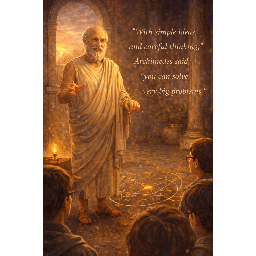
He explained that mathematics and science help us understand the world around us. “With simple ideas and careful thinking,” he said, “you can solve very big problems.”
Archimedes encouraged the students to observe closely, to ask why, and to never stop wondering. “Great discoveries,” he reminded them, “often begin with very simple questions.”
As his talk came to an end, he looked thoughtfully at the audience.
“Before we continue,” he said, “remember this: clear thinking begins by questioning what we see and what we believe.”
Then he smiled and added, “Now, you will meet a thinker who believed that doubt and questioning are the true beginnings of knowledge.”
With that, Archimedes stepped aside, and René Descartes walked onto the stage, ready to show how reason and doubt can lead to truth.
Descartes – The Power of Reason
René Descartes stepped forward calmly and looked around the hall.
“Dear students,” he began, “all my life I searched for certainty. I wanted to understand how we can know what is true.”
He paused for a moment.
“I even doubted things that seemed obvious. This led me to one famous idea: I think, therefore I am. If we can think, then we know we exist.”
The students listened carefully.
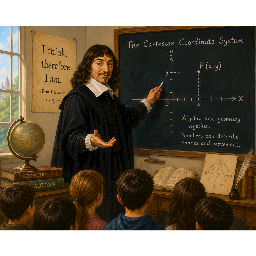
Descartes explained that he wanted to connect mathematics with the real world.
"Before my work,” he said, “algebra and geometry were mostly separate. I brought them together.”
He drew two lines crossing at right angles on the board.
“Today, you know this as the coordinate system. It allows us to describe shapes, curves, and movement using numbers and equations.
” A student raised a hand.
“Were you afraid to question accepted ideas?”
Descartes smiled.
“No. Doubt is not weakness. It is a tool that helps us build stronger knowledge.”
He looked toward the windows,
where sunlight shone through the glass.
“But mathematics is not found only in straight lines and equations,” he continued. “It also appears in nature—in flowers, spirals, and leaves.”
The students looked curious.
“To understand these natural patterns,” Descartes said, “you must meet a man who discovered a sequence of numbers hidden throughout the world around us.”
He stepped aside and gestured toward the next speaker.
“Please welcome Leonardo of Pisa—better known as Fibonacci.”
As Descartes stepped aside, the lights in the hall softened. A man in a long cloak walked calmly onto the
stage.
“Dear students,” he said warmly, “I am Leonardo of Pisa. But today, many people know me as Fibonacci.”
He explained that he traveled to many places when he was young. During these journeys, he learned from different cultures and studied new number systems.
“I helped introduce the numbers from 0 to 9 to Europe,” he said. “These numbers made calculations easier and changed the way people worked with mathematics.”
Then Fibonacci turned to the board and wrote:
1, 1, 2, 3, 5, 8, 13…
“Each number is the sum of the two numbers before it,” he explained.
The students looked carefully at the sequence.
“You can find this pattern in nature,” Fibonacci continued. “It appears in flower petals, seashells, pinecones, and many living things. Mathematics does not live only in notebooks. It lives all around us.”
One student asked, “So numbers can describe nature?”
Fibonacci smiled.
“Yes,” he answered. “When we look closely, we can see that nature has its own hidden order.”
He paused and looked toward the next speaker.
“These patterns inspired many artists and scientists. And there was one master who united mathematics, art, and observation better than anyone.”
He stepped aside respectfully.
“Please welcome Leonardo da Vinci.”
Leonardo da Vinci – Where Art Meets Mathematics
As Fibonacci stepped aside, a tall man with thoughtful eyes walked gracefully onto the stage.
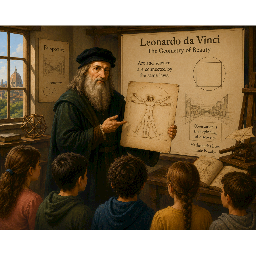
It was Leonardo da Vinci.
He held up one of his famous drawings.
“I always believed that art and science are connected. To create beautiful art, we must first understand mathematics.”
Leonardo explained that he studied shapes, proportions, light, and perspective. He carefully observed nature and filled countless pages with sketches and notes.
“You know this drawing as the Vitruvian Man,” he said, showing a figure inside a circle and a square. “It helped me understand the proportions of the human body and the hidden mathematics within it.”
A student raised a hand.
“Were you an artist or a mathematician?”
Leonardo smiled warmly.
“I was curious,” he replied. “Curiosity led me to both art and science.”
He looked around the hall.
“Nature is our greatest teacher. If you observe carefully, you will find mathematics in flowers, buildings, rivers, and even in the human body.”
The students listened with fascination.
“Never stop observing,” Leonardo continued. “Every question can lead to a new discovery.”
Then he turned toward the next speaker.
“But understanding beauty is only the beginning. To understand how the universe moves, we must discover the laws that govern it.”
He stepped aside and welcomed the next great thinker.
“Please welcome Isaac Newton.”
- Full access to our public library
- Save favorite books
- Interact with authors
- < BEGINNING
- END >
-
DOWNLOAD
-
LIKE(1)
-
COMMENT()
-
SHARE
-
SAVE
-
BUY THIS BOOK
(from $13.39+) -
BUY THIS BOOK
(from $13.39+) - DOWNLOAD
- LIKE (1)
- COMMENT ()
- SHARE
- SAVE
- Report
-
BUY
-
LIKE(1)
-
COMMENT()
-
SHARE
- Excessive Violence
- Harassment
- Offensive Pictures
- Spelling & Grammar Errors
- Unfinished
- Other Problem






COMMENTS
Click 'X' to report any negative comments. Thanks!