Welcome! Click to begin Arty's journey through traditional and digital art.

CONTENTS
Teacher:Emel Çelik |Student: Egehan | School: Atatürk Secondary School, Kütahya, Türkiye | Pages: 4–5
Teacher: Charisia Mavrigopoulou | Students: Magda, Chrisa, Seldi, Damianos, Kunal | School: 2nd Elementary School of Schimatari, Greece | Pages: 6–7
Teacher: Ιωάννα Ράφτη | School: Εκπαιδευτήριο Πολυχρονάκου, Sparti, Greece | Pages: 8–9
Teacher: Claudia Smarandoiu | School: Scoala Gimnaziala Nr. 311, Bucuresti, Romania | Pages: 10–11
Teacher: Maria Benedetta Lorusso | School: ICS Hero Paradiso – San Giovanni Bosco, Santeramo in Colle, Italy | Pages: 12–13
Teacher: Inna Shepelieva | School: Chaiky Private Gymnasium "Unique School", Ukraine | Pages: 14–15
CONTENTS
Teacher: Zeliha Aydemir | Student: Elif | School: Orgeneral Atilla Ateş Secondary School, Kastamonu, Türkiye | Pages: 16–17
Teacher: Berna Elçi | Student: Elif | School: Çinikent Special Education School, Kütahya, Türkiye | Pages: 18–19
Teacher: Esra Toprak | Student: Emin | School: Şehit Selim Cansız Anatolian Imam Hatip High School, Kütahya, Türkiye | Pages: 20–21
Teacher: Öznur Şimşek | Student: Zehra | School: Atatürk Secondary School, Kütahya, Türkiye | Pages: 22–23
Teacher: Gamze Özcan | Student: Tevfikcan | School: Dumlupınar Primary School, Muğla, Türkiye | Pages: 24–25
The End | Page: 26
Once upon a time…
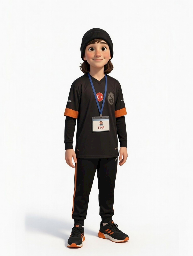
There was a little traveler who lived in the digital age, but whose heart loved traditional art. His name was Arti. With his magical tablet on his back, he traveled the world, discovering art treasures in every country and bringing them into the digital world.
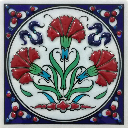
One day, DigitalArt arrived in Kütahya, Turkey. I, Egehan, a student at Atatürk Secondary School, said, “Let me tell you about our city’s famous tile art (çini)!”
Teacher:Emel ÇELİK
Student/School Name:Egehan/Atatürk Secondary School Kütahya-Türkiye
Tile art is a traditional Turkish art form created on ceramic pieces with colorful glazes and elegant patterns. In Kütahya, this art has been practiced for centuries, and each design tells its own story.
“Elegant patterns carry both our history and our cultural creativity.”
DigitalArt admired the beauty of the tiles and, inspired by them, created a digital artwork.
Öğretmen:Emel ÇELİK
Öğrenci/Okul Adı :Egehan/Atatürk Secondary School Kütahya-Türkiye
Öğretmen: Charisia Mavrigopoulou
Öğrenci/Magda, Chrisa,Seldi,Damianos,
Kunal
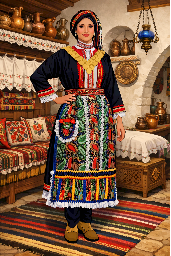
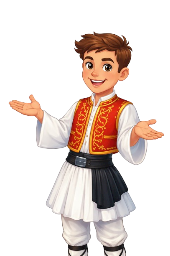
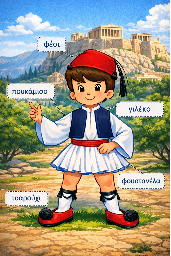
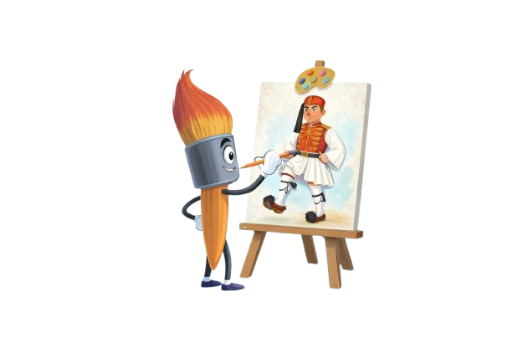
Arti visited Greece to discover its ancient civilization. While walking in Plaka, under the Acropolis, he met Kostas, a boy from Greece. Kostas showed him the traditional art shops and the Greek traditional costumes. He explained to Arti the men’s Tsolias costume from 1821, which was practical for war and a symbol of Greek freedom.

Öğretmen:Charisia Mavrigopoulou
Öğrenci/Magda,Chrisa, Seldi, Damianos,Kunal
He also showed him the traditional women’s costume from Karpathos and explained when it is worn in the village of Olympos. Arti learned many interesting things about Greek traditional art and continued his walk through Plaka full of excitement.
Öğretmen:ΙΩΑΝΝΑ ΡΑΦΤΗ
Öğrenci/ POLYCHRONAKOU PRIVATE PRIMARY SCΗOOL
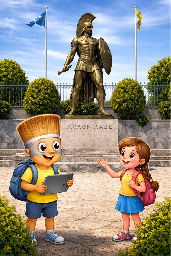
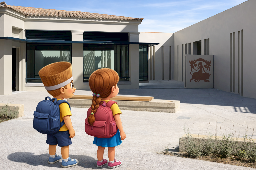
After Athens, Artie headed south and visited Sparta to learn about its history. As he walked through the city, he stopped in front of a large statue. There he met a local girl, Amalia, and asked him what the statue was called. Amalia told him that it was the statue of Leonidas.
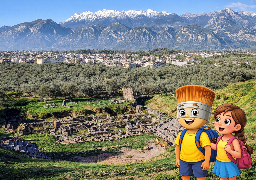
She took him to Ancient Sparta and told him about the city and the way of life of the Spartans, who were known for their strength and discipline.
Öğretmen:ΙΩΑΝΝΑ ΡΑΦΤΗ
Öğrenci/POLYCHRONAKOU PRIVATE PRIMARY SCHOOL OF SPARTA
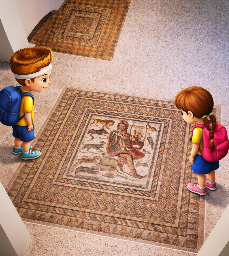
Then he took him to the House of Mosaics, a museum featuring ancient mosaic works. He explained that, although Sparta was primarily known for its warriors, it also had a rich artistic heritage. The Spartans created beautiful pottery, sculptures, and music. Arti learned that art in Sparta was simple yet powerful, just like the character of its people. As he continued his walk, Arti felt he had come to know a place rich in history, tradition, and unique culture.
Öğretmen:Claudia Smarandoiu
Öğrenci/Okul Adı
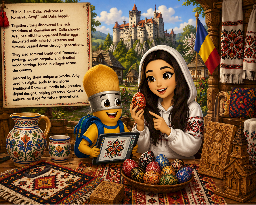
Hello, I am Dalia. Welcome to Romania, Arty!" said Dalia happily.
Together, they discovered the rich traditions of Romanian art. Dalia showed Arty beautiful hand-painted Easter eggs, decorated with colorful patterns and symbols passed down through generations
Öğretmen:Claudia Smarandoiu
Öğrenci/Okul Adı
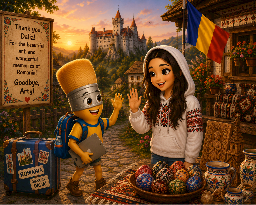
They also admired traditional Romanian pottery, woven carpets, and detailed wood carvings found in villages across the country. Inspired by these unique artworks, Arty used his digital tools to transform traditional Romanian motifs into creative digital designs, helping preserve Romania’s cultural heritage for future generations.
Öğretmen:MARIA BENEDETTA LORUSSO
Öğrenci/Okul Adı
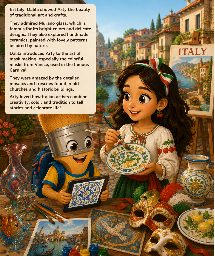
Hello, I am Dalila. Welcome to Italy, Arty!" said Dalila with a smile.
Together, they explored the beauty of Italian traditional art. Dalila showed Arty colorful Venetian masks, handmade ceramics, and the famous Murano glass artworks known for their bright colors and delicate designs.
Öğretmen:MARIA BENEDETTA LORUSSO
Öğrenci/Okul Adı
They also admired beautiful mosaics and frescoes decorating historic churches and buildings. Inspired by Italy’s rich artistic heritage, Arty used his digital tablet to transform traditional Italian patterns into creative digital artworks, connecting the past with the future.
Öğretmen:Inna Shepelieva
Öğrenci/Okul Adı :Anna
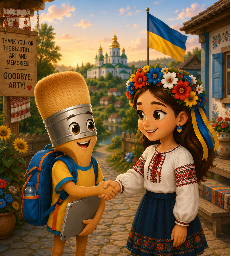
Hello, I am . Welcome to Ukraine, Arty!" said Anna with a warm smile.
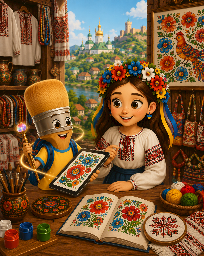
Together, they explored the rich traditions of Ukrainian art. Anna showed Arty the colorful Petrykivka paintings, filled with beautiful flowers, birds, and nature-inspired patterns.
Öğretmen:Inna Shepelieva
Öğrenci/Okul Adı
She also introduced him to Vyshyvanka, the traditional Ukrainian embroidery that tells stories through its unique designs. Inspired by these artistic treasures, Arty used his digital tools to bring traditional Ukrainian patterns into the modern digital world.

Öğretmen:Zeliha Aydemir
Öğrenci/Okul Adı : Elif/Org. Atilla Ateş Secondary School
Arti walked along a quiet street and soon reached the famous Kastamonu Clock Tower. From the top, he could see the entire city surrounded by endless forests. The air felt fresh and peaceful.
As he continued, he entered the historic Nasrullah Square. People were sitting around, chatting, and enjoying traditional Turkish tea. Arti noticed that, just like Sparta, this place also had a strong sense of community—but in a warmer, more welcoming way.
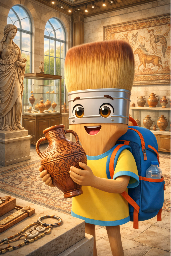
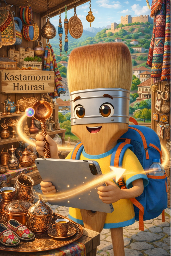
Curious to learn more, he visited the Kastamonu Archaeology Museum. Inside, he saw ancient artifacts, traditional clothes, and beautifully crafted objects. A guide explained that Kastamonu had a deep cultural heritage shaped by many civilizations over thousands of years. “Here,” the guide said, “art is not only seen in museums. It lives in our daily life—our crafts, our food, and our traditions.”
Öğretmen:Zeliha Aydemir
Öğrenci/Okul Adı : Yasemin/Org. Atilla Ateş Secondary School
As Arti walked through the streets, he noticed small shops selling handmade items. Wooden carvings, woven textiles, and copper works filled the windows. He realized that, unlike Sparta’s simple and strong art, Kastamonu’s art was detailed, colorful, and deeply connected to nature.
Soon, the smell of delicious food filled the air. He followed it and discovered local dishes like Etli Ekmek and Banduma. As he tasted them, he felt the culture not only in what he saw—but also in what he ate.
TEACHER:BERNA ELÇİ STUDENT:ELİF ÇİNİKENT ÖZEl eğitim okulu Kütahya,türkiye
Hello, I am Elif. Welcome to the world of Calligraphy Art, Arty!" said Elif with a smile.
Together, they explored the beauty of traditional Turkish calligraphy. Elif showed Arty how skilled calligraphers use special pens and ink to create elegant letters and meaningful words.
TEACHER:BERNA ELÇİ STUDENT:ELİF ÇİNİKENT ÖZEl eğitim okulu Kütahya,türkiye
They admired the flowing lines, balanced compositions, and artistic designs that decorate mosques, manuscripts, and historical buildings. Arty was amazed by the patience and precision required to create each piece
Öğretmen:esra TOPRAK
Öğrenci/Okul Adı
Emin – Şehit Selim Cansız Anatolian Imam Hatip High School, Kütahya, Türkiye
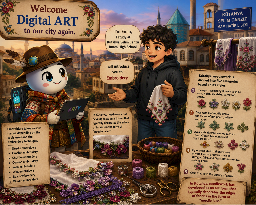
Welcome Digital ART to our city again. I am Ahmet, I study at Kütahya Selim Cansız Imam High School. One of the other handicrafts is diamond embroidery. Diamond engraving consists of sub-sections such as setting, stonecutting, mining, hand engraving, engraving with a burin, openwork engraving, foya chamfering, polishing, sand etching, calibrating, and molding. During the Ottoman period, the Small Bazaar (Bit Pazarı) was the center of heavy-duty clothing and diamond embroidery.
Öğretmen:esra TOPRAK
Öğrenci/Okul Adı
Emin – Şehit Selim Cansız Anatolian Imam Hatip High School, Kütahya, Türkiye
wax embroidery, bead embroidery, and woven embroidery are different examples of these. In Kütahya, needlework has developed as an art form that typically decorates the edges of fabrics in the form of "needle lace." Kütahya needlework is divided into five categories based on its styles. These are the oyas resembling flowers such as rose, violet, lily, daisy, carnation, poppy, oyas with leaf motifs similar to the leaves of itir, peach, willow, carnation, oyas with abstract names such as Heart Closet
Öğretmen:ÖZNUR ŞİMŞEK Student:Zehra
Öğrenci/Okul Adı : Atatürk Secondary School
MINIATURE ART
Öğretmen:ÖZNUR ŞİMŞEK Student:Zehra
Öğrenci/Okul Adı :Atatürk Secondary School
Öğretmen:Gamze ÖZKAN
Öğrenci: Tevfikcan/Dumlupınar ilkokulu
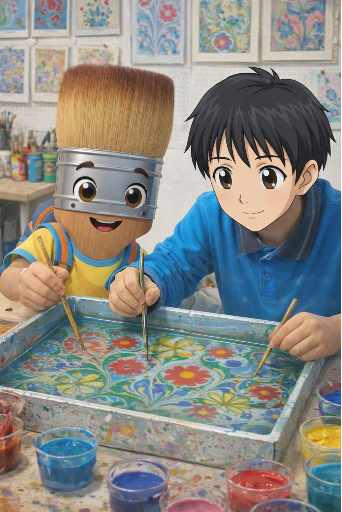
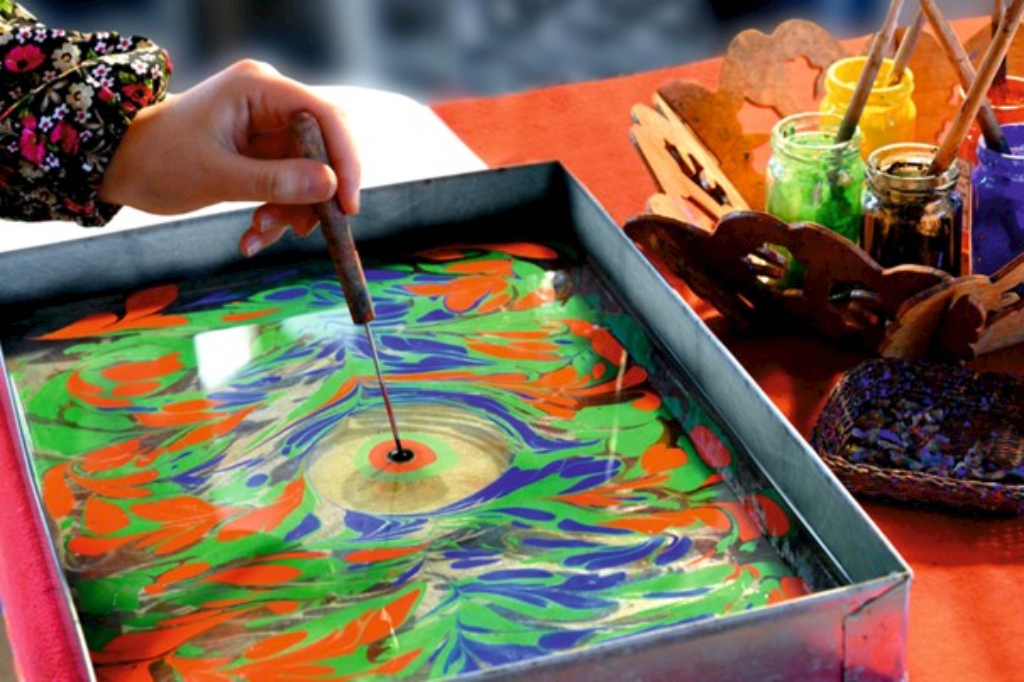
Hi Artie, I'm Tevfikcan, welcome to Muğla. Today we're going to paint on the surface of the water and have a lot of fun.
Ebru is the traditional Turkish art of creating colorful patterns by sprinkling and brushing color pigments onto a pan of oily water and then transferring the patterns to paper. Known as marbling, the designs and effects include flowers, foliage, ornamentation, latticework, mosques and moons, and they are used for decoration in the traditional art of bookbinding.
Öğretmen:Gamze ÖZKAN
Öğrenci: Tevfikcan/Dumlupınar ilkokulu
The practitioner uses natural methods to extract colors from natural pigments, which are then mixed with a few drops of ox-gall, a kind of natural acid, before sprinkling and brushing the colors onto a preparation of condensed liquid, where they float and form swirling patterns. This element was inscribed in 2014 on the Representative List of the Intangible Cultural Heritage of Humanity.
Artie had a lot of fun with Tevfikcan and continued her artistic journey, taking her marbling artwork with her.
"After exploring Kütahya, Greece, Sparta, Romania, Italy, Ukraine, Kastamonu, and Muğla, Arti completed his cultural journey. He discovered traditional arts, made new friends, and learned that art is a universal language connecting people all around the world. With wonderful memories in his heart, Arti continued his adventure, ready to discover new artistic treasures."
- < BEGINNING
- END >
-
DOWNLOAD
-
LIKE
-
COMMENT()
-
SHARE
-
BUY THIS BOOK
(from $5.19+) -
BUY THIS BOOK
(from $5.19+) - DOWNLOAD
- LIKE
- COMMENT ()
- SHARE
- Report
-
BUY
-
LIKE
-
COMMENT()
-
SHARE
- Excessive Violence
- Harassment
- Offensive Pictures
- Spelling & Grammar Errors
- Unfinished
- Other Problem





COMMENTS
Click 'X' to report any negative comments. Thanks!