The continuation of the shared story:
nazlı
Ebru
Marika
Mine
Azra
Canan
Fidanka
Ayşe
İrem
Katarzyna Luto_przybylska


CRAMBA CRISTINA/ROMANIA
Mateo had always felt that the
world was too big to stay in
one place.
Ever since he was a child, he
collected maps, postcards, and
stories from travelers. But one quiet morning, as he stared at a dusty globe on his shelf, he realized something simple: reading about the world was no longer enough. He wanted to feel it. So he packed a small backpack, took a notebook, and promised himself he would travel not just to see places—but to understand people, their cultures, and their customs.
His first stop was Romania.
When Mateo arrived, the air felt different-
fresh, calm, and filled with the scent of forests
and countryside. He made his way to a small
village in Transylvania, where time seemed to
move more slowly. Wooden gates, colorful houses, and blooming gardens welcomed him. There, he met tanti Floarea.
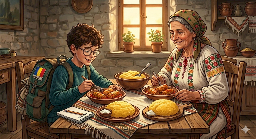
- Bună ziua,” she greeted him warmly, smiling as if she had known him forever. Tanti Floarea invited him inside.
In the kitchen, a pot simmered gently on the stove.
“Sarmale,” she said proudly. Nearby, a pot of polenta—soft and golden—bubbled slowly.
While eating, Aunt Floarea told him stories — about village life, celebrations, dances, and how traditions are passed down from one generation to another like precious treasures.
That day Mateo understood something important: culture was not just in museums or books. It lived in people — in their clothing, food, stories, and kindness
That evening Mateo wrote in his
notebook:
"Today I did not just visit a place."
I was warmly welcomed into a
way of life.
And with a full heart
and a grateful smile, he knew that
this journey would change him — one culture, one story, one person at a time.
.
MANCOVA FIDANKA/ NORTH MACEDONIA
Several weeks passed during which Mateo repeatedly flipped through the notebook, as if searching for something hidden between the lines. With each new opening, the pages rustled softly, as if whispering new ideas to him. And just like that, among thoughts and dreams, he made a bold decision. He spread out the map of Europe before him. With a curious finger, he slowly traced the countries, imagining distant cities and new friendships. Suddenly he stopped. His eyes sparkled.
– Macedonia! – he whispered softly. He stayed like that for a few moments, with his finger placed on the small country on the map, as if calling it to a real experience. And while his finger was still on
the map, a small journey was already born in his heart – a journey filled with new friendships, culture, and warmth
that knows no boundaries.

–
After a few days, Mateo was already walking along the sunny paths of Macedonia. He was greeted by Maria – a smiling village girl with braids and bright eyes. In her smile there was sincere warmth that immediately gave him a feeling of welcome.
– Добредојде ! – she said to him joyfully.
When she heard the reason for his visit,
she was delighted and, with a sparkle in her eyes,
exclaimed:
– I will show you our country!
The next morning Maria said to him:
– Today we will travel a little farther. I want you to see how beautiful our country is.
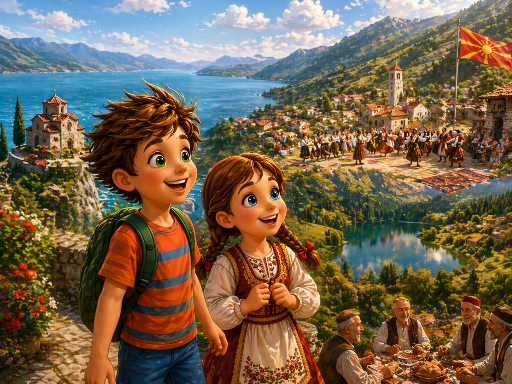
First, they arrived in Ohrid. Before them, the lake gleamed, calm and blue like a mirror holding the sky in its depths. The stone streets led them past old churches and houses with white facades and wooden balconies. Mateo stopped, enchanted by the view.
– Every stone here has a story – Maria whispered to him. – And the lake keeps the secrets of the centuries.

Then they headed to the mountain village of Galičnik. The road took them high among the green slopes, where the air was fresh and smelled of grass and freedom.
The stone houses stood proudly, like guardians of tradition. Marija told him about the Galičnik wedding, about the folk costumes adorned with rich embroidery, and about the sounds of the zourlis echoing through the mountains. Mateo felt as if he were walking through a living story. At the end, they went to eastern Macedonia, to Berovo.
They were welcomed by dense forests, a quiet lake, and a peace that filled the heart. There, time moved more slowly, and the people were smiling and hospitable.
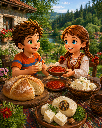
The table smelled of warm bread, delicious ajvar, and the irresistible Berovo cheese. "Every region has its own beauty,"
Marija told him. "But together,
they make our country special."
Mateo looked around with wide-open eyes. From the blue lake in Ohrid, through the mountainous pride of Galičnik, to the quiet beauty of Berovo – he got to know Macedonia as a colorful fabric woven from nature, tradition, and warm people. And in his heart, one feeling remained forever – that true wealth is not measured by size, but by stories, love, and shared smiles.
EDITE FIĪMONOVA, LATVIA
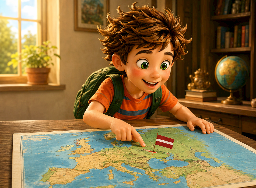
Mateo stared at the map for a long time. His heart was full of joy and adventure. Then he took a deep breath and smiled.
“Where should I go next?” he asked himself silently.
His finger slowly glided across the map… until it stopped at a small, green country on the seashore.
– Latvia! – Mateo exclaimed happily.
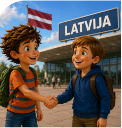

The next day he was on his way – with his suitcase and a big smile. He felt that a new adventure awaited him.
When the boy Mate first arrived in Latvia, he was greeted by a man named
John.
- Hello! – Jānis said with a smile. – Welcome to Latvia!
-Hello ! – Mateo replied. – I want to get to know your country!
- Then come, I'll show you everything! –
The next day they were studying in Riga. Mateo's eyes were wide with surprise.
"What a beautiful city!" he said.
They walked through the old streets, where the houses were colorful and a bit mysterious.
-That's Old Riga, - Jānis explained. -Look, there's a tall
tower!
Mateo raised his head. – Wow! That's very long!
LATVIA


Then they headed out to sea. The sand was soft and the waves were calm.
“Can we run?” Mateo asked.
-Of course! – Jānis laughed.
The two boys ran along the sea, the wind playing in their hair.
The next day they study in the forest.
"There are many forests in Latvia," said Jānis. "We love nature."
Mateo picked up a small pine cone.
"It's like a little treasure," he smiled.
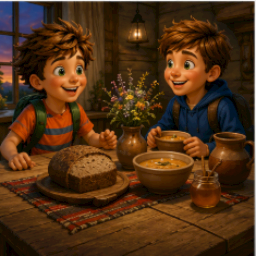
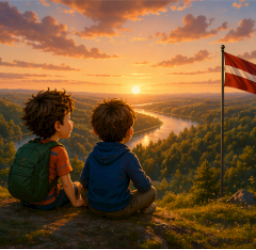
In the evening they sat at the table and ate rye bread with honey.
"Latvia is very beautiful," Mateo said quietly. "Not only the places, but also the people."
John smiled.
-Every country has its own story. And now you are part of our story.
Mateo felt warmth in his heart and knew that his journey was still ahead...
TINA LESTINGI & VITINA CUPERTINO / CONVERSANO (BA), APULIA - ITALY
After one month, it was Spring. One cold afternoon Mateo opened his map again and his eyes settled on the southern curve of Italy’s “boot". There, in bright colors, was a warm region called Apulia. It sounded like a secret waiting to be discovered. “I’ll go there”, Mateo thought.
The journey was amazing and he appreciated everything: the hum of an old train, the shimmer of sunlight over cherry trees, the smell of the sea carried by the wind. Soon, he found himself in a charming
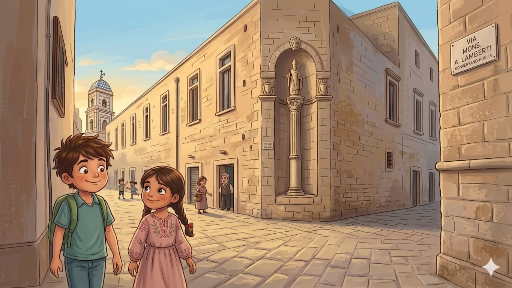
town called Conversano, where narrow streets
curled around ancient stone churches and a grand
castle stood proudly on the top of the hill. As Mateo
wandered through Castle square, he heard laughters
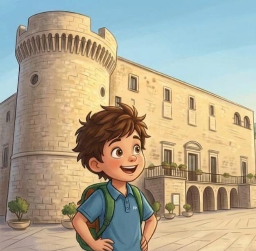
A girl about his age was skipping across the cobblestones.
“Ciao! I’m Laura,” she said, smiling.
“You look like you’re new here!”
“I am”, Mateo replied. “Will you show
me around?” Laura
nodded eagerly, and
together they explored the town. She led him through
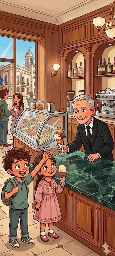
hidden alleys, sunlit courtyards and large stone archways until they reached a café in the old town and each ordered a creamy gelato. Mateo chose chocolate, whipped cream and "spungato", while Laura had chocolate and hazelnut.
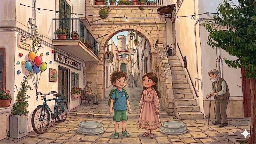
Then Laura said: “I'm going to Alberobello, my granny Ninetta lives there.” "Why don't you come with me?"
They traveled through the
countryside dotted with cherry,
almond and olive trees until they
reached a village unlike any Mateo
had ever seen.
Small white houses with
cone-shaped roofs "the trulli" lined
the streets like something out of a
fairytale.
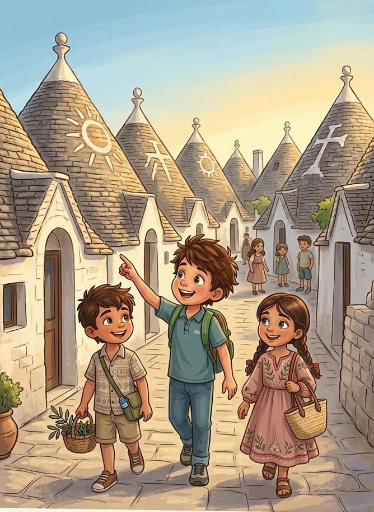
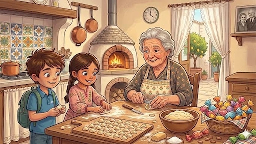
Granny Ninetta welcomed them with a warm hug and flour-dusted hands.
“Come, come! I've made the marzipan candies. Taste them!
now I'm making orecchiette, will you help me?” she asked.
While Mateo ate the delicious almond candies, he watched as granny rolled small pieces of dough with her thumb, shaping them into little ear-like pasta. Soon, he and Laura were trying too, laughing when their
shapes came out uneven.
“You’ll get better”, granny
Ninetta said kindly.
“Cooking takes patience
and love.”
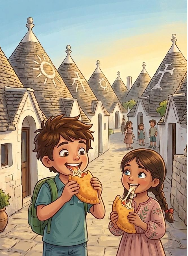
Later, they visited aunt Angelina, who was busy frying golden panzerotti. The smell alone made Mateo’s stomach rumble.
“You must taste these!” she said, handing them each a warm, crispy panzerotto.
They thanked her and wandered through the trulli, the white stone walls glowing softly in the afternoon light.
Mateo took a bite: it was crispy on the outside,
soft and savory on the inside, with plenty of
tomato sauce and mozzarella cheese.
“It’s amazing”, he said.
As they walked, Laura began to tell the legend
about the trulli.
“Legend says the trulli were built this way because of the earl of Conversano, Giangirolamo II Acquaviva d'Aragona", she explained. “People made the roofs without concrete, so they could be taken apart quickly, to avoid paying taxes. But over time, they became a symbol of this place.”
Mateo looked around, thinking about the cleverness, the history, and the lives behind every stone.
As the sun began to set, they came back to Conversano, finishing their food.
“I think I understand something”, Mateo said. “It’s not just the places that matter—it’s the people and what they share”. Laura smiled. “Especially the food”. Mateo nodded. Everywhere they had gone, someone had offered them something: gelato, marzipan candies, panzerotti.
Each dish carried a story, a tradition, a piece of the place itself.
In Apulia, food wasn’t just something to eat. It was a way of saying: YOU ARE WELCOME HERE!
And for Mateo, that made the journey unforgettable.
Katarzyna Luto-Przybylska, MZS Świeradów-Zdrój, Poland
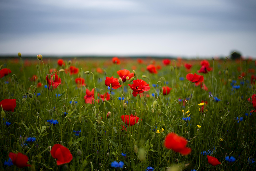
Mateo decided he wanted to explore another country. He had already visited Italy, where he admired ancient cities, ate delicious food, and walked through sunny streets. “Have you thought about where to go next?” asked a travel guide he met. Mateo paused for a moment. “Maybe… Poland? I want to see new landscapes, try new food, and learn about a different culture.” And so, Mateo chose Poland. When he arrived, he stepped off the train and his eyes widened at the sight of green fields and rows of trees swaying gently in the wind. A Polish guide was waiting for him. “Is it always this green here?” Mateo asked. “Not always,” the guide smiled. “In winter, everything is covered in snow, and in autumn, the leaves turn golden.”
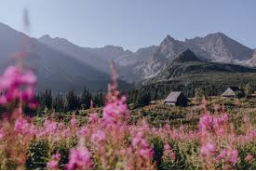
On the first day, they went to the mountains. Mateo stared at the tall peaks and winding trails between the rocks.
“It looks like a fairy tale!” he said.
“These are the Tatra Mountains,” the guide explained. “Many people come here to relax and enjoy nature.”
The next day, they walked through the old town square. Colourful buildings and the sound of street musicians made Mateo feel like he had stepped into another world.
“Why are the buildings so colourful?” he asked. “It’s part of our history and tradition,” the guide replied. “Each one has its own story.”
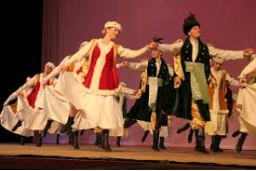
Later that day, Mateo heard lively music coming from a nearby stage. People in traditional costumes were dancing together.
“What’s happening there?” he asked excitedly. “These are Polish national dances,” the guide explained. “That one is called the polonaise, and the faster one is the mazurka.” “They look so elegant and fun!” Mateo said, watching the dancers spin and step in rhythm. “They are an important part of Polish culture,” added the guide.
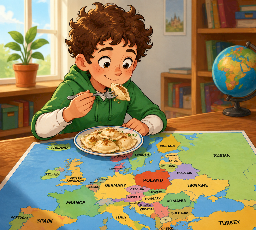
That evening, Mateo tried Polish food. Pierogi and soup were served on the table.
“This is… delicious!” he said with a full mouth.
“These are pierogi,” the guide explained. “One of the most famous dishes in Poland.”
“And this soup?”
“That’s borscht. A very traditional and popular one.”
On the last day, Mateo looked out the window at the landscape one more time.
“I’d like to come back here,” he said quietly.
“You will always be welcome,” the guide replied. “Poland still has a lot to show you.”
Mateo smiled, knowing that this journey was only the part of his big adventure.
Aysun GÜLTEKİN-TÜRKİYE-ERZURUM
The next morning, Mateo woke up early. When he looked out the window, everything was pure white. It had snowed all night.
“How beautiful!” he said excitedly.
Luka knocked on the door.
“Are you ready?” he asked.“I’m ready!” said Mateo.
They started walking together. The snow made a crunching sound under their feet. After a while, they came to a quieter, more special place.
There was a flag in the center. Everything around it was very clean and orderly.Mateo slowed down.
“Where is this?” he whispered.
Luka spoke in a slightly more serious tone:
“This is our village’s martyrs’ cemetery.”
Mateo looked around carefully. There were small stones, names, and flags. A different feeling filled him.
“What does ‘martyrs’ cemetery’ mean?” he asked.
Luka thought for a moment and explained simply:
“It’s the place where the heroes who gave their lives to protect our country are laid to rest.”
Mateo nodded silently.
“They must have been very brave,” he said.
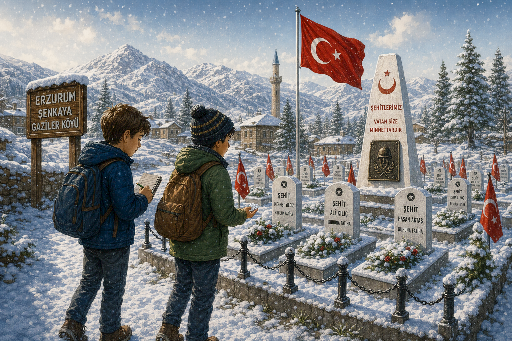
They both stayed silent for a while. Then Mateo took out his small notebook from his pocket and wrote:
“Today, I didn’t just see a new place.
I learned about heroes.”
Luka picked up a snowflake that had fallen to the ground.
“We never forget them,” he said.Mateo looked at the flag.
“I won’t forget them either,” he whispered.
After a while, Luka smiled and said:
“Come on, let me show you other beautiful places in the village too.”Mateo got excited again.
“I wonder what’s next?” he thought…
And together, they continued walking through the snow…
Edanur DİNÇARSLAN- TÜRKİYE/ZONGULDAK
ZANOLI MARIKA “SCUOLA PRIMARIA FELICE MORETTI” ZANICA (BG), ITALY
Mateo in Bergamo: the city between sky, mountains… and food
After traveling across many countries in Europe, and even visiting Puglia, Mateo arrived in a new and surprising destination: Bergamo.
As soon as he arrived, he looked up and was amazed. The city seemed to be divided into two levels, with an ancient part standing high on a hill.
“That is the Città Alta,” a kind woman explained. “You can reach it by funicular.”
Mateo took the small train that slowly climbed the hill. From the top, he saw the strong stone walls of the Mura Venete, surrounding the old city like a protective crown.
He walked through narrow stone streets and reached Piazza Vecchia, a beautiful square full of history.
The deep sound of the Campanone bell filled the air.
Mateo stopped, surprised.
“Don’t worry,” said a small bird, suddenly appearing nearby.
“I know many secrets of this city. Would you like to discover them?”
“Yes, of course!” Mateo replied.
They visited the elegant Basilica of Santa Maria Maggiore and the richly decorated Colleoni Chapel, where art and history seemed to speak from every wall.
Soon after, Mateo began to feel hungry.
“Come with me,” said the bird.
In a small traditional restaurant, Mateo tried casoncelli, a delicious stuffed pasta typical of the region.
“This is really tasty!” he said with a smile.
Then he discovered another local speciality: polenta e osei.
Mateo looked curious.
“This is a very old and traditional dish,” the bird explained. “It represents the history of this land.”
Suddenly, as if by magic, Mateo found himself on a boat on Lake Iseo.
In the middle of the lake, he saw Monte Isola, a peaceful green island where life moves slowly.
They continued their journey to Lovere, a colourful lakeside town, and to the calm waters of Lake Endine, where nature seemed quiet and gentle.
“Here, everything is peaceful,” Mateo said softly.
Later, they reached Crespi d’Adda, a unique village where time seemed to have stopped, showing how workers once lived and worked.
Then they travelled through the mountains of the Val Seriana, visiting charming villages like Clusone and Gromo, surrounded by forests and fresh air.
“It feels like stepping into a storybook,” Mateo said.
At San Pellegrino Terme, he tasted fresh spring water and admired the elegant buildings that told stories of the past.
Even a sweet version of polenta e osei dolce surprised him in a local bakery.
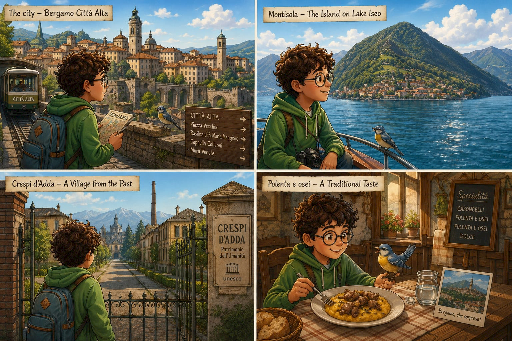
“This city is full of surprises,” he laughed.
Mateo sat on a hill in the Parco dei Colli di Bergamo, looking at the landscape around him.
He wrote in his diary:
“Bergamo is a city that takes you upwards… and welcomes you with history, flavours, nature and beauty.”
And then he added one final thought:
Bergamo is not just a city: it is a whole world made of plains, hills, mountains, lakes and unique villages, all living together in one extraordinary place…
Ebru TOPALOĞLU - Yedinisan Primary School - Şenkaya/Erzurum
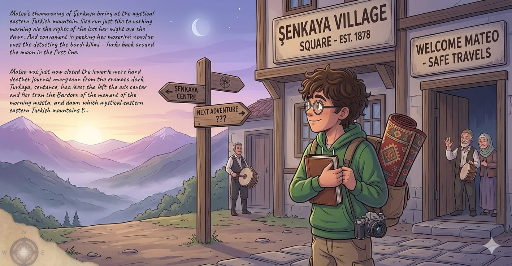
Mateo slowly closed his diary and took a deep breath. Leaving the hills of Bergamo behind, he turned his course towards the mysterious mountains of the east, towards Erzurum, the heart of Anatolia. As he traveled across the vast plateaus of Anatolia, he noticed the colors of nature beginning to change. The sky had turned a brighter blue, and the air was filled with a sharp but fresh scent. Finally, he saw the name on the sign: “ŞENKAYA.”
It was time to explore the epic lands of Şenkaya.
"I wonder what stories these ancient lands will whisper to me?" he thought.
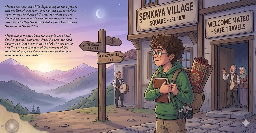
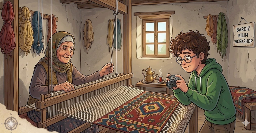
Mateo would be fascinated not only by the geography of this place, but also by its deep-rooted culture. As Mateo walked through the town center, he heard the clatter of a weaving loom. When he went inside, he saw the world-famous BARDIZ CARPET being woven, stitch by stitch. An old master said to him:
"Every motif on this rug tells our love, our sorrow, and our history, Mateo."
As Mateo photographed these geometric patterns colored with root dyes, he marveled at how a textile could transform into a language.(eril)
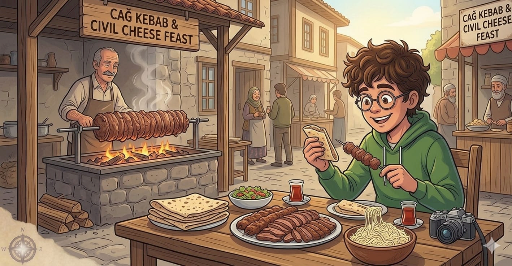
For Mateo, who was hungry, it was feast time. The aroma of the CAG KEBAB, slowly turning over a wood fire, filled the street. Served with Erzurum's famous CİVİL CHEESE and flatbread, this delicacy was one of the best meals Mateo had ever eaten.
Having eaten his fill, Mateo was heading towards the town square when he began to hear a rhythmic, powerful drumming sound in the distance. Walking towards the source of the sound, he saw a group of young people in traditional clothing lined up, holding hands.
"What is this?" he asked the old man next to him.
Uncle replied proudly:
"-This is the BAR dance from Erzurum, Mateo. In our culture, Bar symbolizes unity and togetherness. Look how they move as one body."
Mateo watched as if mesmerized, and at that moment I understood that in Şenkaya, music was not just played for entertainment, but also to stand together against difficulties.
As evening fell, Mateo listened to the sound of the saz rising from the villages of Şenkaya. This was a place where great masters like AŞIK REYHANİ mingled. While watching the bards engage in poetic duels, even though he didn't fully understand the language, the power of the saz strings and the words captivated Mateo.
As she left Şenkaya, she carried a piece of Bardiz rug in her bag, a unique taste in her mouth, and the sound of lovers' music in her ears. It was a warm town where traditions resisted modern times.
Mateo concluded his eventful day in Şenkaya with these words in his diary:
"Every culture is like an embroidery; let's see what patterns await me at the next stop?"
MATEO CLOSED HIS EYES AND SET OFF, DREAMING OF HIS NEW ROUTE…
NAZLI MACİT / ERZİNCAN-TÜRKİYE
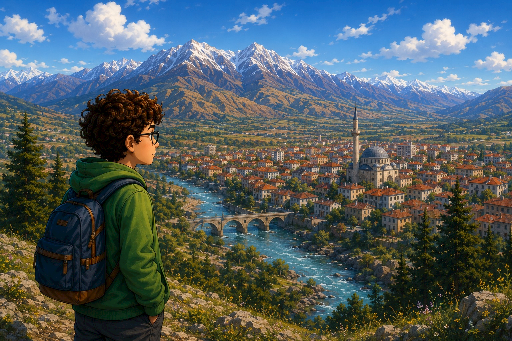
Mateo left Şenkaya and continued his journey accompanied by the cool winds of the east. As the mountains slowly changed shape, wide valleys and rivers followed him along the way. After a while, a new city appeared on the horizon: Erzincan.
When he arrived, the first thing he noticed was how the calmness of nature blended with the warmth of the people. The sky was clear, and the air was fresh. In the distance, the majestic Munzur Mountains seemed to greet the city.
As Mateo walked through the streets, he heard laughter. A group of children were playing with snowballs. One of them called out to him:
“Are you a stranger?”
Mateo smiled and walked closer.
“Yes,” he said, “but I want to get to know this place.”
One of the children, a little girl named Elif, took his hand.
“Then let us introduce you to the real Erzincan!” she said.
As they walked together, Mateo noticed the smell of freshly baked bread coming from a stone oven. Soon, they entered a small shop. Inside, he saw cheeses lined up on the counter. Elif proudly pointed and said:
“This is our famous Tulum Cheese.”
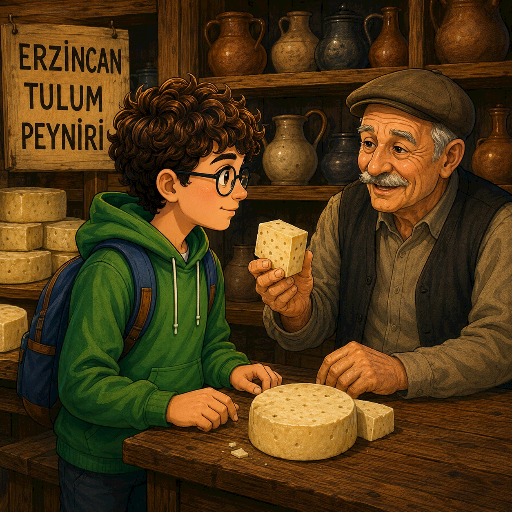
When Mateo tasted a piece, his eyes lit up.
“This… is amazing!” he said.
The old shopkeeper smiled and said:
“Everything here comes from nature, my son. It is made with patience and shared with love.”
Later, Elif and her friends took Mateo to Girlevik Waterfall. As they got closer, the sound of the water grew stronger, spreading a cool sense of peace around them. The water flowing between frozen icicles looked as if it was telling the story of time itself.
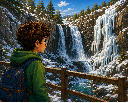
Mateo looked around in amazement.
“This is like a fairy tale…” he whispered.
Elif nodded.
“This is our nature. But Erzincan is not only about nature.”
In the evening, they all gathered in a house courtyard. The elders were chatting, and the young people were preparing something. After a while, the sound of drums and folk songs filled the air. People held hands and began to dance the halay.
Mateo felt the rhythm. It was similar to the bar dance in Erzurum, but it had its own unique warmth. He joined them. At first, he mixed up the steps, but soon he found the rhythm.
At that moment, Mateo realized something else: People danced differently in different places, but in every dance, there was the same feeling—unity, sharing, and joy.
Later that night, Mateo took out his notebook and wrote:
“Today, I saw the rhythm of nature and the human heart beating as one.
Erzincan taught me this:
True wealth is the memories we share.”
He looked up at the sky. The stars seemed brighter than ever.
And wondering what stories his next journey would bring, Mateo closed his eyes…
AYŞE TOPALOĞLU - RİZE/TÜRKİYE
As Mateo left the calm valleys of Erzincan and headed north, he noticed the mountains becoming steeper and the forests turning into a denser, darker shade of green. Finally, the scent of fresh soil and salty sea reached his nose. He saw that magical name on the sign: RİZE.
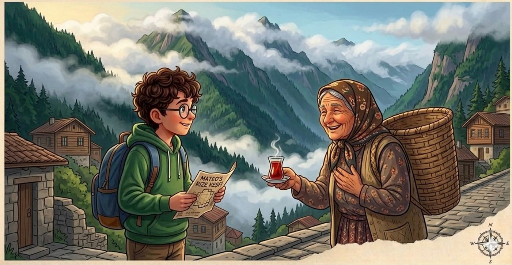
As soon as he stepped into the city, Mateo saw the clouds draped over the mountain peaks like cotton. Just then, an old lady with a sun-kissed face, carrying a wooden basket on her back, approached him. She asked cheerfully, "Hoş geldun uşağum! Çay içer misun?" (Welcome, my son! Would you like to drink some tea?). Mateo smiled and nodded at this warm welcome.
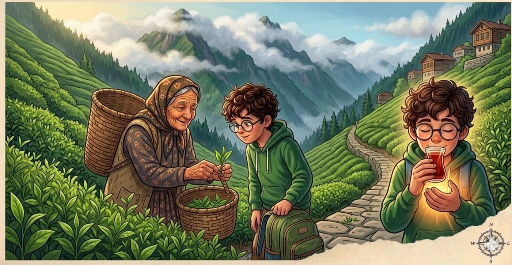
Together, they dived into the lush green Tea Gardens perched on steep slopes. The lady showed Mateo how delicately the tea leaves were picked. At that moment, Mateo understood: in this city, tea was not just a beverage; it was a life bond that lasted from the first light of the morning until the last chat of the evening. When he took a sip of the freshly brewed tea, an indescribable warmth filled his heart.
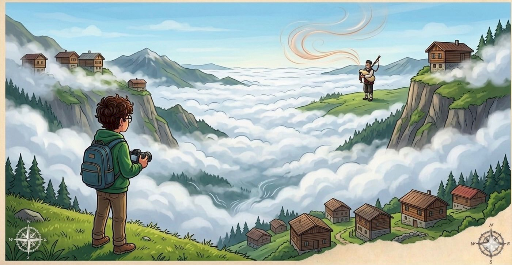
Afterward, accompanied by the roaring sound of the Fırtına River, Mateo climbed up toward the plateaus. When he reached Ayder Plateau—above the clouds in Çamlıhemşin—he couldn't believe his eyes. Wooden houses rose through the mist like something out of a fairytale. Just then, a shrill and joyful sound reached his ears: Tulum! (The bagpipe of the Black Sea)
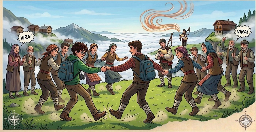
A group of young people, holding hands to the rhythm of the tulum, were dancing the Horon, as if drumming the earth with their feet. Mateo noticed that this dance was much faster than the sarmale-scented kitchen in Romania, the bar in Erzurum, or the halay in Erzincan. He couldn't resist and joined them. Even though his feet got tangled, he got caught up in the rhythm amidst the shouts of "Vira!" (Let's go! / Keep moving!). The Horon was proof of how tightly people held onto life in this rugged geography.
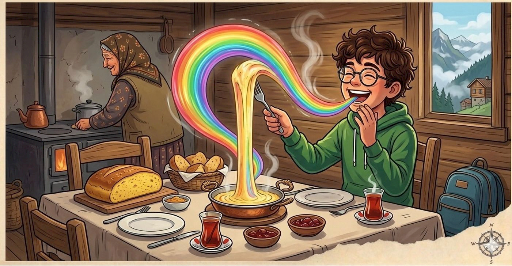
Now hungry, a real Black Sea table was set for Mateo. On the table, there was corn bread and a warm, stretching Muhlama (a local dish made with cornmeal and melted cheese). As the cheese in the Muhlama stretched, Mateo laughed and said, "This isn't just cheese; it's a rainbow!"
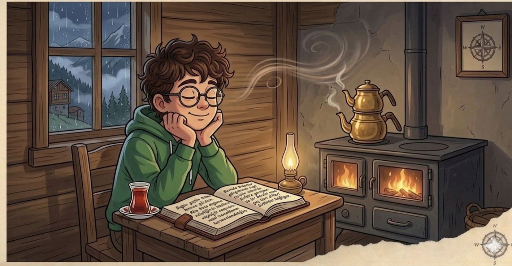
That evening, beside a crackling kuzine (a traditional wood-burning stove), Mateo noted the following in his diary:
"Today, I saw a thousand and one shades of green. Rize taught me how the wildness of nature blends with the joy of people. Here, the clouds aren't in the sky; they walk with you on the street. And a cup of hot tea connects all languages."
As the rain drizzled outside, Mateo closed his eyes peacefully with the echo of the tulum in his ears, wondering which paths he would take tomorrow...
CANAN ADEMOĞLU- KONYA /TURKİYE
As the first light of morning fell over the wide plains of Konya, a gentle breeze swayed the golden wheat fields. In the heart of the city stood history itself, with every stone holding a hidden story. And one of those stories began with our hero, Mateo.
When Mateo first arrived in Konya, he thought it was just a quiet city. But as the days passed, he realized it was a place where the past and present were deeply intertwined—a city with a soul. Walking through the streets that carried the traces of Mevlana, he felt a sense of peace he couldn’t quite explain.
One day, while wandering through an old bazaar, Mateo met an elderly man. The man handed him an old key and said, “This city only reveals itself to those who truly seek it.” Mateo didn’t understand at first, but his curiosity took over.
The key led him to the hidden corners of Konya. He walked through narrow streets, looked behind ancient doors, and discovered small courtyards that had gone unnoticed for years. Everywhere he went, there was a trace, a meaning.
Finally, his path brought him to the Mevlana Mausoleum. He stopped there. Despite the crowd around him, he felt a deep silence within. In that moment, he understood: what he had been searching for was not a door, but a feeling, a deeper understanding.
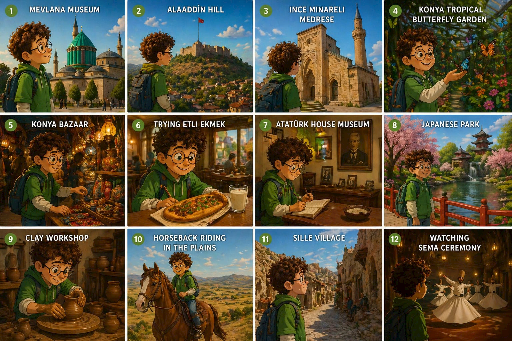
He put the key in his pocket and smiled. Because now he knew… Konya was not just a city to visit, but a story to be felt. And he was now the hero of that story.
MİNE HAFIZOĞLU-TRABZON/ TURKİYE
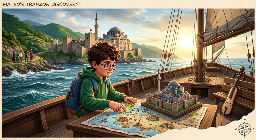
Mateo left the peaceful heart of Konya behind and continued his journey north, where the air grew cooler and the landscape slowly transformed. Rolling plains gave way to steep mountains, and soon the deep blue of the Black Sea appeared on the horizon. His next destination was Trabzon.
When he arrived, he immediately felt the difference. The air was fresh and salty, mixed with the scent of rain and pine trees. The city seemed alive with history and nature intertwined.
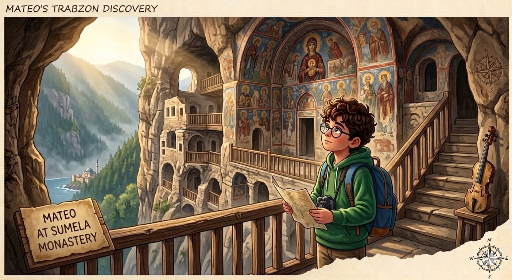
His first stop was the breathtaking Sumela Monastery, perched dramatically on a cliffside in the lush Altındere Valley. As Mateo climbed the winding path, mist drifted through the trees, making the monastery appear almost magical.
Inside, he gazed at the faded frescoes on the walls.
“It feels like time is standing still here,” he whispered.
A guide nearby smiled and said,
“Places like this don’t just tell history—they make you feel it.”
The next day, Mateo visited Uzungöl. Surrounded by green mountains and wooden houses, the lake reflected the sky like a mirror. He sat by the water, listening to the soft sounds of nature.
A local boy approached him.
“First time here?” he asked.
Mateo nodded.
“Then you must try our food,” the boy added with a grin.
Soon, Mateo found himself at a small table enjoying Akçaabat köftesi and warm mısır ekmeği. The flavors were rich and comforting.
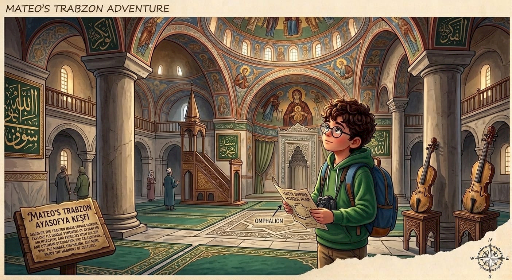
Later, in the city center, he explored the historic Trabzon Hagia Sophia. The architecture amazed him—Byzantine art blending with Ottoman touches.
As the sun began to set, Mateo walked along the coast, watching waves crash gently against the shore. Nearby, he heard lively music. A group of people had gathered, playing the traditional kemençe and dancing the fast-paced horon.
“Come join us!” someone called.
Mateo hesitated for a second, then stepped in. The rhythm was quick, his feet stumbled at first, but laughter filled the air. Soon, he found himself moving with the group, feeling the energy and joy.
That evening, Mateo wrote in his notebook:
“Today, I learned that Trabzon is not just a place of beauty—it is a place of spirit. The mountains, the sea, the music, and the people all move together like a dance.”
He closed his notebook and looked out at the Black Sea.
And once again, he felt it—that quiet realization:
Every place he visited was not just something to see,
but something to live.
Bojana Cvijak, Hırvatistan:
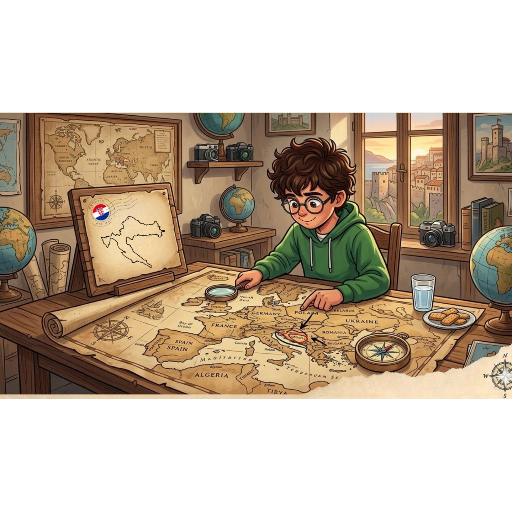
Some time had passed, and Mateo was looking at a map of Europe. His eyes were drawn to a small country shaped like a crescent (croissant), and he read that it was Croatia. He decided that Croatia would be his very next destination.
He landed at the airport near the capital, Zagreb, and from there, he took a train toward Karlovac. The passengers on the train told him that Karlovac is a city that connects the north, east, south, and west of the country. No matter which direction you head, all roads lead through Karlovac.
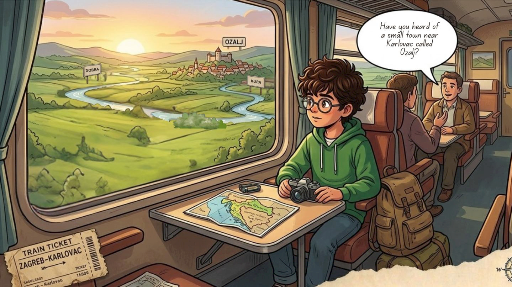
They told him it is a city of four rivers: the Kupa, Korana, Dobra, and Mrežnica, all of which are clean and offer refreshment for swimmers in the summer. They also spoke of Croatia as a land of immense natural beauty and untouched nature. Mateo was particularly thrilled to learn that tap water is drinkable and that there are numerous forest springs around Karlovac where one can freely drink water without fear of pollution.
While on the train, he heard about a small town near Karlovac called Ozalj. Upon arriving in this little place, he noticed a beautiful castle on a hill rising above the Kupa River. Downstream, he spotted another building shaped like a medieval castle, which he later learned was the smallest hydroelectric power plant in Croatia.
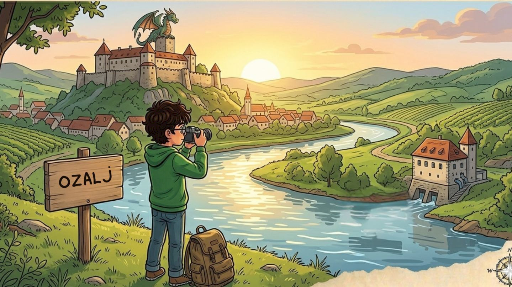
Seeing a group of children out for a walk with their teachers, he approached them and introduced himself. "We are the 'Little Snails' (Pužići) from the Zvončić Ozalj Kindergarten," the children introduced themselves and invited Mateo to join them on their walk. They told him about the city's history, the castle, and the good dragon Ozaljko, who emerges from his hiding place these days to check if everything in town is alright. They also told him the legend of the catfish that guards a golden bell at the bottom of the Kupa, as well as the seven fairies who protect the city.
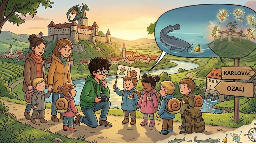
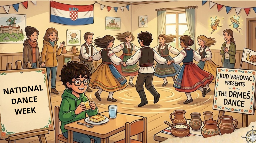
Po povratku u vrtić, Mateo je prvi put kušao štrukle - tradicionalno jelo od krumpirovog tijesta i domaćeg svježeg sira. Tog dana članovi Kulturno-umjetničkog društva Vrhovac posjetili su vrtić kako bi predstavili tradicionalne plesove. Mateo je prvi put u životu plesao drmeš - narodni ples u kojem se plesači drže čvrsto za ruke i vrlo brzo vrte. Iako mu se na kraju dana malo vrtjelo u glavi, bio je
srećan zadovoljan.
Te večeri su u tvom
bilježnicu je zapisao:
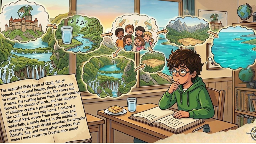
"The beautiful little town of Ozalj, full of legends and natural beauty, simply invites me to return. The drinkable water, the rivers and streams, the rustling leaves from the surrounding forests, the sounds of birds, and the laughter of children create a pleasant peace in the soul. And on my way home, I noticed a National Park woven from many lakes and waterfalls, a sandy desert in the middle of greenery, the great Velebit mountain, the turquoise Adriatic Sea, and many other wonders that mean I must return to Croatia once more!
AZRA BajriĆ, BOSNA HERSEK
Mateo had a playful imagination and a heart full of curiosity. That summer he was on a trip to Croatia, where he explored the coast , walked along the old stone streets and listened to the sound of the sea that lulled him to sleep every night. But as he stood on a lookout and looked towards the distant mountains inland, he remembered his friend Amar.
"You know," he said thoughtfully to his parents, "behind those mountains is Bosnia and Herzegovina. My friend whom I met last year lives there."
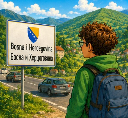
The parents smiled, and the next day the road took them further — across the border, from the coastal landscape to the green valleys and hills. It was as if they had stepped into a completely different story. The sea remained behind them, and it was replaced by the smells of the forest, rivers shining in the sun and small towns full of warmth.
Mateo felt his heart beat faster and faster. This was not just a continuation of the journey — it was a journey towards friendship.
When they arrived in Visoko, Amar was already waiting for him, waving with a smile that could not be hidden. Next to him were his friends: Lejla, who liked to draw, and Emir, who knew the most interesting stories about his city.
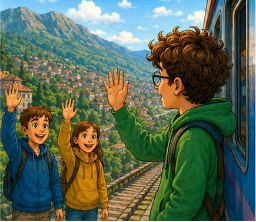
“Ready for an adventure?” Amar asked.
Mateo nodded, knowing that the real story was just beginning.
First they headed towards the Vysok pyramids. As they approached, Mateo saw a huge hill with an oddly regular shape.
"It's the Pyramid of the Sun," Emir explained proudly. "Some say it's the oldest pyramid in the world."
Mateo listened intently as they walked along the paths through the forest. The birds were singing, and the air was fresh and fragrant. When they reached the entrance to the underground tunnels, Mateo felt a slight thrill.
It was quiet inside, almost magical. The light of the lamps illuminated the stone passages.
"They say these tunnels have a special energy," Leyla said quietly.
Mateo closed his eyes for a moment and really felt an unusual peace. It was as if time stood still.
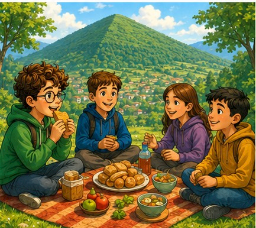
After visiting the pyramids, the children sat on the grass and shared a snack. Mateo tried the homemade pie for the first time and laughed.
“This is the best I've ever eaten!”
But the adventure did not end there.
In the following days, Amar and his friends took Mateo on a trip through Bosnia and Herzegovina.
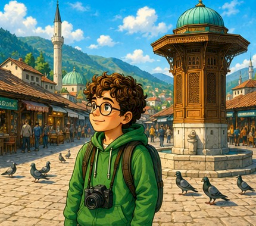
They visited Sarajevo, where they walked through the old streets and listened to the sounds of the call to prayer from the minaret and the bells from the church tower, which blended into a unique melody. In Mostar, they watched brave jumpers jump from the old bridge into the cold Neretva river.
"Would you jump?" Emir asked with a laugh.
Mateo quickly shook his head. "Maybe… one day!"
They also visited mountains, where they ran through meadows full of flowers, and lakes where the sky was reflected as if in a mirror.
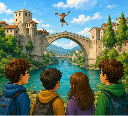
Every day was a new story, a new adventure.
But most of all, Mateo loved the friendship he found. In the evening they would sit together, tell stories and laugh.
"You know," Mateo said one evening, looking up at the stars, "this is the most beautiful trip I've ever had."
Amar smiled. "I told you."
When it was time to go home, Mateo was a little sad, but also happy. He knew this wasn't the end.
“Next year you're coming to me,” Mateo said.
“Agreed!” they all exclaimed in unison.
As the car slowly left Visoko, Mateo looked out the window and waved to his friends. In his pocket he carried a small rock from the pyramid tunnel—a memento of a special trip.
But he couldn't put the most important thing in his pocket.
He carried it in his heart—friendship, adventure, and the promise that the world always had more stories waiting to be told.
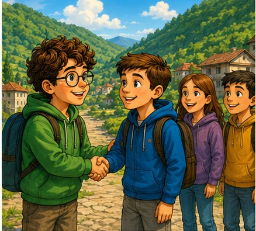
Alena Breu - Czech republic
Mateo closed the map and stared out the window for a moment. So many countries, so many stories… and yet he felt that one country was quietly waiting for him in the middle of Europe. When he opened the map again, his finger stopped over a small country with a rich history.
“Czech Republic,” he whispered with a smile.
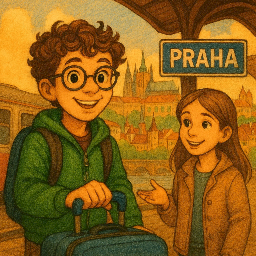
A few days later, he got off the train in Prague. The air was fresh and the city seemed calm yet alive. Towers rose above the roofs of old houses and bells rang out like a greeting. A girl named Eliška greeted him at the station.
“Welcome to the Czech Republic,” she smiled. “I’ll show you our treasures."
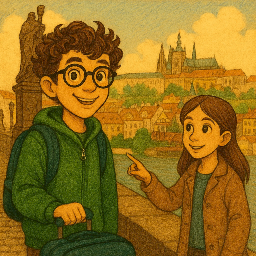
First, they headed to Charles Bridge. Mateo stopped and admired the statues, the Vltava River, and the view of Prague Castle.
“Every stone here has its own story,” Eliška explained. “Prague is a city of legends.”
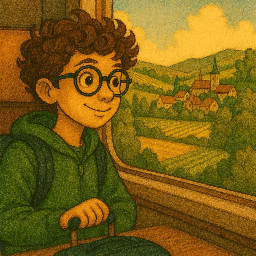
The next day, they traveled by train to a smaller city surrounded by nature - Milovice. Along the way, Mateo saw forests, fields, and small villages with red roofs.
“We love nature,” said Eliška. “And traditions too.”
At the local school, children were singing folk songs. Some sang at the piano, others clapped to the beat.
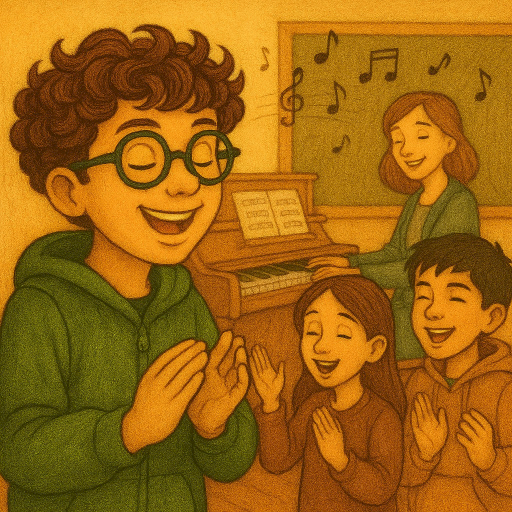
“Czechs love to sing,” explained the teacher. “By the fire, at work, at school… music is part of our lives.”
Mateo sang a simple song with the children, and everyone laughed, even though he didn’t know all the words.
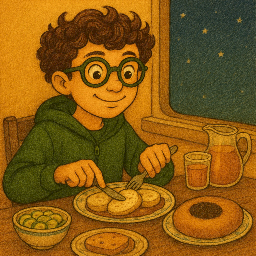
In the afternoon, he tasted dumplings with sauce and a sweet poppy seed cake - koláč. In the evening, he wrote in his diary:
“Today I got to know a country where history mixes with music, nature, and the kindness of its people. The Czech Republic taught me that even a small country can have a big heart.”
He closed his notebook, looked up at the stars, and knew that his journey was far from over.
The world still had many stories to tell—and Mateo was ready to listen.
EMİNE İREM TOPUKSUZ / TÜRKİYE - ERZURUM
Mateo closed his notebook that night, but the old streets and songs of the Czech Republic were still on his mind. Yet his desire to discover new places never faded. He opened the map on the table once again. His finger traveled across long roads, mountains, rivers, and cities… until it stopped at a small place in the east.
Oltu
The name sounded mysterious to him.
“I wonder what kind of story this city will tell me,” he whispered softly.
A few days later, after a long journey through high mountains and wide valleys, Mateo arrived in Oltu, a district of Erzurum. The air was cool, but the sun shone brightly in the sky. The streets were filled with stone houses, old shops, and smiling people.
As he looked around curiously, an old man called out to him:
“Welcome, my son! Is this your first time in Oltu?”
Mateo smiled.
“Yes. I’ve been very curious about this place.”
The old man led him to a small bazaar with his walking stick. In the shop windows, Mateo saw rosaries and jewelry made of shiny black stones.
“What are these?” he asked with amazement.
The old man replied proudly:
“These are Oltu stones — our most precious treasure.”
They entered a small workshop. Inside, a craftsman was carefully carving the black stone. In the master’s hands, the stone almost seemed to glow.
“This stone comes from deep underground,” the craftsman explained.
“It is shaped patiently… just like our culture.”
Mateo watched carefully. Seeing such a small stone turn into a work of art fascinated him.
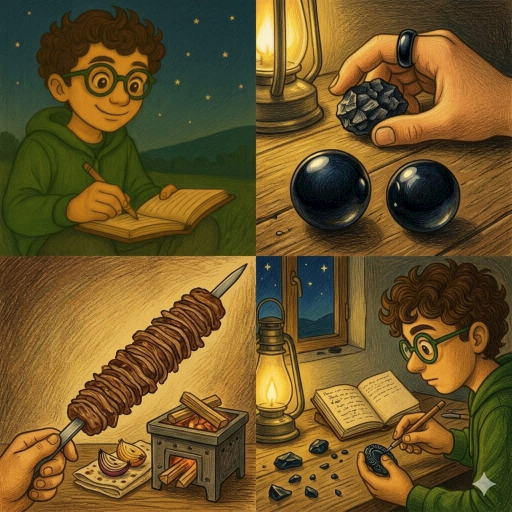
As noon approached, delicious smells filled the streets. They were invited into a nearby home. On the table were cağ kebab, lavash bread, ayran, and Erzurum’s famous civil cheese.
When Mateo took his first bite, his eyes widened.
“This is one of the best meals I’ve ever tasted!” he said.
The lady of the house smiled warmly.
“In our culture, guests are treated like treasures,” she replied.
After lunch, the sound of drums and zurna music rose from the town square. Young people stood side by side in a long line.
“What is this?” Mateo asked excitedly.
“It’s the Bar dance!” one of the boys answered.
“We dance together because Bar means unity.”
Mateo joined them. At first, he mixed up the steps, but after a while he began to feel the rhythm. Watching everyone move together gave him a strong feeling of friendship and togetherness.
As the sun slowly disappeared behind the mountains, an old minstrel began to play his saz. The folk songs echoed through the stone streets of Oltu. They told stories of courage, friendship, and love for one’s homeland.
Mateo listened quietly.
At that moment, he understood something important:
Some cities are not only seen… they are felt deep in the heart.
That night, he opened his little notebook and wrote:
“Today Oltu showed me the soul of a city.
The patience of the Oltu stone, the unity of the Bar dances, the emotion in the folk songs, and the warmth of the people…
Here, everyone keeps their traditions alive and welcomes guests like family.”
As he closed his notebook, he looked up at the stars in the sky.
And he thought to himself:
“Every road teaches me not only a new culture… but also a new heart.”
- < BEGINNING
- END >
-
DOWNLOAD
-
LIKE
-
COMMENT()
-
SHARE
-
BUY THIS BOOK
(from $19.99+) -
BUY THIS BOOK
(from $19.99+) - DOWNLOAD
- LIKE
- COMMENT ()
- SHARE
- Report
-
BUY
-
LIKE
-
COMMENT()
-
SHARE
- Excessive Violence
- Harassment
- Offensive Pictures
- Spelling & Grammar Errors
- Unfinished
- Other Problem





COMMENTS
Click 'X' to report any negative comments. Thanks!