
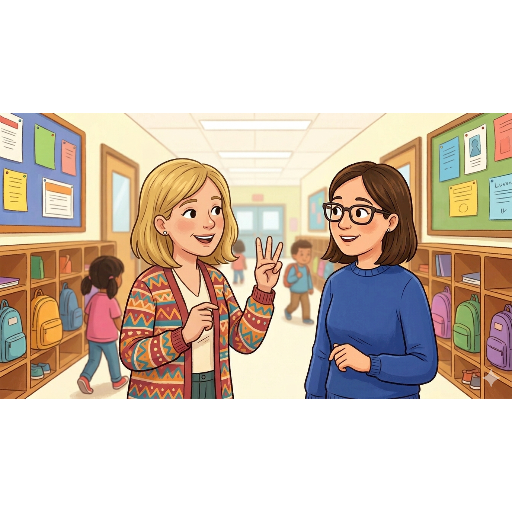
Beka had just returned from her district’s Universal Design for Learning (UDL) training, and her brain was buzzing with new ideas. She bumped into her friend and coworker, Natalie, in the bustling hallway.
"Natalie! I have to tell you what I learned!" Beka said, smiling brightly.

Natalie stopped, juggling her own stack of books. "I’m all ears! You look excited."
Beka took a breath. "The biggest thing I realized is that if we want students to succeed, we have to design the learning environment to match their needs, instead of expecting them to adjust to a design that doesn’t work. Let me show you what I mean."
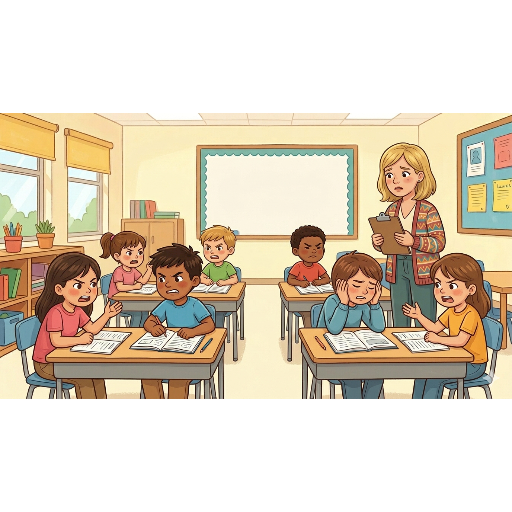
"It started with this hurdle called the Friction Point," Beka explained, pointing down the hall toward her classroom. "My classroom was noisy, and not in a good way. Every day, my students were arguing. There was so much unkindness. I was constantly running over to settle big feelings and fights over things as small as a pencil. It was exhausting, and I felt like I was failing them."
She shared a snapshot of the classroom in chaos.

"My default assumption," Beka continued, "was just that 'kids will be kids.' I figured they just were never taught how to get along, and I’d just have to be the referee until they grew out of it. It was really frustrating."
Natalie nodded sympathetically. "I think we’ve all felt that way."
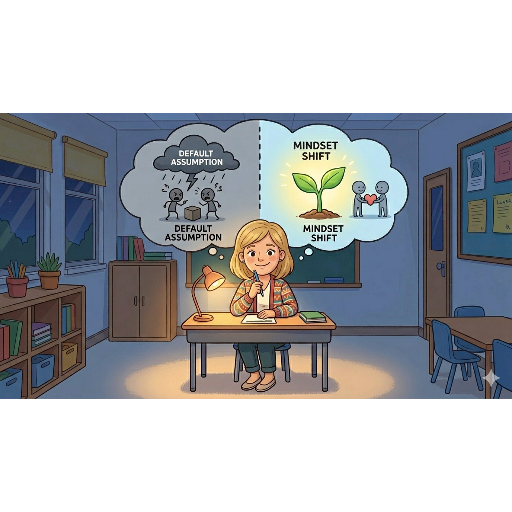
"But during the UDL training, we talked about barriers to learning. I realized the barrier wasn’t the children; it was that they lacked the specific tools to express themselves kindly when they were frustrated. That was my shift! I stopped thinking, 'Why are they so unkind?' and started thinking, 'What tools can I give them to practice empathy?'" She visualized her internal change: the old assumption making way for a new, constructive idea.

"So, what did you do?" Natalie asked.
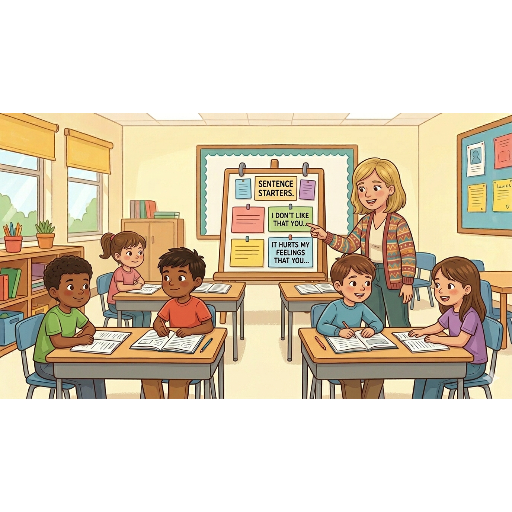
"I proactively designed a new setup for our class meetings. Instead of just talking about being nice, I introduced specific scenarios of conflict that they recognize. And, crucially, I gave them tools: big, bright Sentence Starters. I modeled how to use them, and we practiced during our meeting. Now, when they get stuck, they don't have to scramble for words while they are angry. The words are right there."
Beka showed Natalie what the new, structured practice looked like on the rug.

"Does it work?" Natalie wondered.
"We have real evidence," Beka beamed. "The kids still argue sometimes—that’s natural. But the conflicts are different. Now, instead of yelling, I hear them using the sentence starters. They say things like, 'I don’t like that you used my pencil,' or 'It hurts my feelings that you didn't stop talking when I asked you to be quiet.' They are actually hearing each other."
Beka reflected on the final outcome. "Overall, the experience has completely changed. They try to be less critical of each other. This whole shift taught me that I need to look for behavioral barriers just like academic ones. Next time, I will introduce conflict scenarios and sentence starters before conflict arises."
- Full access to our public library
- Save favorite books
- Interact with authors

- < BEGINNING
- END >
-
DOWNLOAD
-
LIKE
-
COMMENT()
-
SHARE
-
SAVE
-
BUY THIS BOOK
(from $3.39+) -
BUY THIS BOOK
(from $3.39+) - DOWNLOAD
- LIKE
- COMMENT ()
- SHARE
- SAVE
- Report
-
BUY
-
LIKE
-
COMMENT()
-
SHARE
- Excessive Violence
- Harassment
- Offensive Pictures
- Spelling & Grammar Errors
- Unfinished
- Other Problem

COMMENTS
Click 'X' to report any negative comments. Thanks!