




Fossils are the preserved remains or traces of living things.
Most fossils are formed when living things die and are buried by sediment. Then, the sediment slowly hardens into rock and preservers the organism's shape. When an organism dies, the soft parts often decay quickly or are eaten by animals. That's why only the hard parts ( like bones) of a organism leave fossils. It is very rare for the soft parts of organisms to become fossils!


Types of Fossils
Molds - A mold is a hollow area in the shape of the organism or a part of it. A mold formes when the organism is buried in sediment!
Casts - A cast is a solid copy of the shape of the organism. Water may deposit minerals and sediment into a mold, forming a cast!

The two most common types of fossils are molds and casts!


Types of Fossils
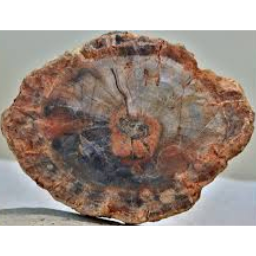
Petrified Fossils - Petrified fossils are fossils in which minerals replace all of an organism, or a part, such as a dinosour bone. This can also happen to wood.
Carbon Films - When sediments bury an organism, some gases escape from the sediment, leaving carbon behind. Eventually, only a thin film of carbon remains.
Trace Fossils - These kinds of fossils provide evidence of the activities of ancient organisms. A fossilized footprint is one example.
There are other kinds of fossils too!


Paleontologist- A scientist who studies fossils

I use something called the fossil record which gives me evidence about the history of life and past environments on Earth. The fossil record also shows how different groups of organisms have changed over time. Evolution is the change of living things over time. The fossil record shows that millions of types of organisms have evolved. An organism is Extinct if it no longer exists on earth and never again will live on Earth.


There are two different ways to express a rocks age!
Relative age- The relative age of a rock is it's age compared to the ages of other rocks. The relative age of a rock does not provide the absolute age.
Absolute Age - The absolute age of a rock is the number of years that have passed since the rock formed. It may be impossible to know a rock's absolute age exactly, so geologists like me often use both absolute and relative ages.
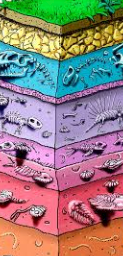
Geologists use the law of superstition to determine the relative age of sedimentary rock layers. According to the law, in undisturbed horizontal sedimentary rock layers the oldest layer is at the bottom. Each higher layer is younger than the layers below it.


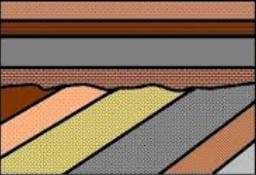
Not all sedimentary rock layers are perfectly horizontal! Gaps in the geological record and folding can change the position in which rock layers appear!
The surface where new rock layers meet a much older rock surface beneath them is called an unconformity. An unconformity is a gap in the geological record.
Sometimes, forces inside the Earth fold rock layers so much that the layers are turned over completely. In this case, the youngest rock layers may be at the bottom!!


The rate of decay of each radioactive element never changes. The half life of a radioactive element is the time it takes for half of the radioactive atoms to decay.
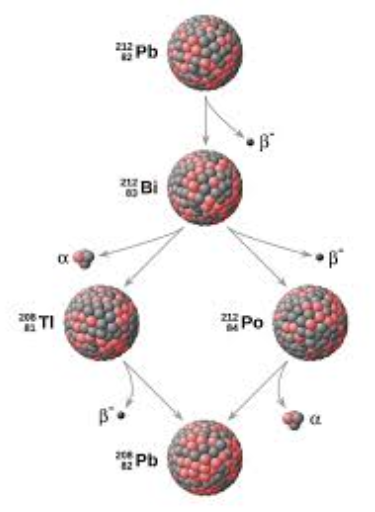
Most elements usually do not change. But some elements can break down, or decay, over time. These elements release particles and energy in a process called radioactive decay! During radioactive decay, the atoms of one element break down to form atoms of another element.

What's radioactive dating?

In radioactive dating, scientists first determine the amount of a radioactive element in a rock. Then they compare that with the amount of stable element into which the radioactive element decays. They use this information and the half-life of the element to calculate the age of the rock! Scientists often date rocks using potassium-40!

- Full access to our public library
- Save favorite books
- Interact with authors

- < BEGINNING
- END >
-
DOWNLOAD
-
LIKE
-
COMMENT()
-
SHARE
-
SAVE
-
BUY THIS BOOK
(from $2.99+) -
BUY THIS BOOK
(from $2.99+) - DOWNLOAD
- LIKE
- COMMENT ()
- SHARE
- SAVE
- Report
-
BUY
-
LIKE
-
COMMENT()
-
SHARE
- Excessive Violence
- Harassment
- Offensive Pictures
- Spelling & Grammar Errors
- Unfinished
- Other Problem

COMMENTS
Click 'X' to report any negative comments. Thanks!