Welcome to the School of Our Dreams!
What does the perfect school look like? Is it just a building with classrooms, or can it be a living, breathing ecosystem that cares for our planet?
In this collaborative book, students and teachers from different classrooms have come together to imagine, research, and design Our Collaborative Sustainable School. By blending real-world green technologies with our imaginations, we have built a vision for an eco-friendly future. Every page of this book represents a shared dream for a cleaner, brighter tomorrow.
Step inside and explore the sustainable world we created together!

Physical structure of our sustainable school -which material will be used for construction
OŠ”Vladimir Nazor” Pisarovina
Materials Used for Construction
Our sustainable school is designed using environmentally friendly, durable, and energy-efficient materials. The goal is to reduce environmental impact while creating a healthy space for students and teachers.
Recycled and Reused Materials
Materials such as recycled steel, reclaimed wood, and recycled plastic are used. These reduce waste and limit the need for new raw resources.
Bamboo
Bamboo is a fast-growing, renewable material. It is strong, flexible, and we used it for flooring, walls, and structural elements.
Glass and Windows
Energy-efficient double or triple-glazed windows will help reduce heat loss and improve natural lighting, lowering the need for artificial lighting.
Green Roofing Materials
On our roof we have a green place for all sorts of plants and birds.
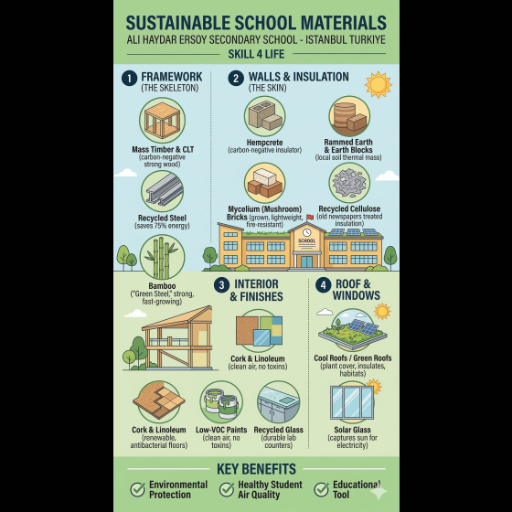
Ali Haydar Ersoy Secondary School -Istanbul Turkiye Berna Efeoglu
Ali Haydar Ersoy Secondary School -Istanbul Turkiye Berna Efeoglu
How Our School Saves Energy
Our school is like a giant battery! We don't want to waste electricity. Here is how we save it:
We have Solar Panels on the roof. They catch sunlight and turn it into electricity for our computers and lights. We make our own clean energy!
We have very big windows. During the day, we don't need to turn on the electric lights because the sun makes our classrooms bright. This is called "Natural Lighting."
Just like you wear a coat in winter, our school has Insulation (like the recycled paper or mushroom bricks). It keeps the heat inside during winter and keeps the school cool in summer. We don't need to use much heating or air conditioning.
Our school has Sensors. If a classroom is empty, the lights turn off automatically. They "watch" to see if anyone is using the room!
We planted trees near the windows. In the summer, the leaves give us shade so the sun doesn't make the room too hot. This keeps us cool for free!
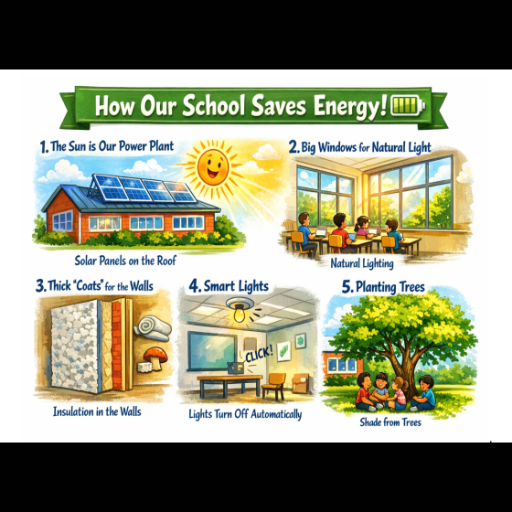
Scoala Gimnazială Hărău, România -Iacob Tatiana
Water usage of the sustainable school
11 Primary Sch./Greece/Maria Machika
In our dream sustainable school
-we use water carefully.
- We do not waste water.
-The school has special systems to collect rainwater.
- We use this water to water plants and clean the yard.
-In the bathrooms, we have smart taps.
They close automatically and save water.
-Students learn to turn off the tap when they wash their hands.
-The school garden uses drip irrigation, so plants get only the water they need
-we have signs encouraging students to save water
-we check for water leaks
Together, we help save water and protect the environment.
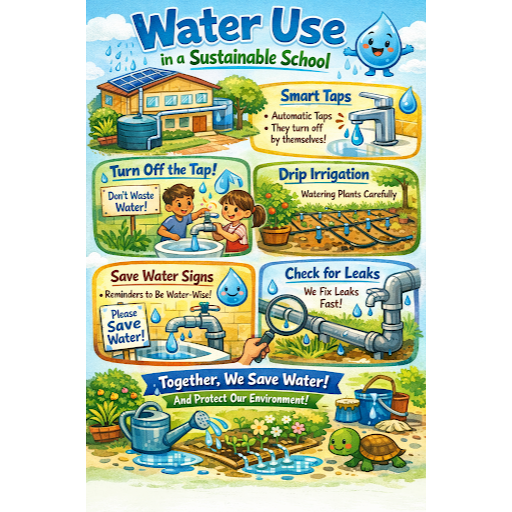
Saint Sava Primary School, Kikinda, Serbia
Green areas of the sustainable school
Şehit Doğan Sevinç Secondary School-Bilge Yılmaztekin
Outdoor Green Spaces:
Rooftop gardens for growing vegetables and herbs
Native plant gardens that support local wildlife
Outdoor classrooms with natural seating areas
Rain gardens to manage stormwater naturally
Butterfly and pollinator gardens
Edible forest gardens with fruit trees
Indoor Green Features:
Living walls with vertical gardens in hallways
Classroom plant stations for hands-on learning
Indoor herb gardens in cafeterias
Green atriums as central gathering spaces
Educational & Functional Areas:
Composting stations for food waste
Permaculture zones for teaching sustainability
Wetland areas for water filtration
Tree groves for shade and carbon absorption
Sensory gardens with aromatic and textured plants
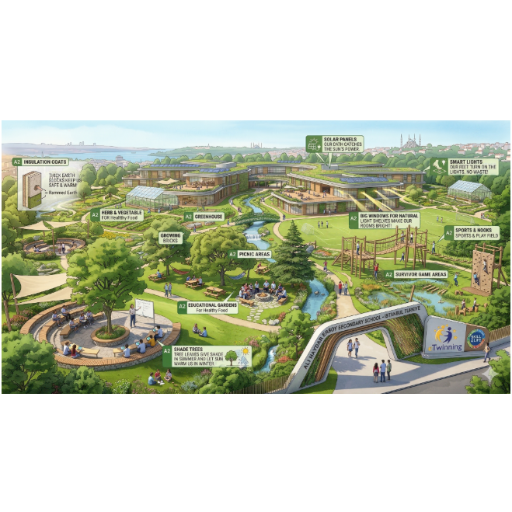
Ali Haydar Ersoy Secondary School -Istanbul Turkiye Berna Efeoglu
On education teaching recycling at school-team tasks, zero waste activities
Şehit Doğan Sevinç Secondary School-Bilge Yılmaztekin
Research shows that hands-on recycling activities help children:
Build strong environmental habits early
Understand real-life problems (plastic, waste)
Continue these behaviors at home and in the future
Important finding:
Students who actively recycle at school are more likely to keep doing it long-term
What makes recycling education successful?
Studies highlight 3 key factors:
1. School environment & teachers
School rules and teacher support strongly affect student behavior
2. Active participation (not just theory)
Activities like sorting waste or projects improve learning
Students learn better by doing, not just listening
3. Family influence
Children recycle more if their families also recycle
Team tasks improve learning
Research on recycling-based activities shows:
Students develop teamwork and problem-solving skills
Creativity and design thinking increase
Students become more confident and active learners
Conclusion:
Group tasks = better learning + stronger environmental awareness
4. Zero Waste schools – what happens?
Studies on zero waste schools found:
Students’ environmental awareness becomes high
They become sensitive to:
Air pollution
Water protection
Nature balance
Care more about nature
Make better daily choices
5. Why schools are important for sustainability
Research shows schools are key because:
They produce a lot of waste
They shape future society
Students learn habits that affect the whole community
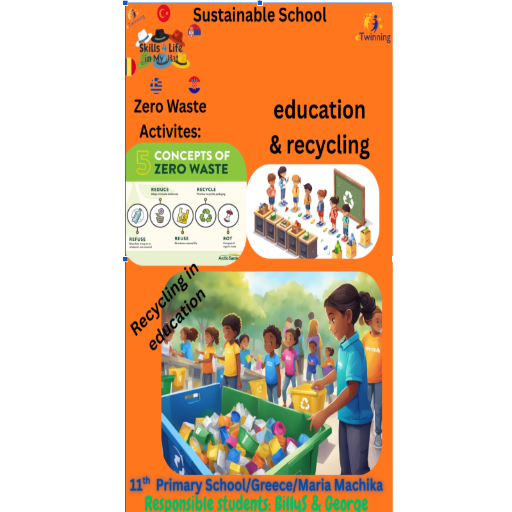
11 Primary School/Greece/Maria Machika
Waste management (recycling, compost, using less paper)
Saint Sava Primary School, Kikinda, Serbia - Dragana Videnov
We treat waste like treasure! Nothing is thrown away without thinking.
1. Recycling Stations Everywhere
We have colourful bins for paper, plastic, glass, and metal. Students learn to sort waste correctly.
2. Compost Corner
Food scraps from lunch go into compost bins. Later, this becomes rich soil for our school garden.
3. Less Paper, More Digital
We use tablets and laptops instead of printing too much. This saves trees and keeps our bags light.
4. Creative Reuse
Old boxes, bottles, and jars become art projects. Waste turns into imagination!
- Full access to our public library
- Save favorite books
- Interact with authors
- < BEGINNING
- END >
-
DOWNLOAD
-
LIKE
-
COMMENT()
-
SHARE
-
SAVE
-
BUY THIS BOOK
(from $4.19+) -
BUY THIS BOOK
(from $4.19+) - DOWNLOAD
- LIKE
- COMMENT ()
- SHARE
- SAVE
- Report
-
BUY
-
LIKE
-
COMMENT()
-
SHARE
- Excessive Violence
- Harassment
- Offensive Pictures
- Spelling & Grammar Errors
- Unfinished
- Other Problem






COMMENTS
Click 'X' to report any negative comments. Thanks!