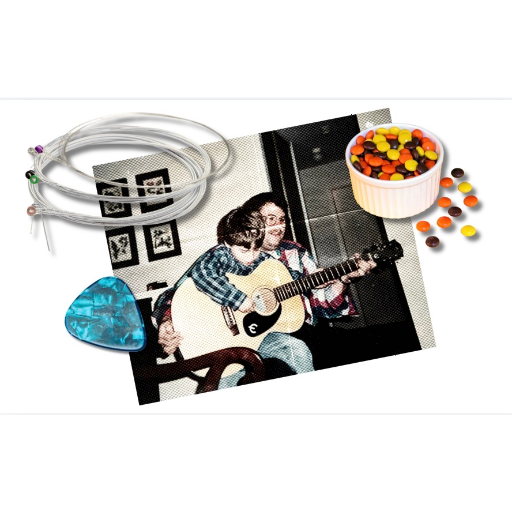

Everybody has dreams — bright, shimmering paths that change color depending on the day. Some children know exactly what they’re getting into, and some simply follow the glow. Strat Hopper was one of the former: a boy who loved music in every form it came in. Soft jazz on rainy afternoons, rhythm and blues when he felt brave, lounge melodies when his mother practiced, and neon‑bright rock and roll when his enthusiasm hit its highest gear. His dream was always the same — to make music that meant something — but the vision shifted in a revolving cycle based on his moods. One day he imagined himself at a piano like a soulful legend, the next with a keytar blazing in electric pink, and sometimes, when he felt particularly mysterious, he pictured himself coaxing ghostly tones from a theremin in the basement. Strat’s imagination never stayed in one place for long, but his heart always stayed with music. And on days when his imagination ran ahead of him — five days out of seven — Strat's mind filled with a rotating gallery of musical fantasies. His dream took on many styles and color filters, filling his mind with vivid fantasies that streamed from his antennae like neon mood threads. From Hopper Hills to the Nevertribe's mesa, no one ever guessed wrong about Strat's imagination; his antennae broadcast his dreams in full color. Humans, avians, reptilians, and mammalian Neverbeings had a daily weather report reflecting what stage he stood on that day. Then one day, not long after he turned six, a new addition to the Hopper family roster was born. His mother Soprana “Churro” Hopper, had laid the egg that would hatch into her second child.



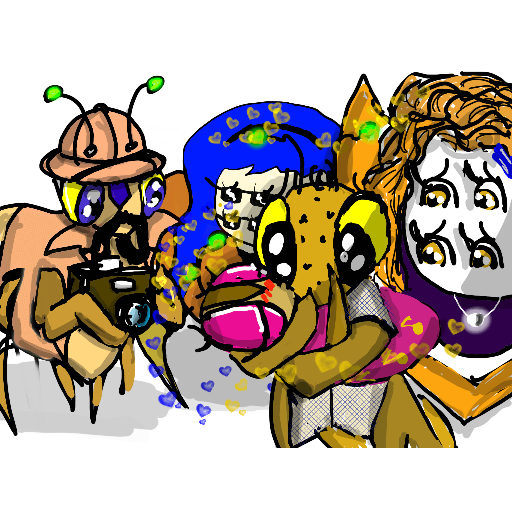
The clock ticked like Strat’s metronome as he and his aunt waited on the couch for the happy couple to return home with the precious bundle. The house felt warm in a way that made his stomach flutter. Dextra, Strat, and his cousin Celia spent days anxiously awaiting this moment while prepping Strat for the changes their family was going to face — and even now Dextra still saw the uncertainty in his soulprint.
“Strattie, when Churro was born, I thought she’d replace me,” she said. “But she didn’t. She became mine. My whole world for a long time. And it is because of her that I have you, and now we have Celesta.” Strat looked up, with a stray tear. Dextra touched his feeler, gentle and sure. “Sweetheart… Churro could have a clutch of a hundred children, and you would still be my special little guy. Nothing changes that.”
The front door opened. Soprana stepped inside with Celesta Melody “Cello” Hopper cradled against her chest, Edmund close behind with his camera. Strat’s breath caught. Dextra rose, giving him space but staying close enough to witness the moment she knew would shape him forever.
Soprana placed the newborn in Strat’s arms. The room fell into a hush so complete it felt like the walls were listening. Perhaps the loudest voice in the room was Strat's beating heart. The new addition to the family was absolutely adorable, and Strat understood immediately what Aunt Dextra said to comfort him. Cello slept through all of it, her tiny antennae glowing in a slow, steady rhythm. Edmund lifted the camera — and just as the shutter clicked, Cello leaned forward in her dreaming and kissed Strat’s cheek. Strat froze.
“Mom…” uttered Strat in a shocked whisper, “Cello pecked me like I was a new doll… That — that cannot have been real, could it?”
Strat’s confusion was adorable, and with great pride, Churro shook her head, and gently caressed his shoulder.
“No, Strattie, my love. She knows who you are, just like when my big sister held me.” Churro and Dextra exchanged a heartfelt glance. “Look at her, son. Only a few days old, and she’s already chosen you as one of her heroes."
Dextra gazed at her little sister’s family in tears. She saw the ribbon begin to weave — the same ribbon that connected her and Churro all their lives.
The photograph captured everything: the kiss, the hush, the beginning of a bond that paved a bright future. As they grew, Strat instinctively would hide copies everywhere — in drawers, closets, instrument cases. Cello would carry her own in journals and picture books. Neither knew why. They only knew the moment mattered. Cello didn’t just kiss him. She knighted him. And Strat, all flushed and in tears, accepted.



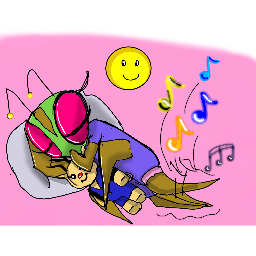
Strat held Cello in his arms, stunned as her dream‑kiss still pumped warmth through the pistons of his heart. When she fidgeted, a soft harmonic in the key of E broke the silence, so pure the family first mistook it for an accidental psicon. But when the note came again, perfectly timed with her movements, Strat felt something inside him shift — an ache he couldn’t name, as if that tiny E had chosen him. He hugged her tighter, and when Soprana lifted Cello away in the flurry of excitement that followed, he stood frozen, holding only the ethereal soulprint her absence left behind, not realizing how deeply he already missed her. When kids like Strat feel a drop on their soul temp like this, it is difficult to detect with empathy. It normally would have gone unnoticed, but Soprana and Edmund had had long talks about this during the time between arriving at the clinic and Cello hatching out of her egg. Although he was snapping pics of every last movement he could, Edmund kept his feelers out, and decided it was time to bring Strat into the study for a man-to-man talk. “Son, you matter to all of us more than ever. Celesta will need our attention, but you will always have it, too.” He handed Strat a heavy gift box, and inside shimmered the Neverchromium briefcase lined with red velvet — the one Strat had admired for months, perfect for his sheet music, violin bows, and guitar picks. Strat’s breath caught. “Dad… thank you,” he whispered, the ache easing just enough for him to understand that his story was still unfolding, even as Cello’s first note lit the world around them.
That night, Strat sat on the edge of his bed with his guitar, practicing as quietly as he could so he wouldn’t wake Cello. But nothing he played disturbed her. In fact, when he brushed a high E, her antennae glowed a soft blue through the crack of the bedroom door. When he tried a low E, they brightened again, pulsing in perfect time with his strumming. Strat froze, breath caught in his throat. Cello wasn’t just sleeping through his music — she was listening. She was answering. And Strat, still clutching the new briefcase his father had given him, felt something warm and terrifying settle in his chest: the sense that her path and his were already beginning to intertwine.
As Cello grew, her understanding of music broadened with her, and her greatest visual aid and example was Strat’s music. It was as welcoming as a bowl of ice cream and as comforting as her blankie. Every day, when Strat came home from school he would give his little sister a kiss and then go upstairs to tune his instruments and set up his sheet music. It never failed that the minute he began his arpeggios in the E key, a love-starved Cello crawled into his room and gazed into his eyes with intrigue. It was not long before she could talk with her voice as clearly as her music.
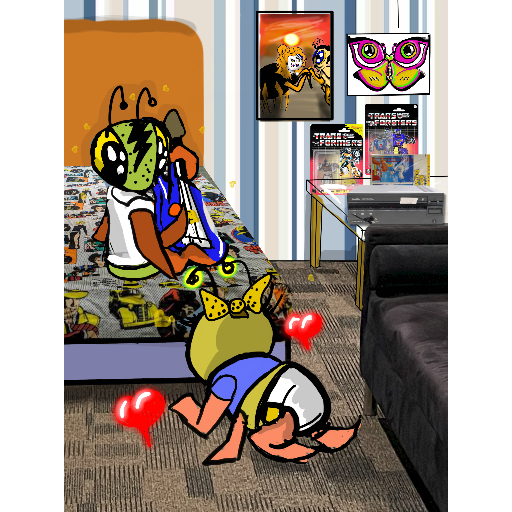

By the time she was five, she stood beside him onstage during their mother’s first tour, her legs shimmering with harmonics while Strat alternated the two instruments he doubled his time practicing for months: a Gibson Les Paul from Earth, and a violin given to him as a gift from the Queen of the Neverhive. At first, this felt like a storybook experience, a talented family of musicians on a Myriad-wide tour, but then he started seeing changes; minute ones at first, but Cello's grasp of music and her ability to play became stronger and sleeker, and Strat in turn began to slow down. Then finally, adolescence caught up with him. Where some teens only have to deal with pimples and hormones, male grasshoppers and spiders become exponentially stronger in the arms, and their silae grow thicker and scratchier. No matter how hard he tried, his limbs did not obey his brain, and it decimated his music. At the same time, Cello flourished effortlessly, able to make entire melodies with a single movement of her legs, and she still looked to Strat for inspiration, unaware of the fear tightening inside him. He loved her brilliance, but each performance made him feel like their siblinghood had become a race to the finish line — and he wasn’t just falling behind. In his mind, his horse had turned back into a pumpkin on the track, leaving him standing alone with a dream his own body was quietly taking away. Little by little, Strat lost his passion for music, unable to swallow the sour notes that he could no longer avoid. He had lost his knack for music and couldn’t bring himself to admit it. Instead, he lay on his bed with the door closed, listening to human music on his audio orb, staring at the ceiling and pretending he still practiced. He kept the illusion alive because he knew Cello’s increasingly strong skills would drown out whatever he pretended to play.
Soon, Cello began seeing less and less of her big brother. And when he was around, she felt the change before she understood it. Strat still kissed her when he came home from school and still gave her Nevermilk and aphid cookies, but the warmth behind his kisses had thinned. Not cold — just quieter. He wasn’t angry with her. He wasn’t pulling away out of resentment. He simply believed he had nothing left to offer her as a mentor, and he surrendered to that truth without telling anyone.
To hold himself together, Strat turned to a pad of paper and black chalk, drawing lines and circles with a precision his instruments no longer allowed. When Cello peeked through his half‑open door and asked what he was drawing, he closed the pad and dismissed it as meaningless doodles, waiting until the door was locked before continuing. It started with the kiss and the pad, but Cello’s notice sharpened, and she hoped she was mistaken.
Cello entered Strat’s room carrying her old music stand, the one he used to adjust for her when she was barely tall enough to reach it, and a fresh pumpkin pie. “If this is a bribe, Cello, I’ll take it happily,” he brought her in closer and playfully noogied her head as she giggled gleefully. Strat promised to help Cello fine-tune her upcoming recital piece. When it was Cello’s music itself, Strat encouraged her as much as their parents. To help her tune up, he took the lint roller he kept on his desk. He brushed her feelers with gentle strokes, the way he always had before a performance, and for a moment the ritual felt almost like it used to. But when he stepped back, he saw how much she had grown — how her legs shimmered with harmonics even before she played a note, how her posture had changed, how her confidence radiated without effort. He was quite proud.
Cello performed her first ballad of the session, a soft, layered melody that filled the room with a glow Strat hadn’t felt in years. When she finished, he whispered, “That was beautiful,” and he meant it. Cello’s antennae brightened with pride — then dimmed with determination.
“Strattie, it's your turn. C'mon, set the chalk down,” she tittered in anticipation for a moment that she wanted and waited a long time for. “Get out your guitar. I wanna see my superstar big brother shredding like a box of cereal.” Strat, like a dragonfly in headlights, froze. This was the absolute last thing he wanted to come out, but he did not care enough to stop it.
Cello walked to his closet, expecting to see the familiar gleam of polished wood and neatly coiled cables. Instead, she found a disorganized heap of Strat's various possessions. Cello could not even see the cases for Strat's instruments. They were shoved in the very back of the closet, frayed, dusty, and the rusted hinges were halfway torn off. She felt the coldest burns of confusion and dread. Strat didn’t move. "Strattie..." wept Cello, "I-I don't understand." Almost as if out of nowhere, the minute Cello focused on Strat’s connection to music unlocked a silent anger and frostiness.
"That's the problem, kid. You never did." he muttered quietly to himself, but not so low that she could not hear it. He flipped the sheet of paper on the pad and clenched his feelers to the chalk tighter; his sword on a battlefield where the other side was armed with cannons towering five stories tall.
And in that moment, the truth began to fall into place for Cello — not all at once, but in quiet, sinking pieces. Her big brother hadn’t simply stopped playing. He had lost something. Something enormous. Something she had never realized he was grieving.
At one time, Strat's instruments were the very core of his personality and the beacon of his soul. To so callously disregard his violin and electric guitar was not the real Stratocaster Hopper. The things that Strat liked now, they blocked the two things that Strat coveted. The stacks of comic books, magazines, 1980s Earth toys, and even leftover pizza boxes and soda cans. Atop the past that was drained of luster forever stood a monument to the one remaining part of his childhood that he refused to let fate part from him. She turned toward Strat, her voice small and breaking. She could not think of a thing to say, in her shock she could only repeat her previous utterance.
Cello’s young mind and her kind heart overclocked themselves with endless questions, but seeing the absence of Strat’s sparkle stole her breath before it could leave her brain stem. There he lay on the bed, chewing boysenberry bubble gum and playing word games with himself. This could not be her brother. She thought to herself it just couldn’t be true. The only thing she felt from him was the icy stare. She would have gladly taken Strat’s anger if he yelled or screeched at her, but he didn’t, and that felt even worse. He squinted his eyes and pointed to the door. He wanted her out.
Cello sadly cantered out of his room, in tears. He just sat there with that silent look of scorn. The moment the door closed behind Cello, Strat’s face stayed unchanged, but on the inside, something foul churned — not anger, not guilt, but a deeper, colder apathy. More telling was the soulprint he spitefully felt toward: Not Cello, not at all. It was Strat himself.
He had just proven, by his own impossible standards, that he wasn’t the soul he thought he was. Not a mentor. Not a musician. Not someone worth saving from the silence he’d fallen into.
He tightened his grip on the chalk and mindlessly kept going with repeating scratches. Cello’s weeping softened into small, frightened breaths. She didn’t understand what she had stepped into — only that her brother’s heart had shifted in a way she could feel but couldn’t fix.
And in that moment, the fracture between them stopped being invisible. He could hear Cello's sobbing through the wall, and for the first time in a long while, a stray tear left his eye. What he had become was unforgivable. He let down Aunt Dextra as a fellow elder sibling; he let down his mother and father for the line he just crossed, and he let down Cello most of all. Like an avalanche, his sorrows and nihilism took him over.
After the longest four months of his life, Strat and his Neverhivian classmates finally had their caps and gowns. It was finally graduation night at Southtropolis High, and Churro and Edmund could not contain their excitement. Their son was graduating in the top ten of his class, and in the orchestra pit, Cello's middle school class played the graduation music. The room roared with applause when Strat crossed the stage, but the minute the ceremony was over, the parents and teachers went straight to the younger students, showing their unfiltered admiration for them, particularly the praise for Cello’s haunting and soulful solo. Cello did not want the attention, but a few Neverhivians talked of scholarship to Princess Maddie’s Magic School; that Cello was the highlight of the ceremony. Despite this, Strat found strength in the darkness of the auditorium and the presence of their closest family friend and fellow classmate Viscountess Billie, an academic prodigy. Cello and Billie were the same age, but Strat gave her the confidence to finish her formal education outside of the Neverhive Palace, and face public school with kids far older than her.
“Well, Stratocaster Hopper,” Billie teased, “now that you have your beeskin, where will the winds of destiny take you?”
“I don’t know about long-term, but I have a hot date after the ceremony.” “Really?” asked Billie with uncontained excitement.
“Yeah, I have a date with a pillow and a malfunctioning air conditioner,” Strat guffawed as Billie nearly gave herself the hiccups from laughing.
“What about you, Bil? You have your future in mind?” Billie turned away with a sad glow from her antennae. “Bil?”
“You made this last year livable for me, Strat. You are why I survived going to school with all the older students. You protected me, and it means the world to me.” Before Strat could deny his magnitude in it, Billie gave Strat a hug and tearfully moaned, “You and Baxter are the best brothers a viscountess could ever ask for. Never, ever forget it." Strat, for how close he and Billie and her siblings were to each other, never talked about his departure from music, yet they were supporters he could trust. "To good friends and bright futures." toasted Strat and Billie. When the ceremony was over, Cello hopped over to Billie and Strat and hugged them both, feeling the utmost pride in her big brother and one of her closest friends.
When he got home, he put a towel over his mirror so the unearthly manifestation of jealousy could not point its poisonous glare outward. A high school graduate with high marks did nothing to stay the bitterness that dripped back into his mind.
The following night, Strat dusted off his Neverchromium briefcase and packed it with his essentials as a kewpie voice from the doorway caught his ear. “Strat… what are you doing?” she whispered. "I'm moving. Now that I am a high-school graduate, I can go wherever I please. But if you need to send my comic subscriptions to me, wire them to Cousin Celia’s apartment."
"Strat, why do you have to leave?" Sharply, he snapped back with snide, "Hey, look on the bright side. With me out of the house and out of the way, it means a room just to store all your awards and Playbills. And here’s one to grow on: Never forget how epic of a fail your big brother was when you have your valet dusting the lint off your perfect and hairless dainty legs.” With that he slammed the briefcase and left. “Strattie..." sobbed Cello, finding herself in unknown territory. Their lustrous and cinematic siblinghood faded to black like a film reel burning at the best part of the movie. The doorbell rang, and she prayed that it was Strat coming back, but it was her friends Dainty Mousette and Juniper Squirrel coming by for a sleepover. Dainty and Junie brought in their slumber bags and three fluffernutter Gladdie Meals. "Cello... are you okay?" Cello did not hear which voice said that, and it did not matter to her. She blithely responded, "I would have said yes if you asked me this morning." Cello broke down into tears as she stared out the window. Not even the promise of a fluffernutter Gladdie Meal with a new series of Benevola premiums could cheer her up, and Dainty and Juniper both felt out of phase with their arthropod gal pal, they felt like they weren’t even in the same world, they felt so helpless. Billie was in another Neverzone unpacking her things for her dorm room, but she felt the horrible sting that her three best friends felt by the loss of another best friend.
Outside the gate to Hopper Hills, Strat boarded the next dragonfly tram and flew straight north. He could not enjoy the scenery of his trip to his new home. He clenched himself and leaned down, feeling sick to his stomach. Strat had vowed there was a line with his baby sister he would never cross, but he did, and as harshly as if he wore spiked shoes. "She'll be better off without me," he sobbed.
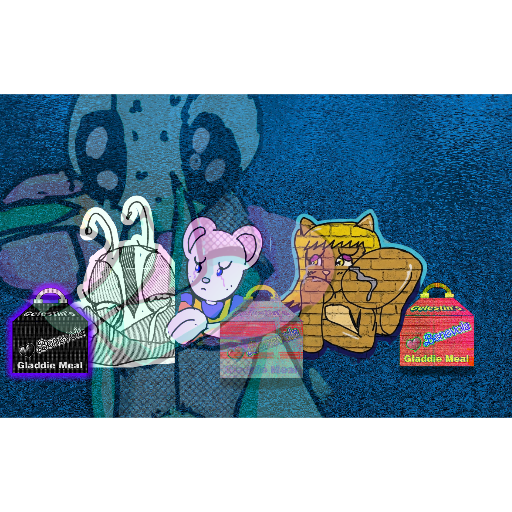
The first night after Strat moved out, Hopper Hills felt like an omelette with no eggs. Churro hummed show tunes to herself as she tried to keep busy in the kitchen, but her mind was elsewhere. Similarly, Edmund sat in his chair with an open book in his arms, but he could not focus on even the first sentence. He felt like he let his son down for years by not noticing the signs that Strat’s commitment to music faltered. Edmund knew of ways to compensate for the enhanced strength and how to tame his silae. Too much time had passed before Strat lost valuable muscle memory. Upstairs, Cello sat on her bed with the rain tapping against her window, hugging a copy of the cameograph of Strat cradling her as a newborn -- the very beginning of their once-beautiful friendship. All she could think of was Strat’s apathy, the volcanic outburst, and the distancing,. It all led to the true source of his pain he had spent the last five years burying. Strat's love for music never left him, but because of his maturing body, it turned its back on him, forever locking him outside in the cold, and all he could do was look in. Cello did not just solve the puzzle, she found the hidden message that Strat did not realize he left in it: it was himself he hated, and it was Cello that he cared about, so much so that he drove her away to protect her by using his anger. He succeeded and he failed at once, shielding her with the very anger that shattered her. Cello stared out into the rain, and her eyes followed its lead, letting a quiet drizzle slip down her trembling cheeks. Miles to the North, Celia’s apartment was quieter than usual, but Strat began to appreciate it. Celia and her girlfriend Sylvia Silkworm who lived in the apartment next door, catered to Strat’s needs, or at least they tried. Strat had fended for himself for so long, he forgot what it meant to be free to rely on others. For the last few hours since he arrived, Strat sat on the couch with his chrome briefcase at his feet, staring at his own copy of the same photograph Cello held. Celia watched him from the kitchenette, her heart heavy. She was happy to have him there — but not at the expense of his own inner turmoil. "Strattie, you can stay here as long as you need. You are always welcome here." "Thanks, Cee-Cee," uttered Strat, passively. Celia kept it to herself, but she felt that Strat was very lucky to have a sister to be mad at. There was little she would not have traded to have a little brother or sister of her own when she was a child. Sylvia inched closer to their tall gentleman caller and bounced onto his lap. “She still loves you, Strat. I am a little sister, myself. Cylindra and I had our fair share of fights, but I cannot imagine a world without her, nor would I ever want to.” Only part of her sentiment was geared toward her sister, and Strat was moved to tears as she nuzzled him.
After a few months, Strat finally adjusted to living in NS Estates, thanks to Celia and Sylvia's patience and love. Celia's apartment was lined with examples of every kind of artistic craft one could think of -- needlepoints of sunsets, pottery clay shimmering with metallic enamel paint. Hidden away in a small binder on the bookshelf was a stack of crumpled drawings Celia found in her refuse bins. Strat spent many rainy nights mindlessly putting his thoughts to paper. Because of the dimness of his inner flames, the quietness that dulled his sense of worth. He saw no value in them. These were sketches and drawings of objects, people, scenery, each drawn in such epic detail that only came to those who spent years of dedication and self-teaching. Celia left Hopper Hills many years prior when NS Estates opened as a co-op for a community of artists with similar backgrounds as her. To Celia, it was fitting that her little cousin was now a resident as well, but it was missing one thing: perspective. So one night, at dinner,
"Strattie, I grew up thinking that Aunt Soprana's children loved impossible-pepperoni pizza, but you have not allowed yourself as much as a nibble."
"I never chipped in for it, so it was never mine to take," sighed Strat. Celia admired his honesty, but he missed the whole point. "Strattie, you are my guest. What's mine is yours. Do not let yourself think you have to earn everything when they are yours rightfully. Pizza, sarsatonic, lodgings, and the most important of all: love." Still, Strat sat there, stomach empty and his heart emptier. "Stratocaster Jeremiah Hopper the First, even if I wanted to, I cannot eat this whole pie myself. Whether you chipped in or not, you will eat it or I will force-feed you this pizza. Make it easy on both of us, won't you?" pouted Celia. Strat replied, “Let Sylvia have it then.” “Sylvia’s stomach is smaller than these olives, baby cuz.” She focused her eyes into the retinas of his, fishing for the true splinter in the finger. “This isn’t about pizza or Nevercoins. It’s about your musical endeavors, isn’t it?”
"Cee-Cee, it used to come to me so naturally. I would have gladly read sheet music until the Nevercows came home, as long as I could make more good notes than not." "I know that, Strattie. But regardless of your Herculean strength conflicting with your instruments, you are still gifted." Strat scoffed at that and replied, "Yeah, so gifted my talents were repossessed before I could ever fully enjoy them."
"Strattie, I want to show you something. Eat your pizza and meet me in the living room, please?" Celia Hopper was herself a living contradiction: her genes carried dominant black-widow spider traits, but she is so gentle that even her anger felt angelic -- as if she meant it as an attempt to comfort.
- Full access to our public library
- Save favorite books
- Interact with authors
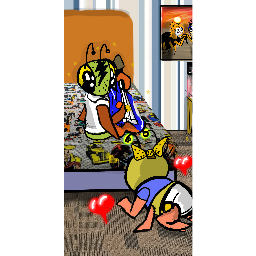
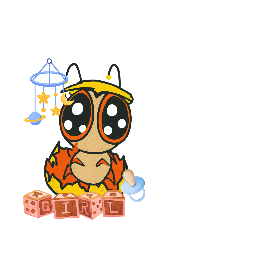

My name is Cello. My big brother was the best musician I ever knew. Then one day, everything changed. I have my own musical aptitude, but I don't want to eclipse him, not ever. Sadly, Strattie loses faith in himself. Please, can you help me give my brother his smile back?
- < BEGINNING
- END >
-
DOWNLOAD
-
LIKE
-
COMMENT()
-
SHARE
-
SAVE
-
BUY THIS BOOK
(from $5.19+) -
BUY THIS BOOK
(from $5.19+) - DOWNLOAD
- LIKE
- COMMENT ()
- SHARE
- SAVE
- Report
-
BUY
-
LIKE
-
COMMENT()
-
SHARE
- Excessive Violence
- Harassment
- Offensive Pictures
- Spelling & Grammar Errors
- Unfinished
- Other Problem





COMMENTS
Click 'X' to report any negative comments. Thanks!