AUTHOR BY AMIRALISIYAHAT HASHEMI

MAKING SPACE TRAVEL EASIER

Making Space Travel Easier
For thousands of years, humans have looked at the night sky and wondered what exists beyond Earth. The Moon, planets, stars, and distant galaxies have inspired scientists, engineers, writers, and explorers
This book explores how technology, science, engineering, robotics, artificial intelligence, and human creativity could make future space travel safer, more comfortable, more affordable, and more accessible.
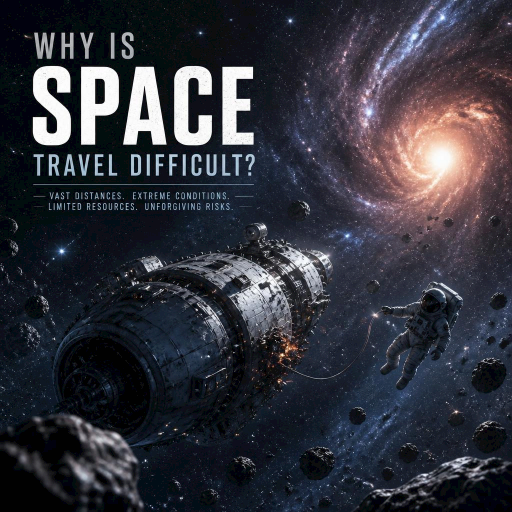
Chapter 1 — Why Is Space Travel Difficult?
About This Chapter
Before thinking about how to make space travel easier, we need to understand why it is difficult in the first place.
Leaving Earth is much harder than traveling across its surface. A spacecraft must overcome Earth's gravity, reach extremely high speeds, and survive an environment that is very different from Earth.
Earth's gravity constantly pulls objects toward the ground. A rocket must produce enough thrust to move upward and eventually reach a speed that allows it to remain in orbit.
This requires a huge amount of energy.
One possible way to make future space travel easier is to develop technologies that reduce the amou
of energy required to reach orbit. More efficient engines, lighter spacecraft, reusable launch systems, and new transportation methods could all help.
Understanding gravity is therefore one of the first steps toward improving space travel.
Speed and Energy
Spacecraft need enormous amounts of energy because they must reach very high speeds.
A spacecraft traveling between planets also needs to manage its speed carefully. Accelerating, slowing down, changing direction, and entering orbit all require planning and energy.
Future propulsion systems could make these tasks more efficient. Scientists are researching different ideas for propulsion, including advanced electric propulsion and other concepts that could eventually help spacecraft travel farther with less fuel.
The Harsh Environment of Space
Space is not simply a very high altitude. It is an extreme environment.
There is no breathable air, temperatures can vary greatly, and radiation from the Sun and other sources can be dangerous. Small pieces of debris can also travel at extremely high speeds.
A future spacecraft must therefore act like a small artificial world. It needs to provide air, water, temperature control, protection, food, communication, and many other things.
The better we understand these challenges, the better we can design systems to overcome them.
About This Chapter
The future of space exploration may eventually move beyond short missions.
Humans could establish permanent or semi-permanent habitats away from Earth and develop new ways of living and working in space.
Space Habitats
A space habitat could provide everything people need to live.
It might contain homes, laboratories, farms, workshops, energy systems, and recreational areas.
Such habitats could be located in orbit or on the surfaces of other worlds.
Space Cities
If technology continues to develop, large communities could eventually exist away from Earth.
A space city would require transportation, food production, energy, communication, education, healthcare, and many other systems.
Building such communities would be an enormous engineering challenge, but it represents one possible long-term direction for human civilization.
Overall Summary
Making space travel easier will probably not depend on one single invention.
It will require many technologies working together.
Better rockets could make launches more efficient. Reusable spacecraft could reduce costs. Comfortable spacecraft could help astronauts live during long journeys. Advanced spacesuits could make work outside spacecraft easier. Robots could explore and perform difficult tasks. Space stations could provide laboratories and transportation hubs. Better systems for water, food, and oxygen
At the same time, new propulsion and energy technologies could eventually help humans travel farther than ever before.
The future of space exploration is therefore not only about going farther. It is also about making every part of the journey safer, smarter, more efficient, and more sustainable.
Space is enormous, but human exploration can begin with a simple question:
Can we go farther?
And the next question is even more important:
How can we make the journey better?
The answer will come from science, engineering, creativity, teamwork, and curiosity.
Perhaps one day, traveling to space will not seem like an extraordinary event. It may become another part of human life.
Until then, we can keep learning, keep building, and keep asking questions.
Let's explore.
10 Useful Skills for a Future Space Explorer
Understanding objects, directions, distances, and movement in three dimensions.
Finding solutions when something does not work as expected.
Mathematics is essential for navigation, engineering, physics, and many space-related calculations.
Understanding gravity, motion, energy, forces, and other physical principles.
Visual-Spatial Reasoning Test
Instructions: Choose the best answer for each question.
Each correct answer is worth 1.5 points.
Maximum score: 30 points.
- Full access to our public library
- Save favorite books
- Interact with authors
AMIRALISIYAHATHASHEMI
- < BEGINNING
- END >
-
DOWNLOAD
-
LIKE
-
COMMENT()
-
SHARE
-
SAVE
-
BUY THIS BOOK
(from $4.99+) -
BUY THIS BOOK
(from $4.99+) - DOWNLOAD
- LIKE
- COMMENT ()
- SHARE
- SAVE
- Report
-
BUY
-
LIKE
-
COMMENT()
-
SHARE
- Excessive Violence
- Harassment
- Offensive Pictures
- Spelling & Grammar Errors
- Unfinished
- Other Problem






COMMENTS
Click 'X' to report any negative comments. Thanks!