
Have you ever stopped to think about how amazing it is to hear someone's voice even when that person is far away? Today, we can call a friend with a tiny device that fits in our hands. But long ago, people could not simply pick up a phone and say hello.
One inventor became fascinated with sound, speech, and communication. His name was Alexander Graham Bell
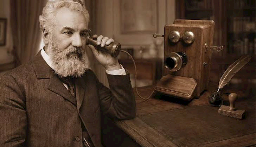
Bell spent years asking questions, building machines, and learning from his mistakes. His experiments eventually helped change the way people around the world communicate.
As we travel through his story, we will discover how curiosity, hard work, and teamwork helped turn an idea into an invention that changed history.
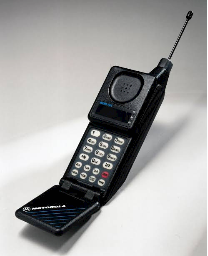
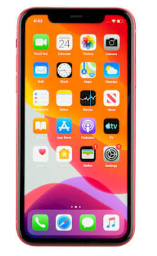
Alexander Graham Bell was born on March 3, 1847, in Edinburgh, Scotland. Bell grew up in a family that was very interested in speech and communication.
His father and grandfather worked as teachers of speech, and his mother was deaf. Because of his family, Bell became especially interested in how people communicate and how sound works.
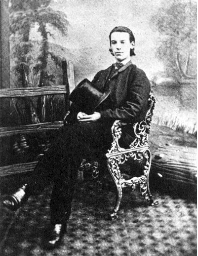
As a young boy, Bell loved to experiment. He was curious about how things worked and enjoyed trying to solve problems.
Instead of simply wondering about a question, Bell often tried to build something that might provide an answer.
That curiosity would follow him for the rest of his life.

In 1870, Bell and his family moved to Canada.
The change gave Bell new opportunities to continue learning and experimenting. The next year, he moved to Boston, Massachusetts, where he worked with students who were deaf and taught methods of speech. Bell's work with deaf students was important because it connected his professional life with his interest in sound and communication. He began thinking about an exciting question: Could a machine somehow carry the human voice from one place to another?
At the time, the telegraph could send coded messages over wires. Bell wondered if technology could do
something even more amazing—send actual speech.

Bell began experimenting with ways to improve the telegraph. A telegraph could send messages over long distances, but the messages had to be translated into signals. Bell wanted to find a way to send many different sounds through wires.
He worked on what became known as a harmonic telegraph. He believed that different sounds could create different electrical signals.Bell did not work completely alone. He found an important partner named Thomas Watson, a skilled mechanic and model maker.
Together, Bell and Watson built, tested, changed, and
tested their machines again. Some experiments worked. Others did not. But every unsuccessful experiment gave them another clue.
Imagine walking into Bell's workshop. Wires stretch across the room. Pieces of metal sit on a table. Tools are scattered everywhere. Bell is writing notes while Watson adjusts another part of the machine.
The two inventors are trying to solve a difficult problem.
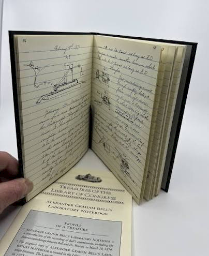
They want electrical signals to carry sound. Bell understood that the human voice creates vibrations. He wanted his machine to turn those vibrations into electrical changes and then turn those changes back into sound. It was a complicated problem, but Bell kept working. His laboratory notebook became a record of his ideas, experiments, drawings, and observations.
It was a complicated problem, but Bell kept working.
His laboratory notebook became a record of his ideas, experiments, drawings, and observations.
Primary Source #1: Bell's 1875–1876 laboratory notebook is an actual historical document preserved by the Library of Congress. It contains Bell's notes and drawings from his experiments.
On March 7, 1876, Bell received a United States patent for his telephone invention. The patent was U.S. Patent No. 174,465. Just three days later, something incredible happened. Bell was working with Thomas Watson when the machine successfully transmitted Bell's voice.
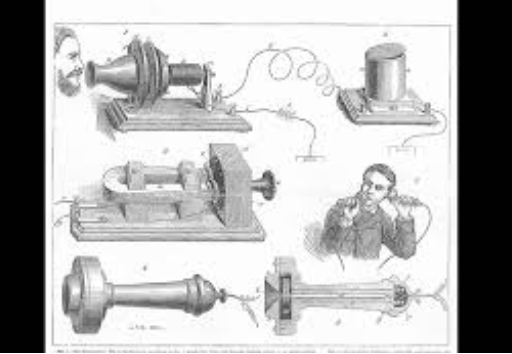
Bell called to Watson: “Mr. Watson, come here, I want to see you!” Watson heard Bell's voice through the device. The experiment had worked! Bell had demonstrated that human speech could be transmitted electrically over a wire.
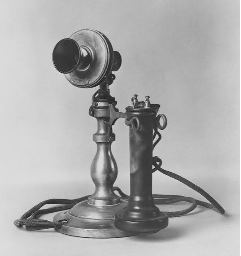
How do we know what Bell was doing during these important experiments? Historians can study primary sources. A primary source is something created during the time being studied. It can be a letter, photograph, diary, notebook, newspaper, artifact, or official document. The Library of Congress preserves thousands of items from Bell's life, including notebooks, photographs, letters, blueprints, and other documents.
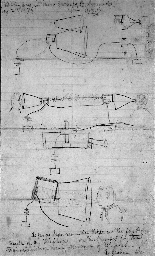
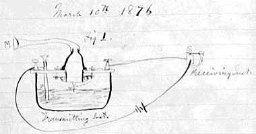
Primary Source #2: Bell's original 1876 telephone design drawing is preserved in the Alexander Graham Bell Family Papers at the Library of Congress.
When we look at Bell's drawing, we are looking at
evidence created during the time he was developing his invention.
Bell and Watson continued improving their invention.
In June 1876, Bell demonstrated the telephone at the Centennial Exhibition in Philadelphia.
People were amazed by the idea that a person's voice could travel through wires. Soon, telephones began appearing in businesses and homes.
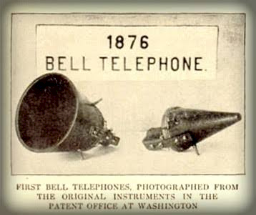
The invention changed the way people communicated. A message that once required a person to travel could now be spoken across a distance.
Bell's invention did not mean that every communication problem disappeared. Instead, it opened the door to new possibilities. People began imagining a world where distance did not have to keep people from talking to one another.
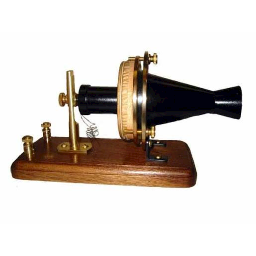
Alexander Graham Bell did not stop experimenting after the telephone.
He continued studying communication and science throughout his life.
Bell worked on a device called the photophone, which used a beam of light to transmit sound. He also experimented with aviation, hydrofoils, and other technologies.
The photophone was especially interesting because its basic idea was connected to transmitting information using light. Modern fiber-optic communication also uses light to carry information.
- Full access to our public library
- Save favorite books
- Interact with authors
- < BEGINNING
- END >
-
DOWNLOAD
-
LIKE
-
COMMENT()
-
SHARE
-
SAVE
-
BUY THIS BOOK
(from $5.59+) -
BUY THIS BOOK
(from $5.59+) - DOWNLOAD
- LIKE
- COMMENT ()
- SHARE
- SAVE
- Report
-
BUY
-
LIKE
-
COMMENT()
-
SHARE
- Excessive Violence
- Harassment
- Offensive Pictures
- Spelling & Grammar Errors
- Unfinished
- Other Problem






COMMENTS
Click 'X' to report any negative comments. Thanks!