 this book is dedicated to the best teacher,
 Ramona Dinger
This book was created and published on StoryJumper™
©2014 StoryJumper, Inc. All rights reserved.
Publish your own children's book:
www.storyjumper.com





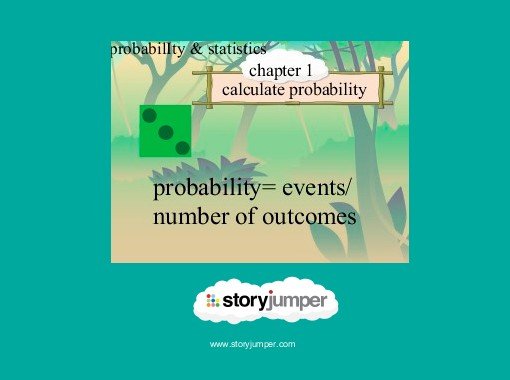
 calculate probabilityprobability= events/
number of outcomes
 chapter 1probabilIty & statistics
~ Probability is the measure of how likely an event is to
occur out of the number of possible outcomes.
~ Calculating probabilities allows you to use logic and
reason even with some amount that's misgiving.
~ Also find out how you can do the math when you
calculate probabilities.
ex: the dice is shacked and thrown the dice has six
sides , but 1 of each numeral so in this case the dice
would be 1/6
By ; Veronica Alvarez

 probability of independent or
dependent events
 P(1st event n 2nd)
 or
or  P(1st event U 2nd)
When you're dealing with Independent and Dependent Events,
it's important to know that dependent events are affected by
previous events, while independent events are not.
Independent events = number of ways it can happen
_________________________
Total Number of Outcomes
Dependent Events = P(1st event) = # of your event
____________
total outcome
If one or both events are affected by the change in an event, it's
a dependent event.
Ex: when you take marbles from a bag, the probability continues
changing to less. That is dependent.
An example of an independent event would be a coin toss. No
matter how many times it lands on Heads, the probability will
always be 50/50
 Probability of Compound
Events



 Event AEvent BbothEvents A or B /neither
Two or more events are known as Compound Events. We calculate
the probability of two events by multiplying the chances.
P(A U B)= P(A)+P(B) - P(A n B)
First, you get the Event A and/or Event B. (The U means or) Next,
you get the probability of A and add it with the Probability of B. Last,
subtract your answer with the probability of A and B. ( n means
and.)
Have you ever thought why it's unlikely to get, say, 7 heads in a row
for a coin toss if the chances are 1/2? When dealing with compound
events, we are asking two questions and solving for one answer.
First you'll figure out the probability of landing 7 heads in a row.
If you land 6 heads in a row, what's the chances of landing another
Head? 1/2. The previous tosses don't accept the current ones.
 Recognize and
 Explain


We use statistics in our everyday life. For
example, when I go to the store every
morning what are the chances of me getting a
specific flavored coffee out of three options.
The store offers coffee, vanilla coffee, and
mocha. The probability of choosing only a
single flavor is 1 out of three. The 1 would
equal to the number of outcome and the 3 is
out of how many.
 Reflection
 chapter 2- transformation
 Reflection is a real simple action one type of
transformation that uses a line that acts as a mirror, the
image is then reflected over the line. After the
reflection, you have your pre-image, which is the image
you started with, and image', which is the picture that
was reflected.
When you're reflection an image, there is something
called a "Mirror Line" that helps reflect the shape.
The reflection has the same size as the first image, the
only difference is that it's flipped over.
For example, when you take selfies on your phone the
picture is the same only flipped.
 Translations

 Translation? Have you ever thought of
 translations? For example the triangle
in the left page is shown how translation
is happening, the blue triangle is moving
without rotating, or resizing or anything else
just moving.
Sliding the shape, object or etc. moving a shape without rotating or
flipping it.The shape still looks exactly the same,
just in a different place.
 Rotations

 tracing paper


Rotation means turning around a center.
When you rotate a shape, you need to know if you
are being asked to turn 90, 180, or 360 degrees.
- you can start by drawing a perfect square
- make sure you use a piece of tracing paper laid over
graph paper
-use edges of a ruler to draw parallel lines
-use protractor to get an 90 degree angle
 Parallel & Perpendicular Lines
 And well down here are 2 lines that
intersect to form a 90 degree angle which
are perpendicular as shown in the bottom

 notice that these parallel line are the
same distance apart at any given point
they have same slopes as well



 Lets start and talk about both parallel and
 perpendicular lines their differences. Well
to start off a difference of a perpendicular
is when 2 lines cross at a 90 degree angle as
shown on the image upper the left. Now a
difference on parallel lines is when 2 lines
go on forever right next to each other as it is
shown at the image below on the left.
 Corresponding Angles
 Chapter 3


 Angle Pair RelationsAngle Pair Relations
When dealing with corresponding angles, if the lines being
used are parallel, then the angles are equal.
also corresponding angles are occurred when two lines are
crossed by another line.
Corresponding Angles can apply to either two polygons and
parallel lines by a transverse.
For example in the picture on the left page is taking action
of a corresponding angles which is showing three
toothbrushes and one of the lines are intersecting both
straight lines and in between where the two black arrows
are at is showing us corresponding angles , angles at the
same position
 Alternate Interior Angles



 Transversal

In this example, these are Alternate Interior Angles:
- C and F are Alternate Interior Angles
- D and E are also Alternate Interior
Angles
angles and then say,"that sounds difficult",but
really it isn't take a look at the picture at the left
and notice the 2 lines being crossed are parallel
lines, then the Alternate Interior Angles are = .
An easy way to help you remember the angle pairs
are on Alternate sides of the Transversal line, and they
are on the Interior of the 2 crossed lines.Therefore inside
the 2 lines is what you call Alternate Interior Angles.

 Alternate Exterior Angles




 Alternate Exterior Angles is also when 2 lines are crossed by
another line called the Transversal just like interior angles,but
this one is slightly different notice it in the word EXterior and
INterior the begging 2 letters of these 2 important words have
an important meaning.For example look at it my point of view
the"Ex"in exterior can mean exit, outside,etc. As well as for the
letters "In" in interior means inside, in.So you should have a
clue that the Exteriors will be dealing at the outside so therefore
the pairs of angles on opposite sides of the transversal but
outside the two lines are Alternate Exterior Angles.
In the example at the left page:
- A and H are Alternate Exterior Angles
- B and G are also Alternate Exterior Angles
 Consecutive Interior angles



 C + E= 180 degreeD + F= 180 degreeJust like the past two different angles this consecutive
interior angles also is see 2 lines crossed by another
line called transversal. To help you remember the angle
pairs are Consecutive they tend to follow each other and
they are on the Interior of the 2 crossed lines as shown
on the picture aside. Therefore if the 2 lines being
crossed are Parallel Lines, then the Consecutive Interior
Angles add up to 180°.
In this example, these are Consecutive Interior Angles:
- D and F are Consecutive Interior Angles
- C and E are also Consecutive Interior Angles
You've previewed 25 of 38 pages.
To read more:
Click Sign Up (Free)- Full access to our public library
- Save favorite books
- Interact with authors

- < BEGINNING
- END >
-
DOWNLOAD
-
LIKE(1)
-
COMMENT()
-
SHARE
-
SAVE
-
BUY THIS BOOK
(from $7.59+) -
BUY THIS BOOK
(from $7.59+) - DOWNLOAD
- LIKE (1)
- COMMENT ()
- SHARE
- SAVE
- Report
-
BUY
-
LIKE(1)
-
COMMENT()
-
SHARE
- Excessive Violence
- Harassment
- Offensive Pictures
- Spelling & Grammar Errors
- Unfinished
- Other Problem





COMMENTS
Click 'X' to report any negative comments. Thanks!