
This book was created and published on StoryJumper™
©2014 StoryJumper, Inc. All rights reserved.
Publish your own children's book:
www.storyjumper.com

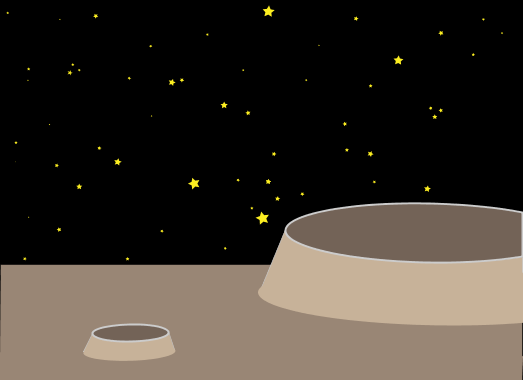 Ethan & Grace Visit Space
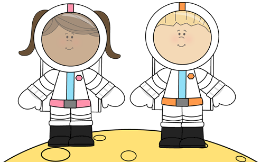 Written by: Sandra Gomez
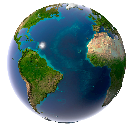
Our planet, Earth...
is one of nine classical planets
in our solar system. It is the
third planet from the sun and
the fifth largest in size. Before
astronomer, Nicolaus
Copernicus' discoveries, people
believed Earth to be the center
of the universe.
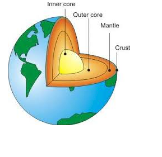
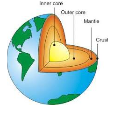
Earth is made up of several
layers: the crust, mantel, outer
core, and inner core. Unlike the
other planets, Earth is made up
of several plates that float
around on top of the mantel.
These are known as tectonic
plates. The plates move slowly
on the planet and give us such
things as tsunamis and
earthquakes. Earth is the only
planet known to have water on its
surface.
Fun Facts About Earth:
Average distance from the Sun: 93 million miles
(150 million km); 1 AU (astronomical unit).
Diameter: 7,927 miles (12,756 km.)
Average temperature: 50 degrees Fahrenheit
(15 degrees Celsius)
Length of year: 356.242 Earth days
Atmosphere: Oxygen and Nitrogen
Moons: One

After learning about planet Earth, Ethan and Grace decided they
wanted to learn more about where their planet came from? What
better way to learn than to take a trip into space? Upon their arrival,
they stumbled across many new discoveries. Their biggest discovery...



Our Gigantic Universe

Our universe is made up
of many stuctures.
Ethan and Grace found
billions of galaxies
within our universe. A
galaxy is a great island
of stars in space,
containing between a few
hundred million and a
trillion or more stars.
We belong to the Milky
Way Galaxy. The Milky
Way Galaxy is a huge,
disk-shaped collection of
stars which contains our
solar system.
Next Stop: The Solar System
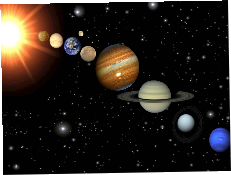
Our solar system is located about 27,000
light-years from the center of the Milky
Way Galaxy. The Solar System is made up of
all the planets that orbit our Sun. In addition
to planets, the Solar System also consists of
other celestial objects such as moons,
comets, asteroids, minor planets, and dust and
gas. Everything in the Solar System orbits or
revolves around the Sun. The Sun contains
around 98% of all the material in the Solar
System. The larger an object is, the more
gravity it has. Because the Sun is so large, its
powerful gravity attracts all the other objects
in the Solar System towards it. At the same
time, these objects try to escape by pulling
away from the Sun. As a result, they get stuck
somewhere in between and spend eternity
orbiting around their parent star.

Formation of the Solar
System
Around 1755, German philosopher, Immanuel Kant
proposed that our solar system formed from the
gravitational collapse of an interstellar cloud of
gas. Because an interstellar cloud is usually called
a nebula, his hypothesis became known as the
nebular hypothesis. Over many, many years of
research, significant evidence had accumulated in
favor of the nebular hypothesis that it achieved
the status of a scientific theory- the nebular
theory of our solar system's birth.

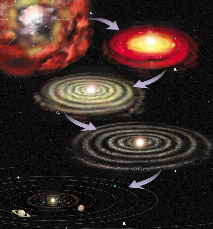
 Ethan, How Did Our Solar System Form
The Nebular Theory...
Begins with the idea that our solar system was born from the gravitational collapse of an
interstellar cloud of gas called the solar-nebular, that collapsed under its own gravity.This
cloud gave birth to the sun at its center and the planets in a spinning disk that formed around
the sun. The gas that made up the solar nebula is said to have been the product of billions of
years of galactic recycling that occurred before the sun and planets were born. Recall that the
universe as a whole is thought to have been born in the Big Bang which essentially produced
only two chemical elements: hydrogen and helium. By studying the composition of the sun,
other stars of the same age, and interstellar gas clouds, we have learned that the gas that made
up the solar nebula contained about 98% hydrogen and helium and 2% all other elements
combined. The Sun and larger planets were born from this gas, while Earth and other
terrestrial worlds were made primarily from the heavier elements such as rock and mineral.

Fun ON the Sun!
Grace was intrigued by all of this information, and convinced Ethan to take a trip to the Sun. While they
were there, they found:
That it is indeed primarily made of hydrogen and helium, that its light and heat come from a nuclear
reaction at its core called nuclear fusion. This happens when two hydrogen atoms collide and stick to each
other. While on the sun they noticed a convective zone and radiative zone. The convective zone forms the
outer shell of the sun. The atoms in this layer have electrons because the temperature is not hot enough to
take them away, like it does in the core. In the convective zone energy is transferred very quickly.
Radiation in the radiative zone is very important. It's what makes the sun transfer energy out into space.
The energy made in the core is in the form of photons (subatomic or itty bitty particles that travel at the
speed of light. In radiation, energy spreads out from the core through these photons. They move at the
speed of light but they bounce off all kinds of other particles. It takes hundreds of thousands of years for
the photons to get through the radiative zone. Speed of light = 186,282,397 miles per second
(299,792,458 meters per second) (Meter is the accepted unit of measure in terms of the speed of light.


While visiting the Sun, Ethan and Grace
explored all of its parts. During their
observations, they found and recorded
the following:
The chromosome is a small region above the photosphere.
The photosphere is the surface of the Sun.
The corona extends millions of miles away from the Sun into
space, but we can see it only when there's a total solar
eclipse. Temperatures in the corona are more than 1 million
degrees kelvin.
The corona hole is a hole in the Sun's atmosphere. Scientists
believe that solar winds start in these holes.
A prominence is a large, bright characteristic that extends
from, but is anchored to the Sun's surface, often in a loop. A
prominence can last for several months.
Sunspots are cool regions (still highly flammable!) on the
sun's surface.
The Sun releases plumes of energy that contain photons, x-
rays, and charged protons and electrons. Flare activity
increases as sunspot activity decreases.

Ethan and Grace Visit the The Inner
Solar System
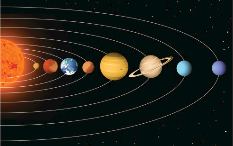
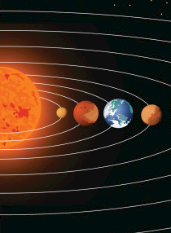
A lot of astronomers like to think of the Solar System as
two parts, the inner and outer:
The inner solar system consists of Mercury, Venus, Earth,
and Mars. These are closest to the sun and are called
terrestrial planets simply because the have very solid
surfaces composed of rock and metal. The reason these
planets are so much smaller than the others is because rock
and metal made up such a small amount of material in the
solar nebula. The process by which these planets were
formed is called accretion. It began with the microscopic
solid particles that condensed from the gas of the solar
nebula. These particles orbited the sun with the same
orderly, circular paths as the gas from which they
condensed. Individual particles therefore moved at nearly
the same rate of speed as neighboring particles causing them
to collide, and stick together using electrostatic forces.,
thus producing planetesimals which would grow larger after
time into what we now call terrestrial planets.

Now off to The Outer Solar System
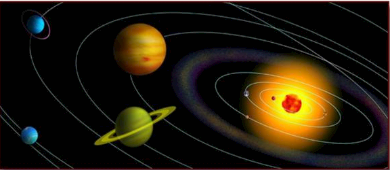
Consists of Jupiter, Saturn, Uranus, and Neptune. These are sometimes
called the gas giants. The leading model for jovian planet formation
holds that these planets formed as gravity drew gas around ice rich
planetesimals much more massive than Earth. Because of their large
masses, these planetesimals had gravity strong enough to capture
some of the hydrogen and helium gas that made up the vast majority
of the surrounding solar nebula. This added gas made their gravity even
stronger, allowing them to capture even more gas. Ultimately, the
jovian planets accreted so much gas that they bore little resemblance
to the icy seed from which they grew.
 What's over there, Ethan?
 Those are dwarf planets!
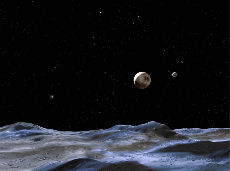
 What are dwarf planets?
Dwarf planets are celestial bodies that: orbit the sun,
have sufficient mass and gravity for assuming a
hydrostatic equlibrium,
has not cleared the neighborhood around its orbit,
is not a satellite .
As of now, there are four dwarf planets in our solar
system:
Pluto-made of nitrogen and methane ice.
Charon-Described as smaller than the 7 moons in our
solar system.
Eris--Is defined as the tenth planet.
Ceres-Data suggests liquid oceans are believed to have
been on Ceres.
Grace has a deep passion for meteorology. Although she has sat through many meteor showers in the
past and observed meteorites as they jet through the dark sky, on this visit she would react with
great joy to have such rare view of something so significant to her area of study, as they had never
been so visible. During her observations, she designed a chart where she would record any data she
found interesting.
Meteors are small pieces of iron or rock. When one of the pieces enters the Earth's atmosphere, it
heats up and looks like a streak of light in the sky, sometimes called a shooting star. Very small
rocks orbiting the Sun are sometimes called meteoroids so scientists can tell them apart from the
larger asteroids, as they can be very similar looking. If a piece of it survives to reach Earth's
surface, it's called a meteorite. While most burn up in the Earth's atmosphere, millions actually
really hit the surface. Meteorites contain a lot of information about our solar system.
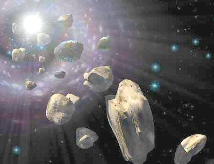
The asteroid belt lies
between the orbits of
Mars and Jupiter.
Asteroids are irregularly
shaped objects that orbit
our stars like our Sun.
The asteroid belt is
occupied by a bunch of
asteroids and one dwarf
planet.
The asteroids sometimes
leave their orbits
because of the strong
pull of Jupiter's
gravity. Asteroids can be
made of rocks, metals,
or a combination of the
two. They come in
different colors, shapes,
and sizes. Collisions
occur all the time in
the asteroid belt.
Sometimes debris from
these collisions reach
Earth's atmosphere as
meteoroids. When an
asteroid collides with
another object, it may
create a crater, break
into smaller pieces, or
scatter the asteroid out
of its orbit. The
surfaces of Earth, the
Moon, and other planets
are covered with craters.
However much of the
processes that occur on
Earth help keep its
surface crater free.
Erosion, for example
wears down the ground and
can break a crater down
to virtually nothing. The
moon on the other hand
has almost no erosion
because it has no
atmosphere. Plate
tectonics too, help keep
our Earth's surface
crater free! Volcanism
also helps in keeping our
Earth crater free, as
volcanic flow can cover
up impact craters.

 Hey Kids! Can I tell you about the asteroid belt?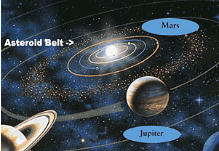
You've previewed 15 of 24 pages.
To read more:
Click Sign Up (Free)- Full access to our public library
- Save favorite books
- Interact with authors
- < BEGINNING
- END >
-
DOWNLOAD
-
LIKE
-
COMMENT()
-
SHARE
-
SAVE
-
BUY THIS BOOK
(from $4.79+) -
BUY THIS BOOK
(from $4.79+) - DOWNLOAD
- LIKE
- COMMENT ()
- SHARE
- SAVE
- Report
-
BUY
-
LIKE
-
COMMENT()
-
SHARE
- Excessive Violence
- Harassment
- Offensive Pictures
- Spelling & Grammar Errors
- Unfinished
- Other Problem





COMMENTS
Click 'X' to report any negative comments. Thanks!