 Hannah Gultom & Estefany Ramos-Parada
Anatomy Honors Period 2
This book was created and published on StoryJumper™
©2015 StoryJumper, Inc. All rights reserved.
Publish your own children's book:
www.storyjumper.com



2
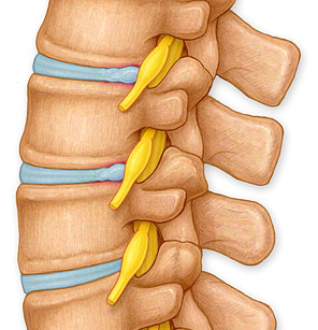
 Hi, I'm a blood cell! I was just born here in the spinal cord.
 This is one part of the Central Nervous System.
My job as a blood cell is to bring nutrients to the body.
So let's begin our journey!
3
4

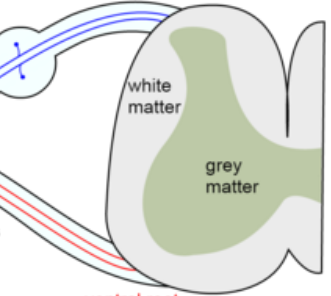
 In the spinal cord you can see white and gray matter.
 White matter is made of myelinated axons.
It carries sensory information to the brain on
ascending tracts as well as motor commands
from the brain on descending tracts.
Gray matter is made of unmyelinated tissue.
It processes spinal reflexes.
5

6
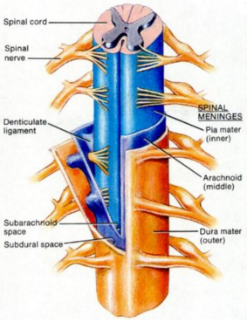
 These are the spinal meninges! They protect
the spinal cord separate it from its
surroundings. Now we will start our journey
through the spinal meninges up to the cranial
meninges in the brain.

7

8
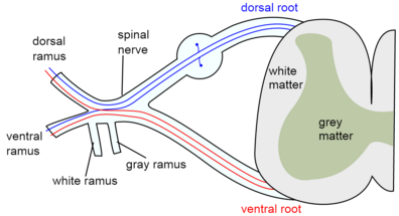

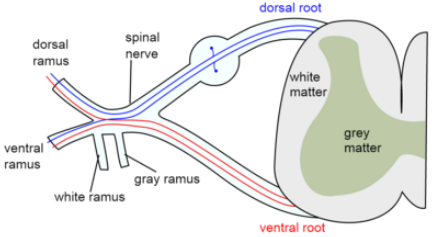
 There are two types of nerve roots that are connected
 to the spinal cord. I am going to travel up the dorsal root,
which goes up to the brain.
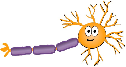
Oh look, there's my friend, the sensory neuron!
She just entered the spinal cord and will be coming with
me to the brain. The ventral roots allow my other friends,
the motor neurons, to exit the spinal cord to muscles and glands.
9

10
 As we continue to move across the PNS, we will look at nerves and nerve
 plexuses.
Nerve plexuses are interwoven webs made from the blended roots of
adjacent nerves.
They allow some overlap and backup pathways for nerve impulses.
There are lots of different kinds of them.
Let's explore!
11

12
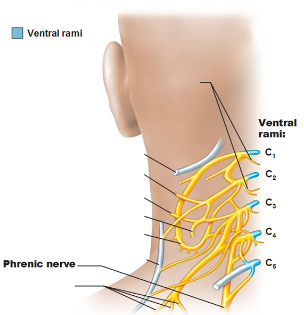
 The cervical plexus refers to the
web-like nerve structure in the neck.
But let's not forget about the nerve itself.
The phrenic nerve comes off the cervical
plexus and controls the diaphragm.
13
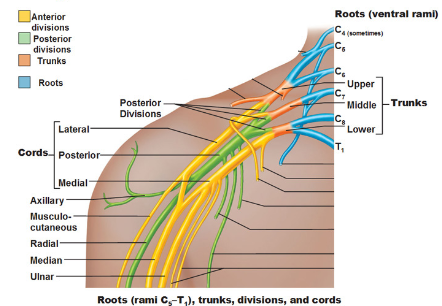
Brachial plexuses are located in the arms and some parts of the neck.
There are a few nerves within this plexus such as the auxiliary,
musculocutaneous, median and much more.
The auxiliary is in charge of controlling the shoulder,
the musculocutaneous is in charge of controlling the front part
of the upper arm, and the median nerve is in charge of controlling
the flexors of the forearm and the radial half of the palm.
14
15

16
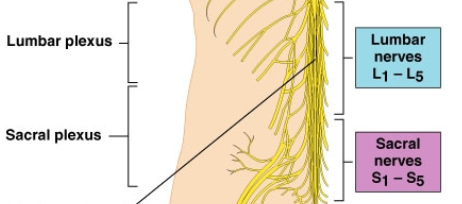
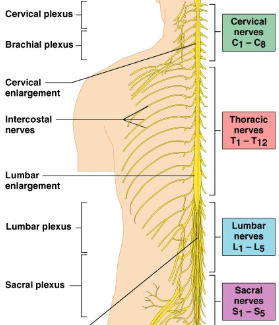
 Lumbar and sacral plexuses are located in the
lower back, connecting to the pelvis and legs.
A few nerves that come off of these plexuses
are the lateral femoral cutaneous nerve, femoral nerve,
obturator nerve, and many more.
 The lateral femoral cutaneous nerve is
 in charge of controlling the skin of the
posterior and lateral thigh.
 The femoral nerve is in charge
 of controlling the muscles of thigh
and anterior skin.
 The obturator nerve is in charge of
 controlling the muscles of the inner thigh.
 And last,
 17
 All Parts
 Together:
18

 To finish off the spinal nerves portion
of this journey, we need to go to where
there are rapid, automatic nerve responses
are triggered by specific stimuli.
19
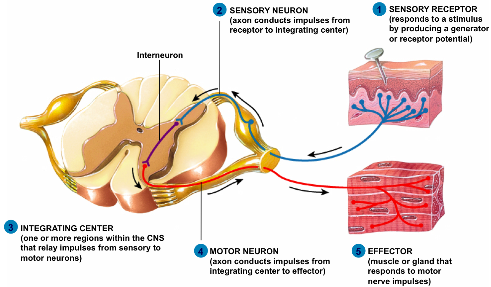
 These are the spinal reflexes, which are
 controlled by spinal cord gray matter,
not by the brain. They follow a few steps, including stimulus,
the activation of the sensory neuron, and the transfer of
information from CNS. They then activate the motor neuron,
which prompts a response from effector organs.

20
21

 As we continue to move along, we are aiming
to meet Mr. Brain. He is full of so much
information and works all the time.
His job is extremely important for the
whole body, so let's go see what he's up to!
22



There he is!
23
 The brain is composed of 4 parts.
CSF
Cerebrum
Cerebellum
Brain stem
Let's begin with a brief
explanation on what CFS is.

 The CSF, Cerebrospinal Fluid, is
 what surrounds the brain. It functions
as a type of cushion for the brain in
order to protect it from physical injury
and control the chemical environment
of the brain.
24

 Now let's go to the largest
 part of the brain which
controls all conscious thought,
intellectual function, processes
somatic sensory and motor information.
25

 It is a heavily folded layer. Each hemisphere is
in charge of receiving sensory information and
sending motor information to the opposite sides
of the body. This is known as the contra lateral.
 The cerebrum includes the corpus callosum,
 many lobes, cerebral cortex and contralateral.
It is divided into right and left halves by the
longitudinal fissure. Each half is called a
cerebral hemisphere and have a surface
composed of gray matter called cerebral cortex.
26


27

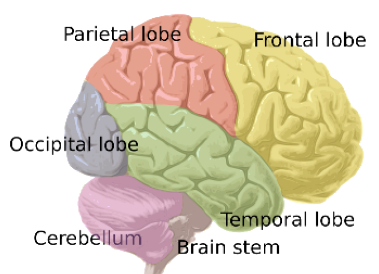
 Now let's look into its divisions, which are divided
 by sulci that mark the boundaries between the
four major lobes.
28
29


 The Corpus Callosum is next, located on the
 outer part of the brain, or more specifically,
it is the outside part of the brain. The Corpus
Callosum is also in the brain, specifically in
the middle of the brain.
30
You've previewed 30 of 46 pages.
To read more:
Click Sign Up (Free)Benefits:
- Full access to our public library
- Save favorite books
- Interact with authors
31

READ

- < BEGINNING
- END >
-
DOWNLOAD
-
LIKE
-
COMMENT()
-
SHARE
-
SAVE
BUY THIS BOOK (from $9.19+)
-
BUY THIS BOOK
(from $9.19+) -
BUY THIS BOOK
(from $9.19+) - DOWNLOAD
- LIKE
- COMMENT ()
- SHARE
- SAVE
- Report
Liked By
X
Encourage this author
-
BUY
-
LIKE
-
COMMENT()
-
SHARE
Problem with this book
X
- Excessive Violence
- Harassment
- Offensive Pictures
- Spelling & Grammar Errors
- Unfinished
- Other Problem
Which pages have problems?
Please describe the problem:
left text
right text
"untitled"
Hi, I'm a blood cell! I was just born here in the spinal cord. This is one part of the Central Nervous System. My job as a blood cell is ...
(47 pages)
Privacy level:
PUBLIC
4 reads
Report





COMMENTS
Click 'X' to report any negative comments. Thanks!