




For someone who would like to create a christmas atmosphere

Christmas or Christmas Day (Old English: Crīstesmæsse, meaning "Christ's Mass") is an annual festival commemorating the birth of Jesus Christ,[7][8] observed most commonly on December 25[4][9][10] as a religious and cultural celebration among billions of people around the world.[2][11][12] A feast central to the Christian liturgical year, it is prepared for by the season of Advent or the Nativity Fast and initiates the season of Christmastide, which historically in the West lasts twelve days and culminates on Twelfth Night;[13] in some traditions, Christmastide includes an Octave.[14] Christmas Day is a public holidayin many of the world's nations,[15][16][17] is celebrated culturally by a large number of non-Christian people,[1][18][19] and is an integral part of the holiday season, while some Christian groups reject the celebration. In several countries, celebrating Christmas Eve on December 24 has the main focus rather than December 25, with gift-giving and sharing a traditional meal with the family.
While the month and date of Jesus' birth are unknown, by the early-to-mid 4th century, the Western Christian Church had placed Christmas on December 25,[20] a date later adopted in the East.[21][22] Today, most Christians celebrate Christmas on the date of December 25 in the Gregorian calendar, which has been adopted almost universally in the civil calendars used in countries throughout the world. However, some Eastern churches celebrate Christmas on the December 25 of the older Julian calendar, which currently corresponds to January 7 in the Gregorian calendar, the day after the Western Christian Church celebrates the Epiphany. This is not a disagreement over the date of Christmas as such, but rather a preference of which calendar should be used to determine the day that is December 25. In the Council of Toursof 567, the Church "declared the twelve days between Christmas and Epiphany to be one unified festal cycle", thus giving significance to both December 25 and January 6.[23][24][25][26][27]
The date of Christmas may have initially been chosen to correspond with the day exactly nine months after the day on which early Christians believed that Jesus was conceived,[28][29] or with one or more ancient polytheistic festivals that occurred near the Roman winter solstice;[30][31]a further solar connection has been suggested because of a biblical verse[a] identifying Jesus as the "Sun of righteousness".[28][32][33][29]
The celebratory customs associated in various countries with Christmas have a mix of pre-Christian, Christian, and secularthemes and origins.[34] Popular modern customs of the holiday include gift giving, completing an Advent calendar or Advent wreath, Christmas music and caroling, lighting a Christingle, an exchange of Christmas cards, church services, a special meal, and the display of various Christmas decorations, including Christmas trees, Christmas lights, nativity scenes, garlands, wreaths, mistletoe, and holly. In addition, several closely related and often interchangeable figures, known as Santa Claus, Father Christmas, Saint Nicholas, and Christkind, are associated with bringing gifts to children during the Christmas season and have their own body of traditions and lore.[35] Because gift-giving and many other aspects of the Christmas festival involve heightened economic activity, the holiday has become a significant event and a key sales period for retailers and businesses. The economic impact of Christmas is a factor that has grown steadily over the past few centuries in many regions of the world.
There are some Christmas movies that I think are the greatest:
-Harry Potter (all series)
-Home alone (all sries)
-The nightmare before Christmas
-Bad Santa
-Elf
-Kiss Kiss Bang Bang
-Miracle on 34th street
-Santa Claus (all series)
The history of Santa Claus
Santa Claus, also known as Saint Nicholas, Saint Nick, Kris Kringle, Father Christmas, or simply Santa, is a legendary figure of Western culture who is said to bring gifts to the homes of well-behaved ("good" or "nice") children on Christmas Eve (24 December) and the early morning hours of Christmas Day (25 December).[1] The modern Santa Claus grew out of traditions surrounding the historical Saint Nicholas, a fourth-century Greek bishop and gift-giver of Myra, the British figure of Father Christmas, the Dutch figure of Sinterklaas (himself based on Saint Nicholas), the German figure of the Christkind (a fabulized Christ Child), and the holidays of Twelfth Night and Epiphany and their associated figures of the Three Kings (based on the gift-giving Magi of the Nativity) and Befana. Some maintain Santa Claus also absorbed elements of the Germanic god Wodan, who was associated with the pagan midwinter event of Yule and led the Wild Hunt, a ghostly procession through the sky.
Santa Claus is generally depicted as a portly, joyous, white-bearded man—sometimes with spectacles—wearing a red coat with white fur collar and cuffs, white fur-cuffed red trousers, and black leather belt and boots and who carries a bag full of gifts for children. This image became popular in the United States and Canada in the 19th century due to the significant influence of the 1823 poem "A Visit From St. Nicholas" and of caricaturist and political cartoonist Thomas Nast.[2][3][4] This image has been maintained and reinforced through song, radio, television, children's books, films, and advertising.
Santa Claus is said to make lists of children throughout the world, categorizing them according to their behavior ("good" and "bad", or "naughty" and "nice") and to deliver presents, including toys, and candy to all of the well-behaved children in the world, and coal to all the misbehaved children, on the single night of Christmas Eve. He accomplishes this feat with the aid of his elves, who make the toys in his workshop at the North Pole, and his flying reindeer, who pull his sleigh.[5][6] He is commonly portrayed as living at the North Pole and saying "ho ho ho" often.
A Christmas tree is a decorated tree, usually an evergreenconifer such as spruce, pine, or fir or an artificial tree of similar appearance, associated with the celebration of Christmas. The modern Christmas tree was developed in early modern Germany(where it is today called Weihnachtsbaum or Christbaum) with predecessors that can be traced to the 16th and possibly 15th century, in which devout Christians brought decorated trees into their homes.[1][2] It acquired popularity beyond Germany during the second half of the 19th century, at first among the upper classes.[3]
The tree was traditionally decorated with edibles such as apples, nuts, or other foods. In the 18th century, it began to be illuminated by candles which were ultimately replaced by Christmas lightsafter the advent of electrification. Today, there is a wide variety of traditional ornaments, such as garland, tinsel, and candy canes. An angel or star might be placed at the top of the tree to represent the archangel Gabriel or the Star of Bethlehem from the Nativity.[4][5]
The Christmas tree has also been known as the "Yule-tree", especially in discussions of its folkloric origins
Holiday Dining
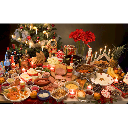
So much of what happens during the Christmas season revolves around people getting together for food and drinks. Whether it’s your company’s holiday party, an ugly sweater party with friends or your traditional Christmas Day dinner with family, these get-togethers always include great food, drinks and fun. If you’re looking for festive pieces of dinnerware, glassware and dining accessories to help make your party special this year, Wayfair has you covered.Usually on Christmas every Moldavian or Romanian family have on their table sarmale, caltabosi, carnati and toba. All of them being part of the traditional Christmas food in these regions.
Romanian Christmas food generally use pork (except Advent food). Pork meat, animal’s organs, fat and blood. Everything swine has inside is used. Some of them are used for Christmas holidays, others are prepared to be eaten later, till in spring.
It is a particularity that most of Moldavian holiday food has a lot of fat. Near all these types of food Moldovans drink wine, especially red wine and also drink tuica (plum brandy) as appetizer. In order to suppress the negative action of fat food Moldovans eat a lot of garlic and onion.
All pork preparation things start on Ignat Day. Then all appetizers are prepared and all the rest at least half prepared. The recipes kept from a generation to another differ from household to household but they can significantly differ from province to province, or from Romanian regions and Republic of Moldova.
In this sense the main components of a Christmas meal are: sarmale - cabbage rolls with pork, baked gammon, baked pork chops, breaded pork chops, baked pork backhead, pork schnitzel, meatballs, pork’s alms, grilled carp, vegetable hodgepodge as well as a large variety of salads and deserts.
- Full access to our public library
- Save favorite books
- Interact with authors

Cahul 26.11.2016
- < BEGINNING
- END >
-
DOWNLOAD
-
LIKE(1)
-
COMMENT()
-
SHARE
-
SAVE
-
BUY THIS BOOK
(from $3.39+) -
BUY THIS BOOK
(from $3.39+) - DOWNLOAD
- LIKE (1)
- COMMENT ()
- SHARE
- SAVE
- Report
-
BUY
-
LIKE(1)
-
COMMENT()
-
SHARE
- Excessive Violence
- Harassment
- Offensive Pictures
- Spelling & Grammar Errors
- Unfinished
- Other Problem





COMMENTS
Click 'X' to report any negative comments. Thanks!