Mens sana in corpore sano

The rules of association football were codified in England by the Football Association in 1863 and the name association football was coined to distinguish the game from the other forms of football played at the time, specifically rugby football. The term soccer originated in England, first appearing in the 1880s as an Oxford "-er" abbreviation of the word "association".
Within the English-speaking world, association football is now usually called football in the United Kingdom and mainly soccer in Canada and the United States. People in Australia, Ireland, South Africa and New Zealand use either or both terms, although national associations in Australia and New Zealand now primarily use "football" for the formal name.
History
Main article: History of association football
Children playing cuju in Song dynasty China.
An episkyros player on an ancient stone carving at the National Archaeological Museum, Athens.
According to FIFA, the Chinese competitive game cuju (, literally "kick ball") is the earliest form of football for which there is scientific evidence. Cuju players could use any part of the body apart from hands and the intent was kicking a ball through an opening into a net. It was remarkably similar to modern football, though similarities to rugby occurred. During the Han Dynasty (206 BC – 220 AD), cuju games were standardised and rules were established. Phaininda and episkyros were Greek ball games. An image of an episkyros player depicted in low relief on a vase at the National Archaeological Museum of Athens appears on the UEFA European Championship Cup. Athenaeus, writing in 228 AD, referenced the Roman ball game harpastum. Phaininda, episkyros and harpastum were played involving hands and violence. They all appear to have resembled rugby football, wrestling and volleyball more than what is recognizable as modern football. As with pre-codified "mob football", the antecedent of all modern football codes, these three games involved more handling the ball than kicking. Non-competitive games included kemari in Japan, chuk-guk in Korea and woggabaliri in Australia.
Association football in itself does not have a classical history. Notwithstanding any similarities to other ball games played around the world FIFA have recognised that no historical connection exists with any game played in antiquity outside Europe. The modern rules of association football are based on the mid-19th century efforts to standardise the widely varying forms of football played in the public schools of England. The history of football in England dates back to at least the eighth century AD. The Cambridge Rules, first drawn up at Cambridge University in 1848, were particularly influential in the development of subsequent codes, including association football. The Cambridge Rules were written at Trinity College, Cambridge, at a meeting attended by representatives from Eton, Harrow, Rugby, Winchester and Shrewsbury schools. They were not universally adopted. During the 1850s, many clubs unconnected to schools or universities were formed throughout the English-speaking world, to play various forms of football. Some came up with their own distinct codes of rules, most notably the Sheffield Football Club, formed by former public school pupils in 1857, which led to formation of a Sheffield FA in 1867. In 1862, John Charles Thring of Uppingham School also devised an influential set of rules.
These ongoing efforts contributed to the formation of The Football Association (The FA) in 1863, which first met on the morning of 26 October 1863 at the Freemasons' Tavern in Great Queen Street, London. The only school to be represented on this occasion was Charterhouse. The Freemason's Tavern was the setting for five more meetings between October and December, which eventually produced the first comprehensive set of rules. At the final meeting, the first FA treasurer, the representative from Blackheath, withdrew his club from the FA over the removal of two draft rules at the previous meeting: the first allowed for running with the ball in hand; the second for obstructing such a run by hacking (kicking an opponent in the shins), tripping and holding. Other English rugby clubs followed this lead and did not join the FA and instead in 1871 formed the Rugby Football Union. The eleven remaining clubs, under the charge of Ebenezer Cobb Morley, went on to ratify the original thirteen laws of the game. These rules included handling of the ball by "marks" and the lack of a crossbar, rules which made it remarkably similar to Victorian rules football being developed at that time in Australia. The Sheffield FA played by its own rules until the 1870s with the FA absorbing some of its rules until there was little difference between the games.
The world's oldest football competition is the FA Cup, which was founded by C. W. Alcock and has been contested by English teams since 1872. The first official international football match also took place in 1872, between Scotland and England in Glasgow, again at the instigation of C. W. Alcock. England is also home to the world's first football league, which was founded in Birmingham in 1888 by Aston Villa director William McGregor. The original format contained 12 clubs from the Midlands and Northern England.
The Aston Villa team in 1897, after winning both the FA Cup and the Football League.
The laws of the game are determined by the International Football Association Board (IFAB). The board was formed in 1886 after a meeting in Manchester of The Football Association, the Scottish Football Association, the Football Association of Wales, and the Irish Football Association. FIFA, the international football body, was formed in Paris in 1904 and declared that they would adhere to Laws of the Game of the Football Association. The growing popularity of the international game led to the admittance of FIFA representatives to the International Football Association Board in 1913. The board consists of four representatives from FIFA and one representative from each of the four British associations.
Today, football is played at a professional level all over the world. Millions of people regularly go to football stadiums to follow their favourite teams, while billions more watch the game on television or on the internet. A very large number of people also play football at an amateur level. According to a survey conducted by FIFA published in 2001, over 240 million people from more than 200 countries regularly play football. Football has the highest global television audience in sport.
In many parts of the world football evokes great passions and plays an important role in the life of individual fans, local communities, and even nations. R. Kapuscinski says that Europeans who are polite, modest, or humble fall easily into rage when playing or watching football games. The Côte d'Ivoire national football team helped secure a truce to the nation's civil war in 2006 and it helped further reduce tensions between government and rebel forces in 2007 by playing a match in the rebel capital of Bouaké, an occasion that brought both armies together peacefully for the first time. By contrast, football is widely considered to have been the final proximate cause for the Football War in June 1969 between El Salvador and Honduras. The sport also exacerbated tensions at the beginning of the Yugoslav Wars of the 1990s, when a match between Dinamo Zagreb and Red Star Belgrade degenerated into rioting in May 1990.
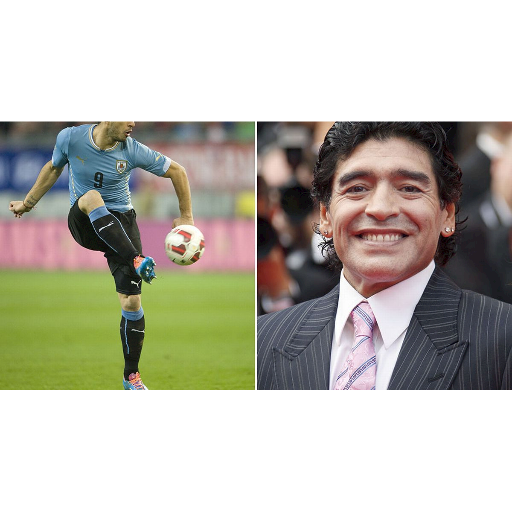
Diego Armando Maradona,
born 30 October 1960 is an Argentine retired professional footballer. He has served as a manager and coach at other clubs as well as the national team of Argentina. Many in the sport, including football writers, players, and fans, regard Maradona as the greatest football player of all time.He was joint FIFA Player of the 20th Century with Pelé.An advanced playmaker who operated in the classic number 10 position, Maradona is the first player in football history to set the world record transfer fee twice, first when he transferred to Barcelona for a then world record £5 million, and second, when he transferred to Napoli for another record fee £6.9 million. He played for Argentinos Juniors, Boca Juniors, Barcelona, Napoli, Sevilla and Newell's Old Boys during his club career, and is most famous for his time at Napoli, where he won numerous accolades. In his international career with Argentina, he earned 91 caps and scored 34 goals.
Maradona's exceptional vision, passing, ball control, dribbling skills, speed, reflexes and reaction time was combined with his small size (1.65 m or 5 ft 5 in tall) giving him a low center of gravity which allowed him to be more maneuverable than most other football players; he would often dribble past multiple opposing players on a run. His presence on the pitch had a great effect on his team's general performance, while he would often be singled out by the opposition. A precocious talent, Maradona was given the nickname "El Pibe de Oro" ("The Golden Boy"), a name that stuck with him throughout his career. Maradona played in four FIFA World Cups, including the 1986 World Cup in Mexico where he captained Argentina and led them to victory over West Germany in the final, and won the Golden Ball as the tournament's best player. In the 1986 World Cup quarter final, he scored both goals in a 2–1 victory over England that entered football history for two different reasons. The first goal was an unpenalized handling foul known as the "Hand of God", while the second goal followed a 60 m (66 yd) dribble past five England players, voted "The Goal of the Century" by FIFA.com voters in 2002.
Maradona became coach of Argentina in November 2008. He was in charge of the team at the 2010 World Cup in South Africa before leaving at the end of the tournament. He coached Dubai-based club Al Wasl in the UAE Pro-League for the 2011–12 season. In August 2013, Maradona joined Argentine Primera D club Deportivo Riestra's staff as "spiritual coach".

- Full access to our public library
- Save favorite books
- Interact with authors
- < BEGINNING
- END >
-
DOWNLOAD
-
LIKE(3)
-
COMMENT()
-
SHARE
-
SAVE
-
BUY THIS BOOK
(from $2.99+) -
BUY THIS BOOK
(from $2.99+) - DOWNLOAD
- LIKE (3)
- COMMENT ()
- SHARE
- SAVE
- Report
-
BUY
-
LIKE(3)
-
COMMENT()
-
SHARE
- Excessive Violence
- Harassment
- Offensive Pictures
- Spelling & Grammar Errors
- Unfinished
- Other Problem





COMMENTS
Click 'X' to report any negative comments. Thanks!