EDUC 390
Spring 2017

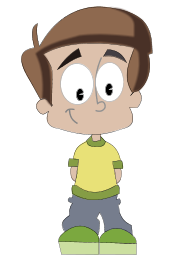
As ninth grader, Billy, sat in his Earth Science class, his teacher was explaining what their final was going to cover.
"Please refer to the books glossary for important vocabulary words, and remember this final is a large portion of your grade." explained his teacher.
As Billy sat there, all he could think about was summer vacation, and his teachers voice became background music to his summer ideas.

"Psst! Come with me! There is a significant amount of things I must show you, and not a lot of time!" said a creature.
At first, Billy was startled by this weird creature that no one else in the class saw. He thought for a minute, and then decided to follow it because anything was better than sitting in this boring science class.

The creature led Billy outside. "Where are we going? And who are you? Billy asked the strange creature. The creature came to an abrupt stop. "I don't have much time to explain, but I was sent to help you study for your Earth Science final. We have several places we need to go, so stay close and move quickly", said the creature. Always up for an adventure, Billy decided to listen and follow the creature. "Can you tell me where we are going first?", asked Billy. The creature smiled, "First stop, the atmosphere!" squealed the creature.
"Have you ever wondered how the man on the TV knows when a rainstorm or thunderstorm is coming and can predict the amount of rainfall or snowfall an area will get? Thanks to a barometer, meteorologists are able to provide people with a daily meteorology report. Meteorologist are able to measure the atmospheric pressure and provide people with a weather forecast. The forecast includes information like the daily temperature (which is given in degrees of Fahrenheit, Celsius, or Kelvin), relative humidity, and even the speed of the wind. Wind speed is measured by another handy tool called a anemometer", explained the creature. "Wow! I thought the weather men and women were just actors and actresses this whole time!" , said Billy.

"Since we are up at such high altitude, lets talk about about the atmosphere in a little more detail. The atmosphere is made up of different layers called troposphere, stratosphere, and the mesosphere. The troposphere contains most of the water vapor which forms clouds and rain. is where you can find altostratus clouds, cumulonimbus clouds, and stratus clouds. Please do watch out for the precipitation of acid rain, it is the pollution of the atmosphere. This occurs when the gas emissions combine with water to form hazardous rain."
"The stratosphere contains much of the ozone in the atmosphere. By absorbing dangerous radiation, the ozone layer protects us from skin cancer and other help problems. Before we go back down, lets take an astronomical leap even higher!", said the creature. "Like to outer space? Wait, is that were you're from?", asked Billy.
"Its called the exosphere and your going to love it! "

"For centuries, astronomers have studied interplanetary and interstellar ideas of astronomy. Our celestial journey will begin in the milky way galaxy. This is where you can find our solar system. Our solar system is made up of an average star called the Sun, the planets Mercury, Venus, Earth, Mars, Jupiter, Saturn, Uranus, Neptune, and Pluto. Also, it includes asteroids, comets, moons, and other celestial bodies."
All of these things have an elliptical orbit around the sun. Before we continue, lets hop over to the constellation Centaurus, and admire for a moment its bright star called Alpha Centauri", said the creature.
"Appreciating the little things in life, I like your style", smirked Billy.
"I knew you would have fun! Now lets take a closer look at the sun, the planet Earth, and its moon." explained the creature.
"The sun, earth, and its moon work in phenomenal ways. Earth is in a constant orbit around the sun while it sits on its axis at a slight tilt. While this is going on, the moon is orbiting the earth at the same time. This is where we get day time, night time, and the different seasons. The term lunar year comes from the concept that it takes the moon approximately 365 days to orbit the earth. There are two times during the year when the sun is aligned with the earths equator which is called an equinox. This is where the idea of day light savings come from. During the spring equinox we move our clocks a hour ahead, and during the fall equinox we move our clocks a hour back. "
- Full access to our public library
- Save favorite books
- Interact with authors
- < BEGINNING
- END >
-
DOWNLOAD
-
LIKE(1)
-
COMMENT()
-
SHARE
-
SAVE
-
BUY THIS BOOK
(from $3.19+) -
BUY THIS BOOK
(from $3.19+) - DOWNLOAD
- LIKE (1)
- COMMENT ()
- SHARE
- SAVE
- Report
-
BUY
-
LIKE(1)
-
COMMENT()
-
SHARE
- Excessive Violence
- Harassment
- Offensive Pictures
- Spelling & Grammar Errors
- Unfinished
- Other Problem





COMMENTS
Click 'X' to report any negative comments. Thanks!