
This book was created and published on StoryJumper™
©2010 StoryJumper, Inc. All rights reserved.
Publish your own children's book:
www.storyjumper.com


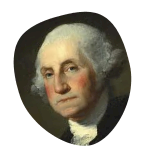
 George Washington


Known as the Father of Our Country, George Washington led our new
country through its hardest times. He was born February 22, 1732 and died
December 14, 1799, and he served as President from the years of 1789 to
1797. There were many important issues that Washington faced and had to deal
with during his presidency.
One of them was having to secure the Northwest Territory. Competing
claims for land in the Trans-Appalachian West led to the trouble brewing
between Spain, Britain, the Native Americans,and the U.S. Washington sent
troops to the Ohio River Valley and in the Battle of Fallen Timbers, the Native
Americans had been defeated. In the end, twelve tribes had signed the Treaty of
Greenville, in 1795, in which they agreed to surrender much of present-day Ohio
and Indiana to the U.S. government.
Another conflict that occurred was when outraged farmers resisted the tax
placed on whiskey, a part of Hamilton's financial plan, from Pennsylvania to
Georgia. In the summer of 1794, a group of farmers in western Pennsylvania led
an uprising called the Whiskey Rebellion. Washington immediately sent 13,000
soldiers to put down this rebellion. As the army approached, the rebels had fled,
and Washington had proved his point that the government had the power and
the will to enforce its laws.
Another struggle was when war broke out between Britain and France.
This war put the U.S. in an awkward position because France had been
America's ally, and Britain was one of America's greatest trading partners.
Washington decided on April 22, 1793 that the U.S. would remain neutral.
Washington, when he was not in office,had joined the Virginia militia in
1752. He created and then was forced to surrender Fort Necessity to the
French. He had also been Chosen by the Second Continental Congress in
1775 to be commander-in-chief of the Continental Army in the American
Revolution.
Though Washington faced many challenges throughout
his presidency he served as a symbol of national unity.
He warned that differences would lead to political parties
in the future which would threaten the nation's
government. Our second president would face this
challenge.

 The Father of
 Our Country

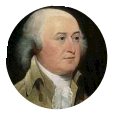
 John Adams
John Adams served as President from March 1797 to
March 1801.He was a Federalist. He was born on October
30, 1735, and died on July 4, 1826.
In his time, the French kept raiding on American ships,
so he sent three minister to France to try to work things
out. There, three men came and told them that in order to
talk to the government, they would have to pay France a
bribe. When Americans heard of this, it outraged them and
Congress canceled all treaties with France. This event
became known as the XYZ Affair.
Later when people began speaking out against Adams,
he became furious and passed the Alien and Sedition Acts.
This limited immigration and the freedom of speech.




Also during Adam's last months in office, he began
appointing Federalist judges and other office holders based
on the Judiciary Act of 1801 instead of attending
Jefferson's inauguration. This was known as the "midnight
appointments."
Before Adams became President, he was a lawyer. He was
also elected a member of the Continental Congress.
John Adams was the second U.S. President and made
quite a difference in our Country, during his term in office.







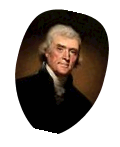
 Thomas Jefferson
Thomas Jefferson served as our Country's third President
during the years of March 1801 to March 1809, and he
served two terms.He was born in 1743 and died in 1826.
Jefferson was the principal author of the United States
Declaration of Independence written in 1776 when he was not in office.
He was also a leader in the Enlightenment, which was a scientific
revolution that brought to an end the medieval world view and replaced it
with our modern understanding of physics, nature, biology, and human
beings.
The most significant event that took place during Jefferson's Presidency
was the Louisiana Purchase which doubled the size of the United States.
He then sent the Lewis and Clark Expedition from 1804 to 1806 to
explore the new west.
Jefferson also encouraged the passage of the Embargo Act in 1807 to
maintain American neutrality in the Napoleonic Wars.
Jefferson was an important President and is admired by many today.
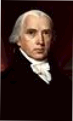
 James Madison
The Democratic Republican, James Madison, who took office on March 4, 1809,
served as President till March 4, 1817. Two terms as President. He was born in
1751 and died in 1836.
He served as a politician much of his adult life. Madison is known as the Father
of the Bill of Rights because he is noted for drafting the first ten amendments.
He drafted the Virginia Resolutions in 1798 in response to the Alien and
Sedition Acts. He held the position of Secretary of State from 1801-09.
During his presidency, when the United States entered the War of 1812,
Madison asked Congress to declare war on Britain because they were impressing
American sailors and seizing goods. This choice and many others led America end
with a stronger and independent economy.
Chaos in American finance, problems with European allies,
and another ineffective military campaign left Madison
discouraged, and he suffered a nearly fatal illness in June 1813.
The young government seemed to be failing apart due to the war.
Also during his presidency, Madison allowed two new states
to enter the Union. Louisiana in 1812 and Indiana in 1816.

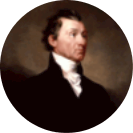
 James Monroe
James Monroe served as president between the
years of 1817 through 1825. He was nicknamed
“The Last Cocked Hat.”
Monroe was the president during the Era of Good
Feeling.
During his Presidency, the Missouri Compromise
and the Monroe Doctrine were established.
In 1818, President Monroe sent General Andrew
Jackson to Spanish Florida to subdue the Seminole
Indians, who were raiding American settlements.
Jackson led his troops deep into areas of Florida
under the control of Spain and captured two Spanish
forts. The mission helped point out the vulnerability
of Spanish rule in Florida.
James Monroe was the last Revolutionary War
general to serve as President.
 John Quincy Adams
Adams served as President between the years
of 1831 to 1848.
John Quincy Adams negotiated the Adams-Onis Treaty
while he was President.He supported internal improvements
including the extension of the Cumberland Road
In 1828, also during his presidency, the so-called "tariff of
abominations" was passed.
He had a goal to protect domestic manufacturing.
Adams kept a diary throughout his adult life, and he was
nicknamed "Old Man Eloquent".
Adams died In the Speakers Room of the House of
Representatives. On February 21 1848, Adams collapsed from
a stroke on the floor of the House of Representatives
Chamber. He was carried to the Speaker's Room where he
died two days later on February 23 1848.


 Andrew Jackson
Andrew Jackson served as President from 1829
to 1837 as a Democrat.
During his Presidency he believed that the common
man should rule the government. He wanted to be the voice of the
common man. This was called the Jacksonian Democracy where
“the people shall rule”. This increased turnout of votes proving that
common people had the vote & would use it to their ends.
He supported the spoils system where he placed many of his
friends, family members, and acquaintances at high places of
authority also when he was President.
The Webster- Hayne Debate, in 1829, also occurred while he
was in office.
Known for his toughness, he was nicknamed “Old Hickory.”
Jackson was an active executive who vetoed more bills than all
previous presidents.
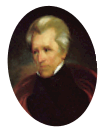
 Martin Van Buren
Martin Van Buren was President from 1837 to 1841.
He had two nicknames, “The Little Magician,”and “The Red Fox
of Kinderhook”.
Van Buren took office as the booming U.S. economy of the early and
mid-1830s began to slow down. The so-called "Panic of 1837" was
followed by the worst depression yet faced by the young nation. These
economic troubles quickly became President Van Buren's main concern.
Van Buren rejected his Whig opposition's suggestion that he support
a National Bank, which the Whigs believed could oversee and stabilize
the nation's economy. Instead, the President blamed the depression on
powerful interests at home and abroad, and proposed that the federal
government deposit its funds in an independent treasury, rather than in
state banks.
Van Buren played key roles in the creation of both the Democratic
Party and the so-called "second party system" in which Democrats
competed with their opponents, the Whigs. In these ways, Van Buren
left an indelible mark on American politics.
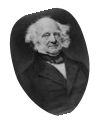

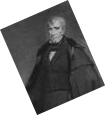
 William Henry Harrison
William Henry Harrison was President for 1841. He was
nicknamed "Old Tip".
William Henry Harrison served the shortest time of any
American President. He served only thirty-two days. He also
was the first President from the Whig Party.
Harrison won the election with 53 percent of the vote, and
more people voted in 1840 than ever before.
People held him responsible for the economic collapse in
the late 1830's.
He had become ill after delivering his inaugural address
outdoors in the cold March weather without a hat or a coat
and died of a respiratory infection, probably pneumonia.
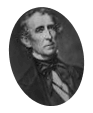
 John Tyler
John Tyler served as President from 1841–1845.
Tyler was called the “Accidental President.”
When Harrison died, Tyler immediately wanted to be inaugurated
as President. Fearing that he would alienate Harrison's supporters,
Tyler decided to keep the dead President's entire cabinet even
though several members were openly hostile to Tyler and resented
his assumption of the office. After Tyler vetoed a bill to resurrect
the Bank of the United States, his entire cabinet resigned in
protest, with the exception of Secretary of State Webster, then in
the midst of sensitive negotiations with Great Britain.
During his second year in office, the Whigs, led by Henry Clay,
expelled him from the party and tried to have him impeached.
The 1844 presidential election boiled down to a fight between
Tyler, Polk, and Henry Clay. Fearing that he and Polk might split the
vote, handing the election to Clay, Tyler voluntarily withdrew.

 James K. Polk
James K. Polk served as President from the years of 1845 to
1849.
He was Member of the Tennessee House of Representatives
from 1823 to 1825, Member of the U.S. House of Representatives
from 1825 to 1839, Speaker of the House from 1835 to 1839, and
Governor of Tennessee from 1839 to 1841.
The Treaty of Guadalupe Hidalgo was signed, and in it, the
United States imposed a Rio Grande border for Texas and paid $15
million to Mexico for the territories of California and New Mexico.
He favored Texas statehood and the acquisition of the Oregon
Territory.
Polk left behind a country that was both larger and
weaker—expanded by more than a million square miles but fatally
torn over the key issue these new lands had once again brought to
the fore which was slavery.

You've previewed 14 of 22 pages.
To read more:
Click Sign Up (Free)- Full access to our public library
- Save favorite books
- Interact with authors


- < BEGINNING
- END >
-
DOWNLOAD
-
LIKE(2)
-
COMMENT()
-
SHARE
-
SAVE
-
BUY THIS BOOK
(from $4.39+) -
BUY THIS BOOK
(from $4.39+) - DOWNLOAD
- LIKE (2)
- COMMENT ()
- SHARE
- SAVE
- Report
-
BUY
-
LIKE(2)
-
COMMENT()
-
SHARE
- Excessive Violence
- Harassment
- Offensive Pictures
- Spelling & Grammar Errors
- Unfinished
- Other Problem





COMMENTS
Click 'X' to report any negative comments. Thanks!