
Angles
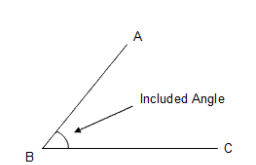
* Two rays sharing a common endpoint. Angles are typically measured in degrees or radians.
* The space (usually measured in degrees) between two intersecting lines or surfaces at or close to the point where they meet.
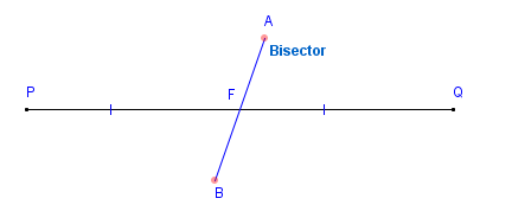
Bisector
* A line segment, line, or plane that divides a geometric figure into two congruent halves.
* something means to cut it into two equal parts. The 'bisector' is the thing doing the cutting.
Chord
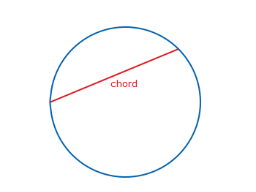
* A chord has both endpoints on the circle.
* A circle is a straight line segment whose endpoints both lie on the circle.
Diameter
* A line segment between two points on the circle or sphere which passes through the center. The word diameter is also also refers to the length of this line segment.
Equation
*A mathematical sentence built from expressions using one or more equal signs (=).
Formula
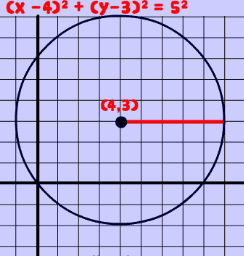
* An expression used to calculate a desired result, such as a formula to find volume or a formula to count combinations. Formulas can also be equations involving numbers and/or variables, such as Euler's formula.
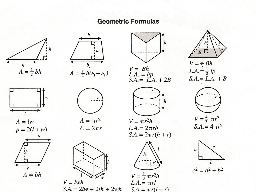
Geometry
* The study of geometric figures in two dimensions (plane geometry) and three dimensions (solid geometry)
* the study of points, lines, triangles, quadrilaterals, other polygons, Etc...
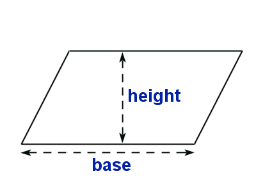
Height of parallelogram
* The distance between opposite sides of a parallelogram. Formally, the shortest line segment between opposite sides. Altitude also refers to the length of this segment.
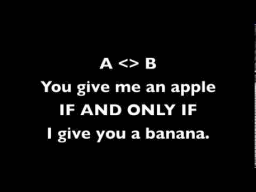
If and only If ( iff )
* A way of writing two conditionals at once: both a conditional and its converse.
* For example, the statement "A triangle is equilateral iff its angles all measure 60°" means both
Joint Variation
* When we say z is jointly proportional to a set of variables, it means that z is directly proportional to each variable taken one at a time

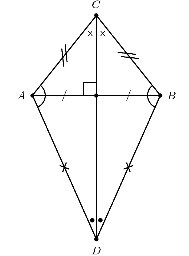
Kite
* A quadrilateral may be convex or concave. A quadrilateral that is concave has an angle exceeding 180o
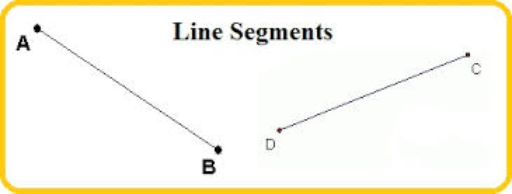
* All points between two given points (including the given points themselves).
Line Segment
Midpoint
* The point halfway between two given points.
* The formula for the midpoint between points (x1, y1) and (x2, y2)

Negative Number
* A real number less than zero. Zero itself is neither negative nor positive.
-5, -4, -3, -2, -1
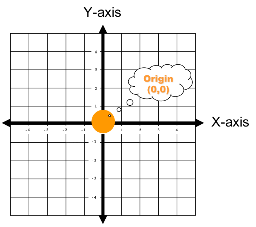
Origin
* On the coordinate plane, the point (0, 0). That is, the point of intersection of the x- and y-axes.
Parallelogram
* A quadrilateral with two pairs of parallel sides.

- Full access to our public library
- Save favorite books
- Interact with authors
- < BEGINNING
- END >
-
DOWNLOAD
-
LIKE
-
COMMENT()
-
SHARE
-
SAVE
-
BUY THIS BOOK
(from $5.19+) -
BUY THIS BOOK
(from $5.19+) - DOWNLOAD
- LIKE
- COMMENT ()
- SHARE
- SAVE
- Report
-
BUY
-
LIKE
-
COMMENT()
-
SHARE
- Excessive Violence
- Harassment
- Offensive Pictures
- Spelling & Grammar Errors
- Unfinished
- Other Problem





COMMENTS
Click 'X' to report any negative comments. Thanks!