 Dedicated to my loving sisters
Table Of Contents
1- Atom Information 10- Compound Pictures
2- Chlorine History 11- Glossary
3- Chlorine Periodic Box 12- Glossary Continued
4- Description of Periodic Box 13- Bibliography
5- Bohr Model
6- Description of Bohr Model
7- Chlorine Information
8- Chlorine Pure Form
9- Chlorine Compounds
This book was created and published on StoryJumper™
©2010 StoryJumper, Inc. All rights reserved.
Publish your own children's book:
www.storyjumper.com


Atoms are the basic building blocks of all matter. Inside
an atom includes the three particles known as protons,
neutrons, and electrons as well as the nucleus which
is the center part of an atom. Protons and neutrons are
located in the nucleus while electrons are located in the
electron cloud outside the nucleus. In the electron
cloud there are three rings where the first ring holds
two electrons, the second holds eight electrons, and the
third holds eight electrons as well.
There was a man named Carl Wilhelm Scheele. He
discovered an element in 1774 later to be known on the
periodic table. Sir Humphry Davy later named it Chlorine
in 1810. Its name comes from the greek word Khloros
meaning green.
 17 Cl35.453
The image to the left shows the periodic table box for
Chlorine. The top number represents the atomic
number. In the middle are the initial letters known as
the symbol used to identify Chlorine. At the bottom is
the atomic mass of Chlorine.
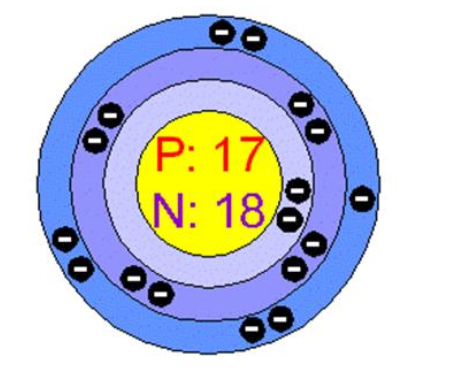 electronsprotons and neutrons
To the left shows the Bohr model of the element
Chlorine. It has 17 protons and 18 neutrons located in
the nucleus. It has 17 electrons located in the electron
clouds.

Chlorine is located in group 17 on period 3 in the periodic
table. It is the second member of the Halogen family. Its
physical state at room temperature is a gaseous form. It
is never found in free form in nature. Its pure form is a
green yellowish gas. It is obtained from salt and its uses
are for water purification and bleaches such as Clorox. It
dissolves when it mixes with water, and it is harmful to
organisms living in water and soil. It is a highly reactive
gas, extremely toxic, and causes environmental harm at
low levels. 2KMnO4 + 16HCl = 2KCl + 2MnCl2 + 5Cl2(g)
+ 8H20 is used to make a pure sample of the element.
You've previewed 8 of 13 pages.
To read more:
Click Sign Up (Free)- Full access to our public library
- Save favorite books
- Interact with authors


- < BEGINNING
- END >
-
DOWNLOAD
-
LIKE(1)
-
COMMENT()
-
SHARE
-
SAVE
-
BUY THIS BOOK
(from $2.99+) -
BUY THIS BOOK
(from $2.99+) - DOWNLOAD
- LIKE (1)
- COMMENT ()
- SHARE
- SAVE
- Report
-
BUY
-
LIKE(1)
-
COMMENT()
-
SHARE
- Excessive Violence
- Harassment
- Offensive Pictures
- Spelling & Grammar Errors
- Unfinished
- Other Problem





COMMENTS
Click 'X' to report any negative comments. Thanks!