
Section 1.
Long-Term Causes
The long-term causes can be called M.A.I.N for short.
M - Militarism
A - Alliance System
I - Imperial Tension
N- Extreme Nationalism
Militarism
Militarism is glorfication of one's military. It is also the belief of a nation or its people to build and maintain a strong military, with the intention to use it whenever it is felt necessary.
During 1870 to 1914, the military spending in Europe increased 300%. The Britain and Germany put pressure on each other by expanding arms. Also, the new technologies they used assured that dead rate would be very high.
The Alliance System
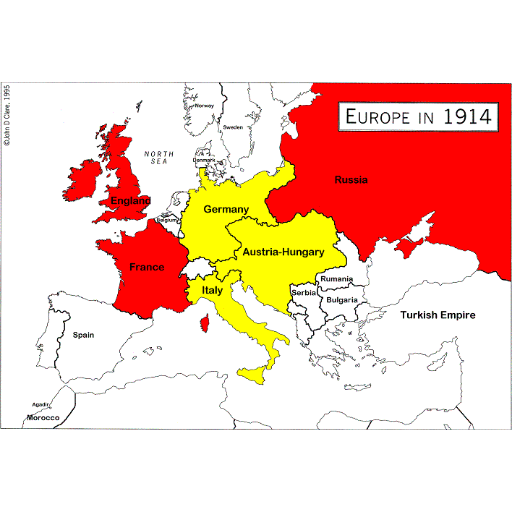
Triple Entente:
Russia
France
Britan
Triple Alliance:
Germany
Italy
Austria-Hungary
Imperialistic Tension
Imperialism also takes time to develop in terms of establishing the dominance needed to
secure another nation/county. Therefore, imperialism is seen as a long-term cause of WWI.
Extreme Nationalism
People are not born with the love of their country and land instilled within them; instead,
they must learn to love it. This requires a longer period of time to complete; thus, it is a long-term cause.
Section 2.
Trigger Event:
Assassination of Franz Ferdinand
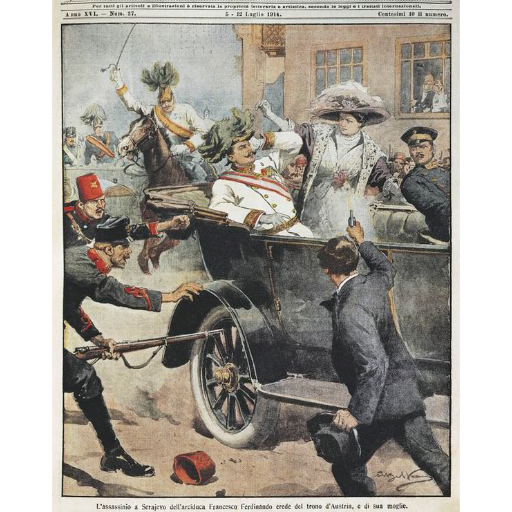
Archduke Franz Ferdinand, nephew of Emperor Franz Josef and heir to the Austro-Hungarian Empire, is shot to death along with his wife by a Serbian nationalist in Sarajevo, Bosnia, on June 28, 1914.
Prior to this, the Balkans was already a powder keg.
The Austro-Hungarian Empire sent a ultimatum to Serbia and listed some demands which violating its constitution and interfering in its sovereignty.
Although Serbia states all the provisions will be accepted except two, the Austro-Hungarian Empire insisted on a war. And with the support of Germany, it sent troops to Serbia on July 28, 1914.
This was the main fuse for World War I.
Section 3.
Description of Two Sides
Central vs Allied
Central Powers:
Germany
Austria-Hungary
Ottoman Empire
Bulgaria
Allies:
Great Britain
France
Italy
Russia
Japan
The U.S. (1917)
The Central Powers consisted of the German Empire and the Austro-Hungarian Empire at the beginning of the war. The Ottoman Empire joined the Central Powers later in 1914.In 1915, the Kingdom of Bulgaria joined the alliance.
The name "Central Powers" is derived from the location of these countries; all of them were located between the Russian Empire in the east and France and the United Kingdom in the west.
Finland, Azerbaijan, and Lithuania joined them in 1918 before the war ended and after the Russian Empire collapsed.
The members of the original Triple Entente of 1907 were the French Republic, the British Empire and the Russian Empire.
Italy ended its alliancewith the Central Powers, arguing that Germany and Austria-Hungary started the war and that the alliance was only defensive in nature; it entered the war on the side of the Entente in 1915.
Japan was another important member. Belgium, Serbia, Greece, Montenegro and Romania were affiliated members of the Entente.
Section 4.
Russian Struggles and Exit from the War
On August 1, 1914, the German declared war on Russia. The Russian ruling class, led by Lenin alone, opposed the war in the Bolsheviks. Lenin hopes to turn this imperialist war into a civil war.
In May 1915, the German allied forces attacked Russia. Russian troops lost half of their troops and soldiers rose in anti-war sentiment, and their domestic economy collapsed. However, the Tsar, the ruler then, did nothing to save the country.
On February 27, 1917, Russia broke out in February revolution. The tyranny was overthrown, and the Soviet, represented by Petrograd workers, was formed.
On October 25, 1917, the October Revolution broke out.
Then, on March 3, 1918, Lenin signed the Brest Treaty with Germany and announced its withdrawal from World War I.
Section 5.
3 Facts that Made the United States Join the War
1.Blockades
Because Britain blockaded (stopped) all German ships going to America, American ships heading to Germany had to stop at British ports for inspection.
Also, Germany announced a submarine war around Britain.
In May, 1915, Germany told Americans to stay off of British ships as they would sink them.
As Germany declared, in May of 1915, the Lusitania was torpedoed, sinking with 1200 passengers and crew (including 128 Americans). The Lusitania was eventually found to be carrying 4200 cases of ammunition.
The US sharply criticized Germany for their action.
2. Unlimited Submarine Warfare
After the sink of Lusitania, in 1917, Germany announced “unlimited submarine warfare” in the war zone would resume since their blockade would not be successful otherwise.
US intercepted a note from Germany to Mexico, which promised Texas, New Mexico, and Arizona back in return for an alliance.
3. Zimmerman Note
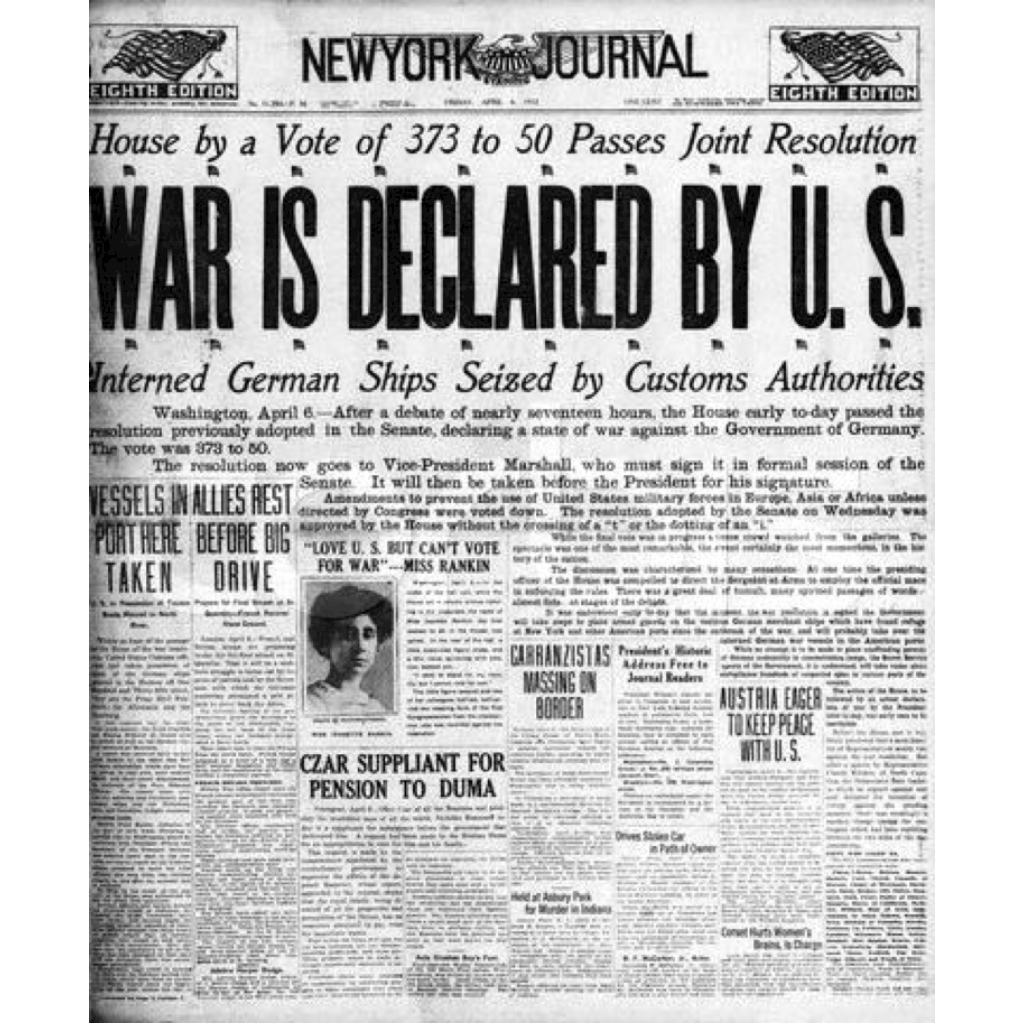
Zimmerman Note + the sinking of 4 unarmed American ships led to a declaration of war
Section 6.
U.S. Propaganda on the Homefront
- Full access to our public library
- Save favorite books
- Interact with authors
- < BEGINNING
- END >
-
DOWNLOAD
-
LIKE(2)
-
COMMENT()
-
SHARE
-
SAVE
-
BUY THIS BOOK
(from $8.39+) -
BUY THIS BOOK
(from $8.39+) - DOWNLOAD
- LIKE (2)
- COMMENT ()
- SHARE
- SAVE
- Report
-
BUY
-
LIKE(2)
-
COMMENT()
-
SHARE
- Excessive Violence
- Harassment
- Offensive Pictures
- Spelling & Grammar Errors
- Unfinished
- Other Problem






COMMENTS
Click 'X' to report any negative comments. Thanks!