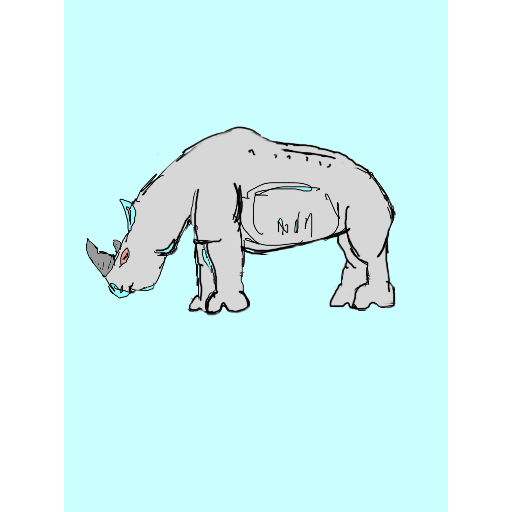

For all Animal lovers

Table of Contents:
Location & Species .................................................................... 3
Habitat & Diet .............................................................................. 4
Facts About White Rhinos ....................................................... 6
Rhino Horns ................................................................................... 10
Courtship ....................................................................................... 14
Off Spring ..................................................................................... 15
Conservation ............................................................................... 16
Glossary ......................................................................................... 17
There are 5 species of different Rhinos and 11 subspecies:
White Rhino
Black Rhino
Greater One-Horned Rhino
Javan Rhino
Sumatran Rhino
Habitat & Diet:
White rhinos and black rhinos live in the grasslands and floodplains of eastern and southern Africa.
Greater one-horned rhinos can be found in swamps and rain forests of northern India and southern Nepal.
Sumatran and Javan rhinos are found only in small areas of Malaysian and Indonesian swamps and rain forests.
Rhinos are herbivores, which means they eat only vegetation. The type of vegetation they eat varies by species. The black rhino eats trees or bushes because its long lips allow it to pick leaves and fruit from up high. The white rhino has a flat-shaped snout that lets it get closer to the ground for eating grass.
White Rhinos are the second largest land mammal and White Rhinos are easy to identify by their square upper lip that also happens to be hairless. The Northern and Southern White Rhino are found in two different regions of Africa.
Facts About white Rhinos:
The Southern White Rhinos are not endangered compared to the Northern White Rhino, which has 21,000 left that are in protected areas.
There are only two female northern white rhinos alive and they live in the Ol Pejeta Conservancy in Kenya and these beautiful animals are protected 24/7 by armed guards. The reason for their near extinction is due to decades of poaching for rhino horn.
The last Northern male white Rhino passed away recently. The 45 year old Northern Male White Rhino was named Sudan.
Rhino Horns: Rhino horns are made of keratin, similar to horses’ hooves and turtle beaks. Rhino horns tend to curve backward, toward the head, because the keratin in front grows faster than the keratin in the back. The outside of the horn is rather soft and can be worn down or sharpened after years of usage.
Rhino horns have been used in Chinese medicine for more than 2,000 years and are used to treat fever, gout, and other disorders. Many people also think that rhino horns can cure snakebites, headaches, vomiting, and food poisoning.
- Full access to our public library
- Save favorite books
- Interact with authors

- < BEGINNING
- END >
-
DOWNLOAD
-
LIKE
-
COMMENT()
-
SHARE
-
SAVE
-
BUY THIS BOOK
(from $3.79+) -
BUY THIS BOOK
(from $3.79+) - DOWNLOAD
- LIKE
- COMMENT ()
- SHARE
- SAVE
- Report
-
BUY
-
LIKE
-
COMMENT()
-
SHARE
- Excessive Violence
- Harassment
- Offensive Pictures
- Spelling & Grammar Errors
- Unfinished
- Other Problem

COMMENTS
Click 'X' to report any negative comments. Thanks!