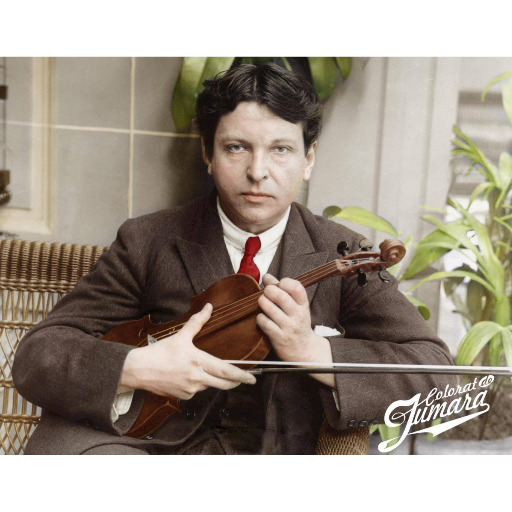
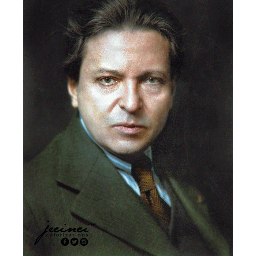

George Enescu was a Romanian composer, violinist, pianist and teacher. He is regarded by many as Romania's most important musician.
Operas
Œdipe, tragédie lyrique in four acts, libretto by Edmond Fleg, Op. 23
Other orchestral works
Poème Roumain, symphonic suite for orchestra, Op. 1
Romanian Rhapsody No. 1 in A major, Op. 11
Romanian Rhapsody No. 2 in D major, Op. 11
Young George Enescu
Enescu was born in Romania, in the village of Liveni (later renamed "George Enescu" in his honor), in Dorohoi County at the time, today Botoşani County. He showed musical talent from early in his childhood. A child prodigy, Enescu began experimenting with composing at an early age. Several, mostly very short pieces survive, all of them for violin and piano. The earliest work of significant length bears the title Pămînt românesc ("Romanian Land"), and is inscribed "opus for piano and violin by George Enescu, Romanian composer, aged five years and a quarter".
In 1891, the ten-year-old Enescu gave a private concert at the Court of Vienna, in the presence of Emperor Franz Joseph. Joseph Hellmesberger Sr., one of his teachers and the director of the Vienna Conservatory, hosted Enescu at his home, a place where the child prodigy met his idol, Johannes Brahms.
He graduated before his 13th birthday, earning the silver medal. In his Viennese concerts young Enescu played works by Brahms, Sarasate and Mendelssohn.
In 1895 he went to Paris to continue his studies. He studied violin with Martin Pierre Marsick, harmony with André Gedalge, and composition with Jules Massenet and Gabriel Fauré. Enescu then studied from 1895 to 1899 at the Conservatoire de Paris. André Gedalge said that he was "the only one who truly had ideas and spirit".

On 6 February 1898, at the age of only 16, George Enescu presented in Paris his first mature work, Poema Română, played by the Colonne Orchestra (at the time, one of the most prestigious in the world) and conducted by Édouard Colonne.
Many of Enescu's works were influenced by Romanian folk music, his most popular compositions being the two Romanian Rhapsodies (1901–2), the opera Œdipe (1936), and the suites for orchestra. He also wrote five symphonies , a symphonic poem Vox maris, and much chamber music (three sonatas for violin and piano, two for cello and piano, a piano trio, two string quartets and two piano quartets, a wind decet, an octet for strings, a piano quintet, and a chamber symphony for twelve solo instruments).
On 8 January 1923 he made his American debut as a conductor in a concert given by the Philadelphia Orchestra at Carnegie Hall in New York City, and he subsequently made frequent returns to the United States. It was in America, in the 1920s, that Enescu was first persuaded to make recordings as a violinist. He also appeared as a conductor with many American orchestras, and in 1936 he was one of the candidates considered to replace Arturo Toscanini as permanent conductor of the New York Philharmonic. In 1932, Enescu was elected a titular member of the Romanian Academy.
- Full access to our public library
- Save favorite books
- Interact with authors

- < BEGINNING
- END >
-
DOWNLOAD
-
LIKE(1)
-
COMMENT()
-
SHARE
-
SAVE
-
BUY THIS BOOK
(from $2.99+) -
BUY THIS BOOK
(from $2.99+) - DOWNLOAD
- LIKE (1)
- COMMENT ()
- SHARE
- SAVE
- Report
-
BUY
-
LIKE(1)
-
COMMENT()
-
SHARE
- Excessive Violence
- Harassment
- Offensive Pictures
- Spelling & Grammar Errors
- Unfinished
- Other Problem

COMMENTS
Click 'X' to report any negative comments. Thanks!