Dedicated in the name of Science

Pages 4-5: Introduction to the Phases of the Moon
Pages 6-21: Descriptions and pictures of each Moon phase
Page 22-23: Oreo cookie activity
Page 24-25: Visual aid
Page 26: Example of Children's book
Page 27: Recent news story
Page 28: Extra resources and standard
Table of contents:
The phases of the moon are the eight different ways that the moon looks from the Earth. These eight phases happen over the course of about a month. Phase refers to the angle of the moon, and its' placement from the sun. It is different everyday. The moon does not actually change shape, it just appears that way because of the shadow from the sun.



Each phase involves sunlight and the rotation/orbit of the moon at a specific time.
Rotation is the spinning of the moon itself, while orbit deals with the moon moving around Earth.
- New Moon
- New Crescent
- First Quarter
- Waxing Gibbous
- Full Moon
- Waning Gibbous
- Last Quarter
- Old Crescent
The eight phases in order:
The first phase of the moon is called the New Moon phase. We cannot see the moon in the sky when it is in this phase.
During the new moon phase the Sun and the Moon are close to each other in the sky. In fact, the Moon in its new phase will sometimes block all or part of our view of the Sun. This event is called a solar eclipse. The side towards us is in shadow and is dark.

New Moon
Since the Moon and Sun are so near to each other in the sky, they are above the horizon at the same time. Thus, the Moon is only in the sky during the day, when the sky is bright which means a new moon cannot be seen from Earth!
Fun fact: It would take 130 days to get to the moon if you traveled by car!


As time passes after the New Moon, the Moon (which is orbiting counterclockwise around the Earth) moves away from the Sun toward the east from our vantage point. It travels about 12 degrees per day toward the left, as seen from Earth's northern hemisphere.
Two or three days after the new moon, a waxing crescent can be seen just to the east of the Sun.
It is most easily seen just after sunset, following the Sun closely down toward the western horizon.

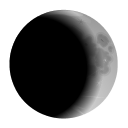


The "horns" of a crescent moon always point away from the Sun.
Also, since the Moon in a crescent phase (either waxing or waning) is close to the Sun on the sky, it can't be above the horizon at night unless it's shortly after sunset or before sunrise. An exception to this is if you are near the Earth's North or South poles. At those places, near the time of the "midnight sun," it is possible to see the crescent above the horizon.
horns

First Quarter
About a week after the new moon, the Moon has moved about 90 degrees away from the Sun, a quarter of the way around the sky toward the east.
At this time, its right half is illuminated by sunlight. This phase is called first quarter because it occurs when the Moon has completed the first quarter of its orbit from the previous new moon phase.


Since it is 90 degrees (1/4 of a full circle) away from the Sun in the sky toward the East, the Moon will lag behind the Sun by about 6 hours (1/4 of 24 hours).
During first quarter and waxing gibbous phases, the Moon is easily seen in the eastern sky on a clear afternoon. It's also easy to see in the western sky on clear mornings at waning gibbous and last quarter phases.


Fun Fact: The moon moves at 3,682 kilometers per hour around earth.
In the waxing gibbous stage, the moon appears to be almost a full moon but not fully illuminated by direct sunlight. The fraction of the Moon's disk that is illuminated is increasing. This is the last phase before the moon is full. It is called a "gibbous" moon because that is the name dedicated when the moon is larger than a quarter.
False: The moon gives off its own light.
(It actually reflects the sun's light)
Waxing Gibbous
Full Moon

Fun fact: when there is more than one full moon in a month, it is referred to as a blue moon
When the Moon has completed exactly half of its trip around the Earth from the previous new moon, it is on the opposite side of the Earth from the Sun; the face toward us is fully illuminated, and the full moon has arrived.
Strictly speaking, the "full moon" occurs only for an instant: the time when the Moon is as nearly opposite the Sun in the sky as it will be during its current orbit. However, the Moon will look only imperceptibly different from full moon for a night or two around that time.
Waning Gibbous
Did you know? If there was no sun then we would not be able to see the moon!
During the week after a full moon, as the Moon continues to move eastward in its orbit about 12 degrees per day. The Moon rises later and later and the side we see is illuminated by less and less sunlight.
While the Moon is in this waning gibbous phase, its east (right) side remains fully sunlit, while darkness creeps in from the right (east).
As the Moon moves farther toward the east from night to night, the Earth has to turn a little farther toward the east each night for us to see it. On the average, the Moon rises about 50 minutes later each night, but this can vary significantly depending on the time of year and your latitude north or south of the equator.
- Full access to our public library
- Save favorite books
- Interact with authors
- < BEGINNING
- END >
-
DOWNLOAD
-
LIKE(1)
-
COMMENT()
-
SHARE
-
SAVE
-
BUY THIS BOOK
(from $5.39+) -
BUY THIS BOOK
(from $5.39+) - DOWNLOAD
- LIKE (1)
- COMMENT ()
- SHARE
- SAVE
- Report
-
BUY
-
LIKE(1)
-
COMMENT()
-
SHARE
- Excessive Violence
- Harassment
- Offensive Pictures
- Spelling & Grammar Errors
- Unfinished
- Other Problem





COMMENTS
Click 'X' to report any negative comments. Thanks!