History of Vietnam
By Dang Viet Hoang

Contents:
Part 1: The foundation of Vietnam
Part 2: French imperialism
Part 3: The guns
Part 4: The communist & anti communist
Part 5: From poor 2 rich
Part 1: The foundation of Vietnam
700 B.C - 1858 A.C
Chapter 1: Van Lang
Before 700 B.C, the Luoyue people, or the Lac Viet people ( người Lạc Việt) dominated the Red River Delta and started to grow rice in there. The first culture that stated in Vietnam was the Phung Nguyen culture, a culture that's formed because of the rich soil of the delta.
At exactly 700 B.C, a person of the Hung family formed a kingdom named Van Lang. Nobody knows what's his name, but mythical stories said his name is Loc Tuc, or Hung Vuong I.
The kingdom's economy was agriculture. Not only they grew rice, they also grew potatoes, beans, fruits, vegetables, .... They learned how to make cakes, fish sauces, potteries and bronzes.
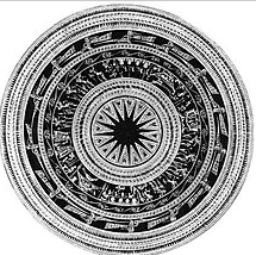
The most notable item is the bronze drums. It was used for ceremonies. The drums has arts on it that shows a bunch of things, animals and actions like boats, birds, grinding rice,..... The drums were made by using lost-wax casting, and the casts have to be big because the drums are up to a meter in height and weight up to 100 kilograms. More than 200 have been fond in southern China, Vietnam, and Indonesia ( because the culture that
made those drums have went to Indonesia).
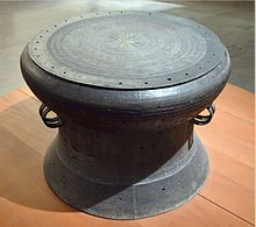
The drum
The same drum from the top
( both from Wikipedia: Dong Son drums)
Today, the people of Vietnam build a lot of Hung Kings temples to show their respect to the Van Lang kings that founded the country.
Chapter 2: Au Lac
By 3rd century B.C, the Ouyue people came in. They also wanted to become the king. So An Dzuong came and kick the Hungs out of the throne and became king of the Au Lac kingdom.
He built a new citadel named Co Loa Citadel (in present day part of Hanoi). It was like a coil on the top since it had many round areas. Although most of these areas were destroyed by the French in the 1800s, 3 of the areas weren't destroyed, and now it's a museum.
Map of Co Loa citadel
( source: Wikipedia: Co Loa citadel)
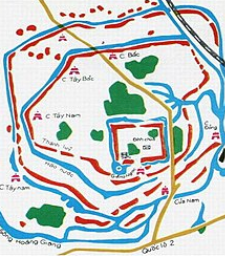
Note that this map only shows the 3 remaining areas.
Zhao Tuo, the king of Nanyue tried to dominate Au Lac, but An Dzuong army had crossbows that can shot more than 2 arrows. Not to give up, Zhao Tuo sent his prince to spy about how to make crossbows. So Zhao Tuo had annexed Au Lac.
Chapter 3: Chinese occupation
The kingdom of Nanyue captured Au Lac but they had to face with another problem. In 111 B.C, the Han Dynasty of the north invaded Nanyue, and it became worse to the Nanyue people.
Like normal invaders, the Han forced the Nanyue people to speak Chinese, become slaves, did force labor, followed Han traditions,.....
The people soon became restless and decided to focus on their traditions plus learning some more skills from the north. They became more skillful and the Nanyue people in present day Vietnam are ready to be independent from the Han.
Chapter 4: Independences and invasions
In present day called Me Linh district, there were to sisters named Trung Trac and Trung Nhi. Trac husband, Thi Sach was killed by Su Dung because he was planning an uprising. The sisters decided to do it with peoples help.
In 40 A.D, the sisters hop on 2 elephants and pulled their soldiers to Co Loa and gave the Han
a surprised attack. After that, they made another one at Luy Lau. The Han soldiers were unprepared and saw the aggressive elephants so they ran away. Su Dung cut his hair, shaved his beard, and joined the chaos. Trung Trac became queen and ruled the country for 3 years.
Learned that lesson, Emperor Guangwu of Han send general Ma Yuan and captured the country.
To avoid being captured, the Trung sisters killed themselves by jumping into a river. The whole country was collapsed.
To stop any revolts, the Han limited the power of the Vietnameses. But that didn't stop Trieu Thi Trinh (our Lady Trieu), who also used an elephant and made an uprising in 248 A.C. Unlike the Trung sisters, she didn't made the country became independent and she was
defeated after 7 months and committed suicide.
A guy named Ly Bi built up a powerful army and formed the early Ly (Lee) Dynasty in 544 A.D. It lasted to 602 A.D, longer than the Trung sisters country.
The Tang Dynasty started to name Vietnam as Annam. During that time, the Chinese was trading with the Roman Empire. The Chinese
figured that if they built a trading post in Annam, they could bring Roman goods up the Red River without facing a typhoon. Then, Annam became a trading outpost for the Tang Dynasty.
In 886, Annam was renamed Jinghai Military Command. Early in the 10th century, Duong Dinh Nghe became the leader of the land and ruled it. autonomously under the Tang.
Chapter 4: Ngo Quyen
Ngo Quyen was the military governor of Ai Chau. In 938, Kieu Cong Tien assassinated Duong Dinh Nghe so he could enter power. When Ngo heart about that, Ngo led his army for revenge. Kieu called the Southern Han (or Great Yue) for aid. Ngo heart it and executed Kieu.
Liu Hongcao ( son of Liu Yan) was the leader of the invasion. His plan was to invade Jinghai by using a fleet of large ships and sailed up the Bach Dang River. But Ngo was ready to gave him a prize: a line of sharp iron-head poles on the river mouth. When the low tide was coming, the poles raised and punctured the large ships! There were some spaces between the poles so the small boats of Ngo could passed through.
When Liu Hongcao arrived, the army that was settled at the front of the river mouth started to block his ships until the low tide was coming. The front army retreated, and their enemy chased them. And yes, the large enemy ships got punctured by the poles and the ships got stuck.
Then, the reinforcement that Ngo led started to
surrounded their ships. Ngo forces started to shot arrows that could set fire when it hit its target. A group of small boats rushed to the ships and attacked the Han army. Liu Hongcao was killed. Ngo won.
In 939, Ngo Quyen became the king of the newly independent Jinghai, ending 1000 years of occupations of the north.
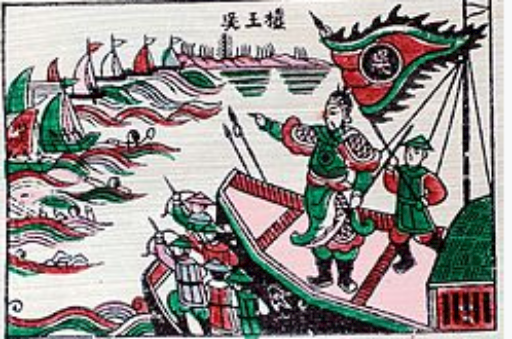
Dong Ho woodblock art about the war ( picture: Wikipedia: Battle of Bach Dang (938)
Chapter 5: The 12 warlords
Ngo Quyen died after 6 years on the throne. After that, his brother-in-law Duong Tam Kha, who was to serve as regent to the king's son Crown Prince Ngo Xuong Ngap, who became the king from 944 to 950. But somehow, Ngo Xuong Ngap fled and hid in the countryside, while his little brother, Ngo Xuong Van became
the adopted son of Duong Tam Kha.
Because of this, the local lords rebelled by seizing power of their local governments and created conflicts with the Duong's court. Duong sent an army led by Ngo Xuong Van to suppress the rebellions. But he wasn't good at warfare, and his army staged a coup d'état in 950. Instead facing a harsh punishment, Ngo
Xuong Van forgave Duong Tam Kha and became emperor. He sent envoys in search for his older brother Ngo Xuong Ngap and Ngap became the co-king. Unfortunately, the co-king was short-lived, as Ngap died of illness in 954.
Then it became worse after Ngo Xuong Van was assassinated by general La Xu Binh and switch from general to emperor. Ngo Xuong Xi, prince of
Ngo Xuong Van, tried to become king but he couldn't. So he retreated to Binh Kieu and established his power base in there. And then, the rest of the warlords divided Jinghai into 12 domains where each was administered by a powerful warlord. The country was divided.
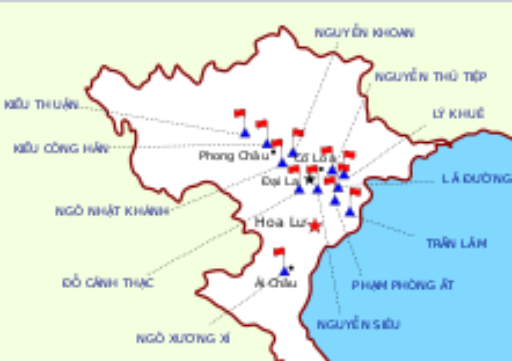
This map shows who control which land ( showed as a flag on a triangle) The black star shows the capital of La Xu Binh. The red star shows the capital after the 12 warlords period has ended ( Next chapter) (picture: Wikipedia: Anarchy of the 12 Warlords)
Just as everything was in chaos, something really happened that ended this period. And that is.......
Chapter 6: The Dinh Dynasty
Dinh Bo Linh, or Dinh Hoan, adopted of Lord Tran Lam, was a man who wanted to re-unite Jinghai. He became the lord after Tran Lam died. He started to build his army and defeated La Xu Binh and the rest of the warlords, reunited the country.
He renamed Jinghai to Dai Co Viet ( Great Buddhist Viet in old Vietnamese).
and moved the capital to Hoa Lu in present day Ninh Binh. He strengthened the countries army and chose Nguyen Bac, his older son Dinh Lien, Le Hoan, etc as the top generals.
One night in 980, as Dinh Hoan and Dinh Lien was having a party, a mandarin official sneaked into the palace and assassinated them. The 6 years old Dinh Toan, who became king, was fac-
ing another problem: the Song Dynasty was preparing to use that time to invaded the country. To help Great Buddhist Viet to fight, Le Hoan took the throne, founded the Early Le Dynasty.
Chapter 7: The Early Le
In 981, the Song's army marched to Great Buddist Viet. They had two teams: one went on large ships and the other went on land. The team that went on water entered the Bach Dang River, but they should know about the battle in 938 because the Early Le army used those poles again. The team that went on land got attack by the mobs who were waiting at the Chi Lang Pass.
There general was killed and the rest fled back to China.
Le Hoan started to invade some parts of the Champa Kingdom and started to build roads and canals for greater transports in these areas. The Song and Viet started to return their prisoners back and maintained their relationship.
The economy was mostly based on agriculture, but there were other things that helped the economy of Vietnam. Trading with the Song was very important because it healed the relationship between China and Vietnam. Some of the things that Vietnam exported to China were gold, silver and bronze products. In domestic trades, the Vietnamese used rivers or canals and roads.
But relations with the Champa Kingdom was not good. The Viet declared war on Champa after an envoy was captured by them. In 982, Le successfully took the Cham's lands and killed their king. Moreover, he burned the fortresses and tombs of former Cham kings. He kept the soldiers until 992, when the Champa king Harivarman II sent an envoy to the Viet king to
release the prisoners.
After Le Hoan died in the year 1005, his sons were fighting for the throne. The winner, Le Long Dinh, devised sadistic punishments of prisoners for his entertainment and indulged in deviant sexual activities. But luckily, he died early, and a Buddhist from the Ly family was on to form the Later Ly Dynasty.
Chapter 8: The Later Ly Dynasty
Ly Cong Uan became emperor in 1009 and took the king name Ly Thai To. It's the starter of the longest ruling dynasty of Vietnam .
In the spring of 1010, Ly was on a trip back to his hometown and made a pit stop at Co Loa. He found out that the land was the plain of the Red River Delta. If a city was build in there, it could be
larger than Hoa Lu city because the city won't need to face any mountains. The flood made the soil richer and better to grow crops.
So, he ordered the new capital named Thanglong (now in present day Hanoi) to be constructed. Each streets had names of each goods so it's going to be easy to find the shops that sold those goods. The palace was constructed at the center.
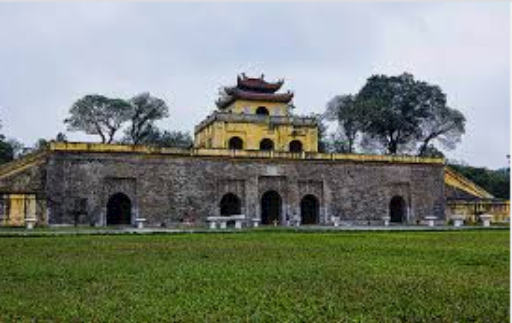
The Doan Mon gate of the palace ( picture: hoangthanhthanglong.vn)
Buddhism started to grow in the Ly Dynasty. A bunch of pagodas were constructed like the One Pillar Pagoda in Hanoi. He also made laws that followed Buddhist teachings because it helped people to be good.
In 1028, after Ly Thai To died, there was a crisis for people to be on the throne. Most of the mandarins expected crown prince Ly Phat Ma to
take the throne. However, 3 of his brothers Duke of Dong Chinh, Duke of Duc Thanh and Duke of Vu Duc rejected that decision, and built up their armies to steal the throne. Ly Phat Ma responded by lock all the doors of the palace and arranged guards for protections. He ordered Ly Nhan Nghia to fight his brothers and defeated them. Ly Nhan Nghia captured Duke
of Vu Duc but the 2 others escaped. After that, Ly Phat Ma became emperor and took the temple name Ly Thai Tong and pardoned his two brothers to grant his mercy to all who opposed him.
Ly Thai Tong strengthened internal rules, territory reigning and military. But the event that the Vietnamese said it's the biggest event was renamed
Great Buddhist Viet to Great Viet (Đại Việt).
After 15 years from the time when Ly Thanh Tong became emperor, the Champa Kingdom got supports from the Song Dynasty so they stopped paying tributaries to Great Viet and this made emperor Ly Thanh Tong felt angry. As a result, he ordered his army to teach them a lesson and they captured the Champa King Rudravarman III in 1069.
Then Rudravarman III signed a treaty with Ly Thanh Tong to cede the present day Quang Tri, Quang Nam and Quang Binh to Great Viet.
The Ly Dynasty also cared about the teachings, so in 1070, Ly Thanh Tong ordered the construction of the Temple of Literature, which was a temple for Confucius in that time.
In 1072, Ly Thanh Tong died. His son, Ly Can Duc, who's 7 years old, became emperor and got the temple name Ly Nhan Tong. Since he's too young to become king, so he was ruled with the assistance of Empress Y Lan (his mother) and the chancellor Ly Dao Thanh to help his power. Empress Mother Thuong Dinh also helped him, but she was soon dismissed by the young emperor after the influence from his natural mother Y Lan. Later the Empress Mother Thuong
Ding and her 76 imperial maids were imprisoned, and eventually they were executed and buried in Ly Thanh Tong tomb.
Ly Nhan Tong always cared about Confucian leaning, so in 1072, he ordered the first imperial test that's base on the teachings of Confucianism at the Temple of Literature. This was the time when the education of Great Viet flourished.
But then, he's facing a new problem. In 1075, Wang Ashi, the chancellor of China told Emperor Shenzong that Great Viet was destroyed by Champa, with less than 10,000 surviving, so he said it's a good time to annex the country. But Wang Ashi often made mistakes, so it's very normal. But that made the Song emperor ended trade to Great Viet, and this prompted the Ly court to make an
invasion of Guangxi of the Song. The 10 years old emperor chose Ly Thuong Kiet and Nung Tong Dan as the generals for the plan.
In the autumn of 1075, Nung Tong Dan ground troops advanced into Guangxi while Ly Thuong Kiet naval fleet invaded present day Qinzhou and Lianzhou prefectures. It was the first time in history that Vietnam was invading China.
Then, they both defeated the Song militia Yongzhou in the spring of 1076, and they beheaded the Governor-General of Guangnan West Curcuit, Zhang Shoujie. After that, they went to Yongzhou city and met another Song army. After a 42 day siege, the city had to surrender as the two generals massacred 58,000 people in the city. Prior to the massacre,
the Viet army executed the governor family, with the the governor starting " I won't die in the hand of those thieves." At the end, the Viet forces returned back so they could deal with that Champa. That's good for the emperor in that time because it struck the same year when he turned the Temple of Literature into the Royal Academy.
The Song was ready for revenge by sending general Guo Kui with 300,000 men to teach the Ly a lesson. And that became worse to the Ly because Guo Kui destroyed 2 armies and was ready to reach Thanglong. The Song armies were halted at the Nhu Nguyet River ( or the Cau River) by Ly Thuong Kiet army. Ly Thuong Kiet army built a defense system by placing
spikes under the river and killed 1,000 Chinese soldiers who used flatboats to cross. Guo Kui decided to led his army to the place that didn't have any spikes and cross the river and ambushed Ly Thuong Kiet army and it's like a wall was ready to fall. Ly Thoung Kiet tried to make his army to feel strong by citing a poem named Nam quoc son ha ( Moutain and river of
the Southern Country), which is the first declaration of independence of Vietnam. It reads:
In Vietnamese:
Sông núi nước Nam, vua Nam ở,
Rành rành định phận ở sách trời.
Cớ sao lũ giặc sang xâm phạm
Chúng bay sẽ bị đánh tơi bời.
English translation:
River and mountain of the Southern Country, the king of the South lives,
destiny in heaven destiny.
Why does the enemy dare to invade,
When they come, they'll be beaten up.
It supposed to make the Viet soldiers to feel strongly and win the war but the Song made the
Viet army almost became the looser. So that made Ly Thuong Kiet had to find an idea.
In the past, when the sun was coming down, the armies that were fighting each other had to stop fighting and spent the night in there camps. So his plan was to attack Guo Kui and his army when they're sleeping deeply. And it worked! Guo kui and his soldiers didn't prepare yet, so they left everything and ran for
- Full access to our public library
- Save favorite books
- Interact with authors

- < BEGINNING
- END >
-
DOWNLOAD
-
LIKE(2)
-
COMMENT()
-
SHARE
-
SAVE
-
BUY THIS BOOK
(from $17.79+) -
BUY THIS BOOK
(from $17.79+) - DOWNLOAD
- LIKE (2)
- COMMENT ()
- SHARE
- SAVE
- Report
-
BUY
-
LIKE(2)
-
COMMENT()
-
SHARE
- Excessive Violence
- Harassment
- Offensive Pictures
- Spelling & Grammar Errors
- Unfinished
- Other Problem






COMMENTS
Click 'X' to report any negative comments. Thanks!