"Life is pretty simple: You do some stuff. Most fails. Some works. You do more of what works. If it works big, others quickly copy it. Then you do something else. The trick is the doing something else. ”
- Leonardo da Vinci

Page
.Who was Da Vinci? 3
.Early life 5
.Education and Early works 10
.Da Vinci's Paintings 14
.His Inventions 26
.Final Years 29
.Glossary 34
. References 35

Table of contents
Who was Leonardo Da Vinci?
Leonardo Da Vinci was one of the greatest artists to ever live. He was also an Italian sculptor,draftsman,inventor,engineer,
architect and scientist during the Italian Renaissance.He was adored by many and his drawings and paintings greatly influenced the generations after his.
EARLY LIFE

Da Vinci's childhood home
Leonardo di Ser Piero da Vinci, commonly known as Leonardo Da Vinci was born in a beautiful farmhouse in Anchiano, Tuscany on the 15th of April,1452. He was the illegitimate son of Ser Piero Da Vinci,a respected notary of Florence,Italy and Caterina, a peasant woman.He spent his first few years with his mother who later remarried.At the age of 5, Leonardo moved to his fathers estate nearby Vinci and there, he was raised by his father,stepmother and grandparents. He was the eldest among his father's 12 children and was never treated as an illegitimate child.
A view of nature in Tuscany
During this period of his life, he was also influenced by his uncle, Francesco da Vinci, who had a love for nature and had a hand in raising him during his childhood.
EDUCATION AND EARLY WORKS
Da Vinci did not receive much of a formal education beyond basic reading, writing and arithmetic. However, his artistic talents were evident from an early age.At the age of 15, his father having recognized his potential as an artist, sent him to learn with sculptor and painter Andrea del Verrocchio of Florence.He spent six years polishing up his painting and sculpting techniques and trained in mechanical arts.
At the age of 20, Da Vinci qualified for membership as a master artist in Florence’s Guild of Saint Luke and established his own workshop. However, he continued to collaborate with Andrea del Verrocchio for an additional five years.
In 1478,he became an independent master and took on his first commission.He was tasked with painting the Adoration of the Magi, for Florence’s San Donato, a Scopeto monastery. He never completed this piece because he relocated to Milan to serve as an engineer, painter, architect and sculptor for the ruling Sforza dynasty.There, he spent 12 years on and off, working on a magnificent statue, in bronze, to honor the dynasty founder, Francesco Sforza.
Florence, Italy
DA VINCI'S PAINTINGS
It is known all around that Da Vinci was gifted artistically but his inability to complete his works may come as a shocker to many. He was horrible at sticking to projects he had started and Da Vinci although consider to be one of the greatest artists to have ever lived unfortunately has only a few finished paintings to his name.Some of the paintings that many know of him include; The Vitruvian Man, The Last Supper and The Mona Lisa.
THE VITRUVIAN MAN
Notably less known compared to the other artworks to be discussed, The Vitruvian Man is a pen and ink drawing that Da Vinci completed around 1487. He incorporated the use of art and science to depict a male figure, in two superimposed positions with his hands and legs apart perfectly inscribed in a circle and square.The painting represented the study of proportion and symmetry, as well as Da Vinci's desire to relate man to the natural world.
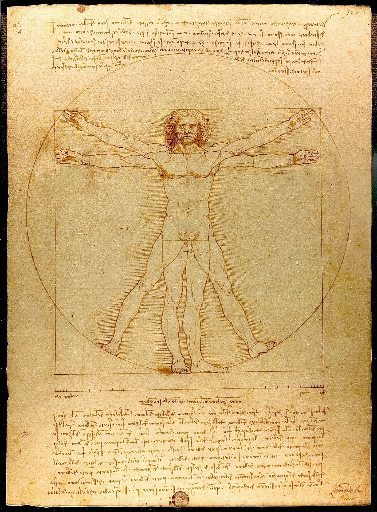
The painting of The Vitruvian Man can be found at The Gallerie dell'Accademia in Venice, Italy.
THE LAST SUPPER
Around 1495, Ludovico Sforza, then the Duke of Milan, ordered Da Vinci to paint “The Last Supper” on the back wall of the dining hall inside the monastery of Milan’s Santa Maria delle Grazie. The masterpiece, took approximately three years to complete. In order to paint it, Da Vinci used an oil-tempera mix , so he could achieve the look of an oil painting.However, this decision led to the quick deterioration and flaking of “The Last Supper.” Further damage was done to the painting but it has now been stabilized using modern conservation techniques.
The painting illustrates the drama of the moment when Jesus informs the Twelve Apostles gathered for Passover dinner that one of them would soon betray him. The different facial expressions and body language of the figures around the table created an effect that brought the masterful composition to life.
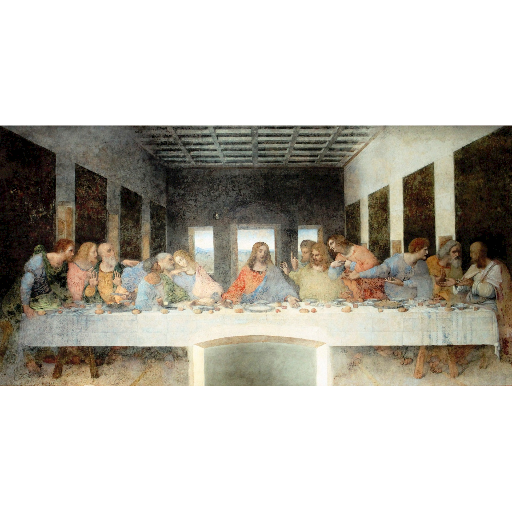
The original painting can be found on the wall of the dining room of the former Dominican convent of Santa Maria delle Grazie
MONA LISA
- Full access to our public library
- Save favorite books
- Interact with authors
- < BEGINNING
- END >
-
DOWNLOAD
-
LIKE(7)
-
COMMENT()
-
SHARE
-
SAVE
-
BUY THIS BOOK
(from $6.99+) -
BUY THIS BOOK
(from $6.99+) - DOWNLOAD
- LIKE (7)
- COMMENT ()
- SHARE
- SAVE
- Report
-
BUY
-
LIKE(7)
-
COMMENT()
-
SHARE
- Excessive Violence
- Harassment
- Offensive Pictures
- Spelling & Grammar Errors
- Unfinished
- Other Problem






COMMENTS
Click 'X' to report any negative comments. Thanks!