


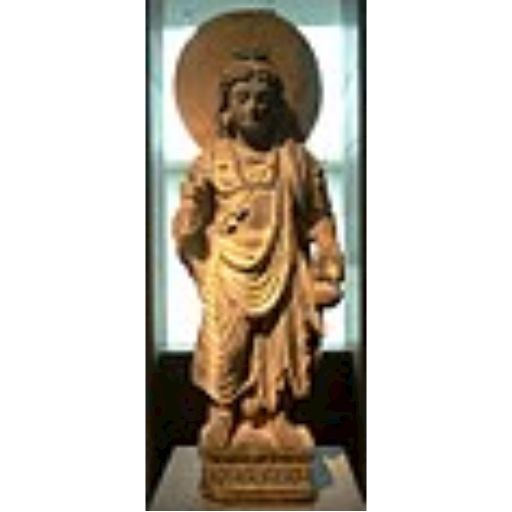



Gandhāra was an ancient region in the Peshawar basin in the far north-west of the ancient Indian subcontinent, corresponding to present-day north-west Pakistan and east Afghanistan


Gandhāra was an ancient region in the Peshawar basin in the far north-west of the ancient Indian subcontinent, corresponding to present-day north-west Pakistan and east Afghanistan.
The Gandhara Civilization existed in what is now Northern Pakistan and Afghanistan from the middle of the 1st millennium BCE to the beginning of the 2nd millennium CE. Although multiple major powers ruled over this area during that time, they all had in common great reverence for Buddhism and the adoption of the Indo Greek artistic tradition which had developed in the region following Alexander’s invasions into India.
the beginning!
Gandhara's existence is attested since the time of the Rigveda (c. 1500 – c. 1200 BC), as well as the Zoroastrian Avesta, which states it as Vaēkərəta, the sixth most beautiful place on earth produced throughAhura Mazda. Gandhara was one of sixteen mahajanapadas (large conglomerations of urban and rural areas) of ancient India mentioned in Buddhist sources such as Anguttara Nikaya. Gandhara was conquered by the Achaemenid Empire in the 6th century BC. Conquered by Alexander the Great in 327 BC, it consequently became part of the Maurya Empire and then the Indo-Greek Kingdom. The region was a significant center towardGreco-Buddhism under the Indo-Greeks and Gandharan Buddhism under later dynasties. It was also a central location for the spread of Buddhism to Central Asia and East Asia. It was also a centre of Hinduism.
it was a great civilization.Famed for its local tradition of Gandhara (Greco-Buddhist) Art, Gandhara attained its height from the 1st century to the 5th century under the Kushan Empire. Gandhara "flourished at the crossroads of Asia," connecting trade routes also absorbing cultural influences from diverse civilizations; Buddhism thrived until the 8th or 9th centuries, when Islam first began to gain sway in the region. Pockets of Buddhism persisted in Pakistan's Swat Valley until the 11th century.
The Persian term Shahi is used by historian Al-Biruni[12] to refer to the ruling dynasty[13] that took over from the Kabul Shahi and ruled the region during the period prior to Muslim conquests of the 10th and 11th centuries. After it was conquered by Mahmud of Ghazni in 1001 AD, the name Gandhara disappeared. During the Muslim period, the area did administer from Lahore or from Kabul. During Mughal times, it was an independent district which included the Kabul province


Gandhara was known in Sanskrit as गन्धार gandhāra, in Avestan as Vaēkərəta, in Old Persian as Gadāra (Old Persian cuneiform: 𐎥𐎭𐎠𐎼, Gadāra, also transliterated as Gadāra since the nasal "n" before consonants was omitted in the Old Persian script, and simplified as Gandara) in Babylonian and Elamite as Paruparaesanna (Para-upari-sena), in Chinese as T: 犍陀羅/S: 犍陀罗 (Qiántuóluó), and in Greek as Γανδάρα (Gandhara).
The End!


- Full access to our public library
- Save favorite books
- Interact with authors

- < BEGINNING
- END >
-
DOWNLOAD
-
LIKE(1)
-
COMMENT()
-
SHARE
-
SAVE
-
BUY THIS BOOK
(from $2.99+) -
BUY THIS BOOK
(from $2.99+) - DOWNLOAD
- LIKE (1)
- COMMENT ()
- SHARE
- SAVE
- Report
-
BUY
-
LIKE(1)
-
COMMENT()
-
SHARE
- Excessive Violence
- Harassment
- Offensive Pictures
- Spelling & Grammar Errors
- Unfinished
- Other Problem

COMMENTS
Click 'X' to report any negative comments. Thanks!