





This is dedicated to all of the eighth graders at Lawler Middle School. I want everyone to learn all about Chemistry.


Now let us learn about the periodic table.


Families, also known as groups are in vertical lines on the periodic table. There are 18 groups in the periodic table which have 9 families. The elements in the same family have a similar amount of valence electrons. Most of the time the elements in the same family have the same physical characteristics.
Families
P
E
R
I
O
D
S
The periods are the horizontal rows on the periodic table that symbolize the number of energy levels for each element. This helps us know whether the element is big or small.
Protons
The number of Protons determines the identity of the element. We can find the protons by using the atomic number (the number above the element's abbreviation), which gives us the number of Protons. This number is also applicable to the number of electrons.
The elements in the periodic table are either metals, nonmetals, or metalloids. We know this because we have distinguished portions of the periodic table for categorizing the elements in this way. There is a staircase kind of line towards the right. Anything touching that is a nonmetal. Anything to the left of those elements is metal and to the right are metalloids. Metals are malleable, ductile, conductors and mostly solid, whereas nonmetals are the opposite of this and they are mostly not solid. Metalloids have properties of both and whatever they are mixed with gives us the properties to determine which category this fits into.
Elemental Properties
Valence Electrons
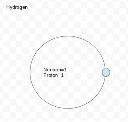
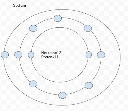
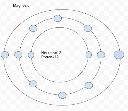
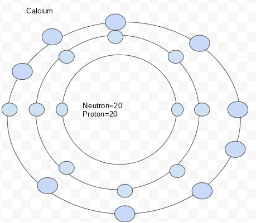
The valence electrons are the electrons on the outmost energy level of the element's Bohr model. You can know how much valence electrons there are by looking at the number right under the group classification number. The valence electrons determine the reactivity because if it is super close to the minimum or maximum it is not reactive, but if it is closer to the middle it is highly reactive. If the number of valence electrons is equal to the maximum it is definitely not reactive. These are the valence electrons.
1. Alkali Metals
2. Alkaline Earth Metals
3. Transition Metals
4. Boron Family
5. Carbon Family
6. Nitrogen Family
7. Oxygen Family
8. Halogens Family
9. Noble Gases Famiyl
Families and their Properties
Examples of each Family
Alkali Metals
Alkali metals are metals with a lot of metallic properties such as thermal and electric conductivity, ductile, and malleable features. Some Alkali Metals include hydrogen, lithium, and sodium. Some practical uses for these include the metals being good for construction by using the metal and it would also good for making batteries.


Alkaline Earth Metals
Alkaline Earth metals are metals with a lot of metallic properties such as electric conductivity, ductile, and malleable features. Some Alkaline Earth Metals include magnesium, calcium, and radium. Some practical uses for these include the metals being good for making aircraft by using the metal and would also good for electrochemical cells.


- Full access to our public library
- Save favorite books
- Interact with authors

- < BEGINNING
- END >
-
DOWNLOAD
-
LIKE
-
COMMENT()
-
SHARE
-
SAVE
-
BUY THIS BOOK
(from $3.59+) -
BUY THIS BOOK
(from $3.59+) - DOWNLOAD
- LIKE
- COMMENT ()
- SHARE
- SAVE
- Report
-
BUY
-
LIKE
-
COMMENT()
-
SHARE
- Excessive Violence
- Harassment
- Offensive Pictures
- Spelling & Grammar Errors
- Unfinished
- Other Problem

COMMENTS
Click 'X' to report any negative comments. Thanks!